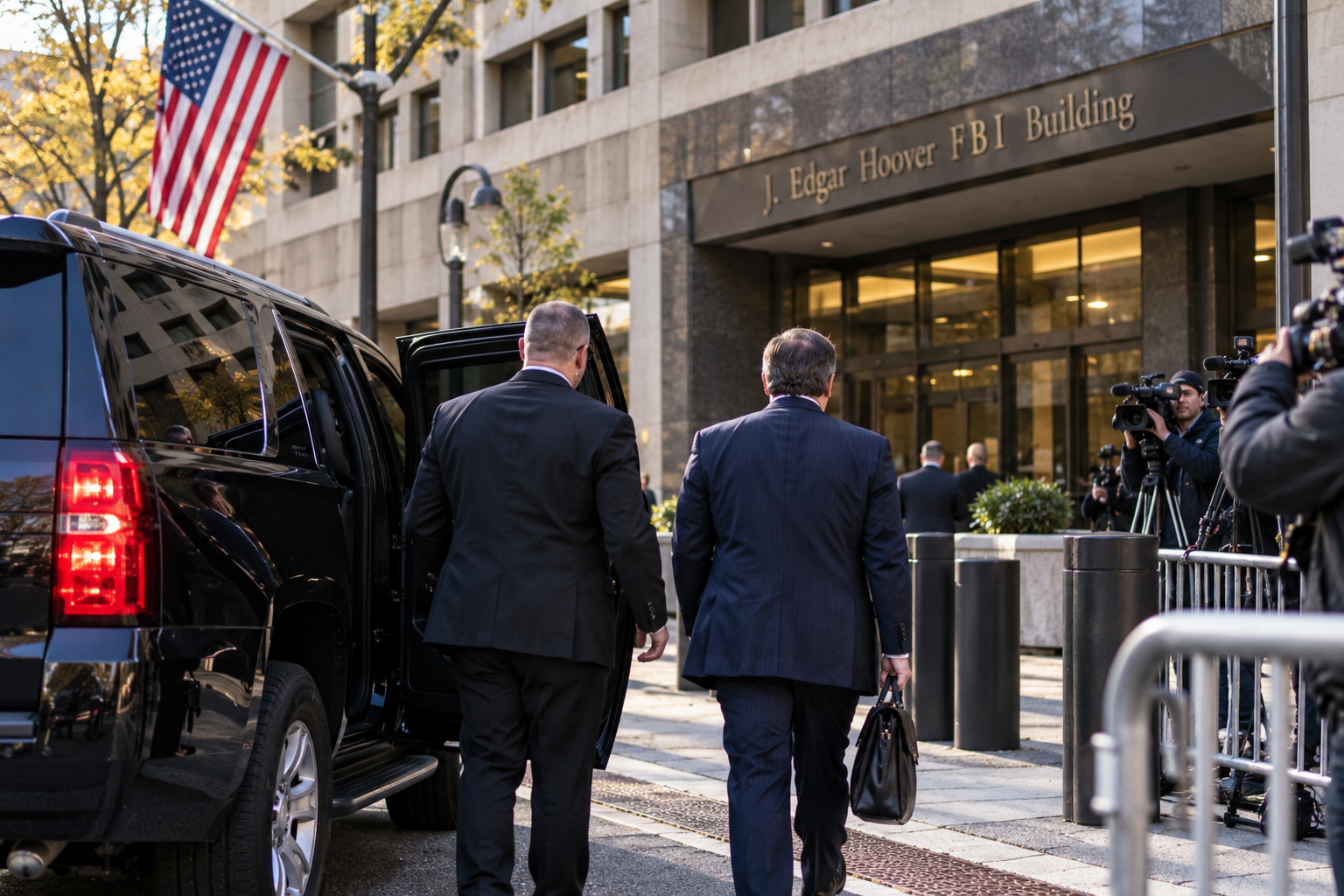
For months, Washington had waited to see what Special Counsel Robert Mueller's investigation would produce.
On October 30, 2017, the answer began arriving.
Former Trump campaign chairman Paul Manafort and his longtime associate Rick Gates surrendered to federal authorities after being indicted on 12 criminal counts.
The charges included conspiracy against the United States, conspiracy to launder money, failing to disclose foreign financial accounts, making false statements and violations involving their work as agents for foreign interests.
But another development revealed that Mueller's investigation had already moved considerably further than the public knew.
Hours later, federal court documents were unsealed showing that George Papadopoulos, a former foreign-policy adviser to Donald Trump's presidential campaign, had secretly pleaded guilty earlier in October to lying to the FBI about his contacts with people he understood to have connections to Russian officials.
Papadopoulos was also cooperating with investigators.
For the first time since Mueller's appointment five months earlier, the investigation had produced criminal charges.
And suddenly Washington could see that Mueller had been working on more than one front.
The Investigation That Had Shadowed Trump's Presidency
Questions about Russian interference in the 2016 election had followed Trump into the White House.
American intelligence agencies had concluded that Russia conducted an influence campaign intended to interfere with the election.
The FBI was also investigating contacts between individuals associated with the Trump campaign and Russians.
Then came the firing of FBI Director James Comey in May 2017.
Eight days later, Deputy Attorney General Rod Rosenstein appointed former FBI Director Robert Mueller as special counsel.
Mueller was authorized to investigate Russian interference in the election, connections or coordination between the Russian government and individuals associated with the Trump campaign, and matters arising directly from the investigation.
For months, Mueller's team operated largely outside public view.
Grand juries were used.
Witnesses were interviewed.
Documents were collected.
Search warrants were executed.
But no one had yet been publicly charged.
That changed on October 30.
Manafort Surrenders
Paul Manafort was not an obscure campaign volunteer.
He had joined Trump's presidential campaign in March 2016.
As Trump's campaign organization underwent repeated changes, Manafort's influence grew.
By May he was effectively running major parts of the operation.
In June, after Corey Lewandowski was fired, Manafort became campaign chairman.
He helped oversee the campaign during the Republican National Convention and one of the most important periods of Trump's race against Hillary Clinton.
Manafort left the campaign in August 2016 as scrutiny intensified over his previous political consulting work in Ukraine.
More than a year later, he walked into the FBI's Washington field office to surrender.
Rick Gates surrendered as well.
Twelve Criminal Counts
The 31-page indictment accused Manafort and Gates of participating in a years-long scheme involving millions of dollars they earned while working for Ukrainian political interests.
According to prosecutors, the two men worked for Ukraine's Party of Regions, former Ukrainian President Viktor Yanukovych and related political interests.
Prosecutors alleged that more than $75 million flowed through offshore accounts connected with Manafort and Gates.
The indictment alleged that Manafort laundered more than $18 million that he used to purchase property, goods and services in the United States.
Gates was accused of transferring more than $3 million through offshore accounts.
The government alleged that the men concealed foreign accounts and income from American authorities.
They were also accused of failing to properly register their work on behalf of foreign interests under the Foreign Agents Registration Act.
Both men pleaded not guilty.
The charges were allegations, and neither had been convicted of the offenses at the time.
The Charges Were Not About Election Collusion
There was an important distinction in the Manafort indictment.
The charges did not accuse Manafort or Gates of conspiring with Russia to interfere in the 2016 presidential election.
Much of the conduct described in the indictment predated Manafort's involvement with Trump's campaign.
The case focused largely on their Ukraine-related political consulting, lobbying, foreign bank accounts and financial transactions.
Trump quickly seized on that distinction.
The president argued publicly that the alleged conduct occurred before Manafort joined his campaign and reiterated that there had been no collusion between his campaign and Russia.
But Mueller's investigation was not limited to a single allegation.
The indictment demonstrated that the special counsel was willing to pursue potential crimes discovered during the broader investigation.
And another case revealed the investigation's direct interest in contacts between a Trump campaign adviser and people claiming connections to Russia.
Then Came George Papadopoulos
The Papadopoulos revelation changed the story.
Unlike Manafort and Gates, Papadopoulos had already pleaded guilty.
And the public had known nothing about it.
On October 5, Papadopoulos admitted in federal court that he had made false statements to FBI investigators.
The case remained sealed.
Twenty-five days later, Mueller's office revealed it.
Papadopoulos had served as a foreign-policy adviser to the Trump campaign during the 2016 election.
According to the statement of offense filed in his case, Papadopoulos met a London-based professor in March 2016 who claimed to have significant connections with Russian government officials.
Papadopoulos initially told FBI agents that his interactions with the professor occurred before he became involved with the Trump campaign.
That was false.
He had already joined the campaign.
The timing mattered because the professor's interest in Papadopoulos increased after learning that he was working for Trump.
“Thousands of Emails”
The most significant portion of the Papadopoulos documents concerned a conversation in April 2016.
According to the court filing, the professor told Papadopoulos that he had learned the Russians possessed damaging information about Hillary Clinton.
The information supposedly included “thousands of emails.”
This conversation occurred months before WikiLeaks began publishing hacked Democratic emails that became a major issue during the presidential campaign.
Papadopoulos also communicated with people he believed had connections to Russian officials and repeatedly attempted to facilitate meetings between members of the Trump campaign and Russian representatives.
The proposed Trump-Russia meeting never occurred.
But the court documents established that a campaign foreign-policy adviser had been actively pursuing contacts with individuals claiming access to Russian officials.
Papadopoulos Lied to the FBI
When FBI agents interviewed Papadopoulos in January 2017, prosecutors said he gave them false information about those interactions.
He minimized the professor's significance.
He falsely described the timing of their relationship.
And he misrepresented aspects of his communications with a woman he believed had connections to Russian officials.
Those lies became the basis for the criminal charge.
Papadopoulos ultimately pleaded guilty to one count of making false statements to federal investigators.
But the plea itself was only part of the story.
He was cooperating with Mueller.
Mueller Had Kept a Cooperating Witness Secret
The secrecy surrounding Papadopoulos's case demonstrated something important about Mueller's investigation.
The public did not know everything the special counsel knew.
While television panels, politicians and reporters publicly debated whether Mueller had uncovered anything significant, his prosecutors had already obtained a guilty plea from a former Trump campaign adviser.
Papadopoulos had agreed to cooperate with investigators.
That immediately raised questions about what information he had provided and what Mueller's team had learned from him.
It also demonstrated Mueller's ability to conduct important parts of the investigation without leaks revealing them in advance.
The morning had begun with Manafort surrendering to federal authorities.
By midday, the Papadopoulos documents suggested a broader investigative picture.
Trump Responds
Trump responded to the Manafort indictment on Twitter.
He emphasized that the alleged conduct occurred before Manafort's time with the campaign and again denied collusion.
The White House similarly attempted to separate the president and his campaign from the criminal charges.
Regarding Papadopoulos, administration officials portrayed him as a relatively minor campaign figure.
There was some truth to the characterization of his limited role.
Papadopoulos was not a senior campaign official comparable to Manafort.
But he had been publicly identified by Trump in March 2016 as one of his campaign's foreign-policy advisers.
And Mueller's documents showed that while serving in that role, Papadopoulos was communicating with people claiming connections to the Russian government.
The significance was not simply his position in the campaign hierarchy.
It was what he had been discussing — and why he later lied to the FBI about it.
Two Very Different Cases
October 30 revealed two distinct parts of Mueller's investigation.
The Manafort and Gates case focused primarily on financial activity, foreign lobbying and their work involving Ukraine.
The Papadopoulos case involved a Trump campaign adviser, contacts with people claiming Russian government connections and false statements made during the investigation into those contacts.
The distinction was crucial.
The Manafort indictment was not proof that the Trump campaign had coordinated with Russia.
The Papadopoulos plea did not establish such a conspiracy either.
But together, the cases showed that Mueller's investigation had moved beyond interviews and document requests.
People were now facing criminal prosecution.
One campaign adviser had already pleaded guilty.
And investigators had secured his cooperation.
Manafort's Legal Problems Were Just Beginning
The October indictment would not be the end of Manafort's prosecution.
Additional charges followed in 2018.
His former associate Rick Gates eventually changed course and pleaded guilty to conspiracy and making false statements, agreeing to cooperate with Mueller's investigation.
Manafort went to trial in Virginia in August 2018 and was convicted on eight financial crimes.
He later pleaded guilty in a separate federal case in Washington to conspiracy charges and agreed to cooperate with prosecutors.
That cooperation agreement subsequently collapsed after a federal judge found that Manafort had intentionally lied to investigators on multiple subjects.
Trump would eventually pardon Manafort in December 2020.
But all of that remained in the future on October 30, 2017.
Mueller Makes His First Move
Until this point, the Mueller investigation had largely been something Americans heard about rather than something they could see.
There were reports of subpoenas.
Reports of interviews.
Reports of grand juries.
Reports that investigators were examining financial transactions and Russian contacts.
October 30 changed that.
There were now defendants.
There was an indictment.
There was a guilty plea.
And there was a cooperating former Trump campaign adviser.
The charges against Manafort and Gates did not establish that Trump's campaign had conspired with Russia.
Papadopoulos's guilty plea did not establish it either.
But the day's developments demonstrated that Robert Mueller's investigation was producing criminal cases — and that some of its most important work had been occurring completely outside public view.
For months, Washington had wondered what Mueller had found.
On October 30, Americans got their first substantial look.
The investigation was no longer theoretical.