For more than a year, Americans had heard that Russia interfered in the 2016 presidential election.
On February 16, 2018, Special Counsel Robert Mueller's investigation put names, organizations and an extraordinary amount of detail behind one part of that accusation.
A federal grand jury indicted 13 Russian nationals and three Russian organizations, alleging they participated in a sophisticated operation designed to interfere with the American political system and the 2016 presidential election.
This wasn't simply an allegation that Russians posted a few inflammatory comments on Facebook.
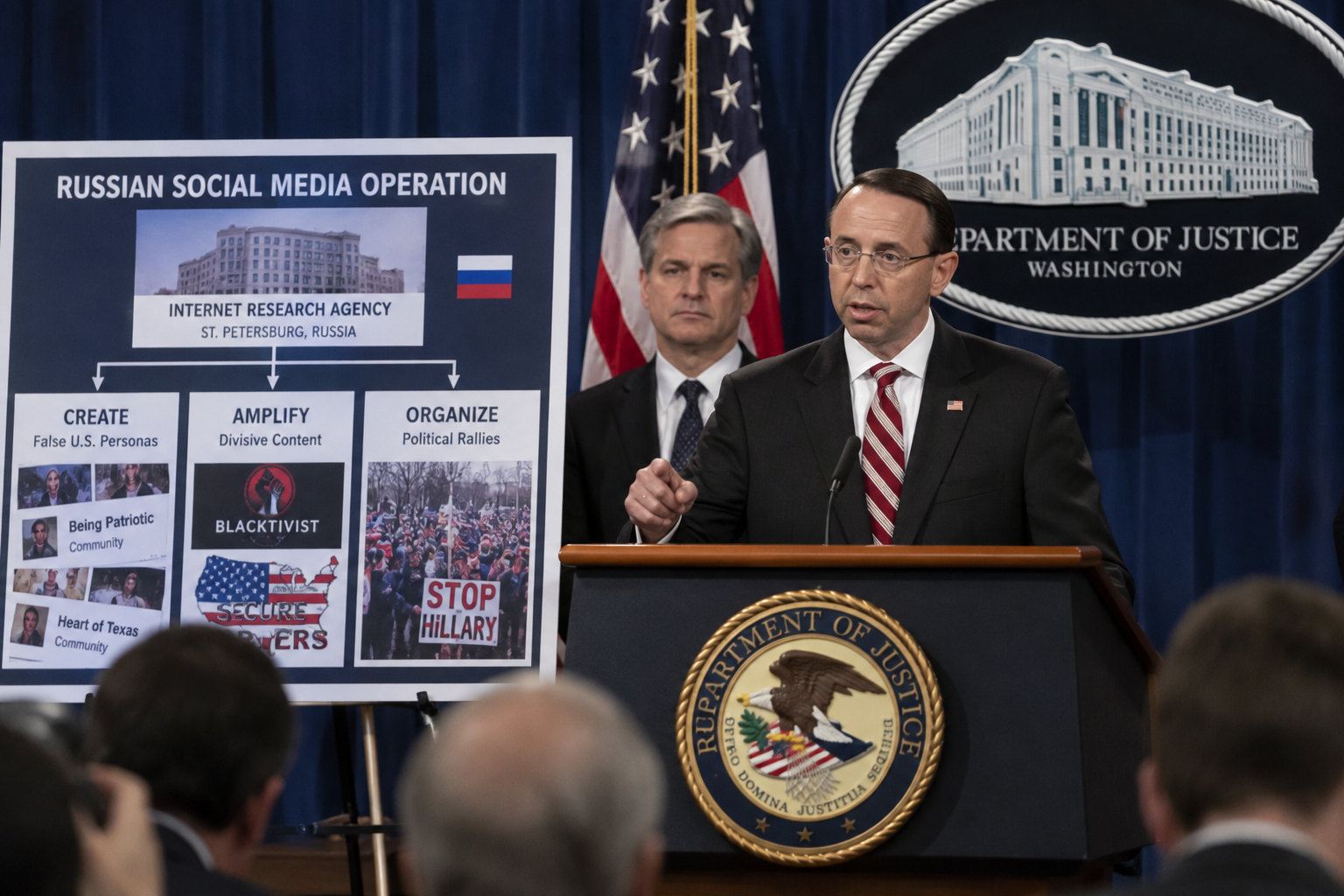
According to the 37-page indictment, Russian operatives created fake American identities, built social-media communities, purchased political advertisements, stole the identities of real Americans, communicated with political activists and organized actual political rallies on American soil.
The operation had begun years before Election Day.
And by 2016, prosecutors alleged, its activities included supporting Donald Trump's presidential campaign and disparaging Hillary Clinton.
The Internet Research Agency
At the center of the indictment was a St. Petersburg organization called the Internet Research Agency, commonly described as a Russian “troll farm.”
According to prosecutors, the organization employed hundreds of people involved in online influence operations.
It wasn't portrayed as a handful of individuals working from laptops.
It was an organization.
There were managers.
There were specialists responsible for creating fictional American personas.
There were graphics employees.
There were information-technology workers.
There were financial departments.
There were employees responsible for search-engine optimization.
And there was a substantial budget.
The Justice Department said the Internet Research Agency's annual spending amounted to millions of U.S. dollars.
The operation targeting the United States was known internally as the “translator project.”
By July 2016, prosecutors alleged, more than 80 employees were assigned to it.
The Operation Began Before Trump Became the Republican Nominee
The indictment alleged that Russian efforts targeting the United States dated to at least 2014.
Two defendants allegedly traveled to the United States that year to gather intelligence for future influence operations.
They traveled through states including Nevada, California, New Mexico, Colorado, Illinois, Michigan, Louisiana, Texas and New York.
The purpose, according to prosecutors, was to better understand American politics and identify ways to make the operation appear authentically American.
Back in Russia, the Internet Research Agency began building an enormous collection of fake identities and online organizations.
Many appeared to be ordinary Americans.
They weren't.
Fake Americans Talking to Real Americans
This was one of the most disturbing elements of the operation described by Mueller's prosecutors.
Russian operatives didn't simply broadcast propaganda from accounts obviously connected to Russia.
They pretended to be Americans.
They created fictitious U.S. personas.
They created hundreds of email accounts.
They established social-media pages and groups designed around divisive American political and social issues.
The accounts claimed to represent American activists and grassroots organizations.
In reality, prosecutors alleged, many were being operated from Russia.
The Russians also allegedly stole Social Security numbers, dates of birth and other identifying information belonging to real Americans.
Those identities were used without the victims' knowledge.
The operation even obtained U.S. computer infrastructure so its activity would appear to originate inside the United States rather than Russia.
This wasn't simply propaganda.
It was deception designed specifically to make Americans believe they were talking to other Americans.
Build an Audience First
The strategy was remarkably patient.
Russian-controlled accounts didn't necessarily begin by telling Americans how to vote.
First they built audiences.
They created pages dealing with immigration.
Race.
Religion.
Gun rights.
Regional identity.
Political activism.
And other subjects capable of producing strong reactions among Americans.
Some accumulated enormous followings.
Once those audiences existed, the accounts could inject political messages into communities that believed they were following genuine American organizations.
The power of the operation wasn't merely the content.
It was the disguise.
An American seeing a political message supposedly posted by another American might evaluate it differently than the same message coming from a Russian propaganda organization.
The entire system depended upon Americans not knowing who was actually speaking to them.
By 2016, the Operation Had a Presidential Preference
The indictment was explicit about what happened as the presidential campaign developed.
By early to mid-2016, prosecutors alleged, the Russian operation included supporting Donald Trump and disparaging Hillary Clinton.
An internal instruction described in the indictment told employees to use opportunities to criticize Clinton and other candidates while making exceptions for Bernie Sanders and Trump.
Russian-controlled accounts attacked Republican presidential candidates Ted Cruz and Marco Rubio as well.
But as the general election approached, the operation increasingly focused on Clinton and Trump.
Russian operatives created election-related accounts.
They purchased advertisements.
They promoted political messages.
They used pro-Trump hashtags.
They circulated attacks against Clinton.
And they communicated with Americans who had no idea the people contacting them were allegedly operating from Russia.
They Contacted Trump Supporters
The Russians allegedly went beyond broadcasting messages.
They communicated directly with real Americans.
Some were grassroots political activists.
Some were Trump supporters.
Some were individuals connected with local campaign activities.
According to the indictment, the Russian operatives concealed who they really were.
The Americans therefore didn't know they were dealing with Russians.
That distinction would become extremely important.
The indictment alleged contacts with “unwitting” individuals associated with the Trump campaign.
In other words, the indictment did not accuse those Americans of knowingly participating in a Russian operation.
They were allegedly being deceived too.
Russians Organized Real Political Rallies in America
Perhaps the strangest part of the operation was how successfully activity originating in Russia crossed from the internet into the physical world.
The defendants allegedly organized actual political rallies inside the United States.
Using fake American identities, they contacted activists and recruited people to participate.
They purchased advertising promoting the events.
They communicated with grassroots organizations.
They paid Americans to perform certain tasks.
For one event, prosecutors alleged that the Russians asked an American to construct a cage on the back of a flatbed truck.
Another person was paid to portray Hillary Clinton wearing a prison uniform inside the cage.
The Americans involved allegedly didn't know that Russians were directing the activity.
People could therefore attend what appeared to be a grassroots American political rally without realizing that some of its organization had originated thousands of miles away in St. Petersburg.
The Goal Was Bigger Than Electing One Candidate
The indictment contained another important detail.
The operation wasn't solely about promoting Donald Trump.
Prosecutors alleged that the Internet Research Agency had a broader strategic goal:
Sow discord inside the United States.
The operation exploited existing political divisions rather than inventing all of them.
Race.
Immigration.
Religion.
Gun rights.
Distrust of government.
Distrust of elections.
Hostility between political groups.
The Russians allegedly found subjects Americans were already fighting about and amplified them.
And the clearest demonstration came after the election.
After Trump Won, the Russians Played Both Sides
Donald Trump won the election on November 8, 2016.
If the Russian operation's only objective had been electing Trump, its work might logically have ended.
It didn't.
According to the indictment, Russian operatives continued organizing political events after Election Day.
And sometimes they organized events on opposite sides of the same political divide.
On November 12, Russian-controlled personas allegedly organized a New York rally supporting President-elect Trump.
At approximately the same time, another Russian-controlled group organized a New York protest called “Trump is NOT my President.”
Russian operatives were therefore allegedly helping organize both Trump supporters and Trump opponents.
That detail revealed something fundamental about the operation.
The objective wasn't simply persuasion.
It was division.
Get Americans angry.
Get them suspicious.
Get them fighting one another.
And make the American political system appear less trustworthy in the process.
Yevgeny Prigozhin
The indictment also named Russian businessman Yevgeny Prigozhin, whose companies allegedly financed the operation.
Prigozhin controlled Concord Management and Consulting and Concord Catering.
Prosecutors alleged those companies provided funding for the Internet Research Agency's activities.
Prigozhin would later become internationally known as the leader associated with Russia's Wagner mercenary organization.
But in February 2018, Mueller's indictment placed him at the financial center of the alleged election-interference operation.
Eight Criminal Counts
The indictment contained eight criminal counts.
All defendants were charged with conspiracy to defraud the United States.
Additional defendants were charged with conspiracy to commit wire fraud and bank fraud.
Others faced aggravated identity-theft charges.
The conspiracy charge was based partly on allegations that the defendants impaired the lawful functions of agencies including the Federal Election Commission, Department of Justice and State Department by concealing foreign involvement in American political activities.
The charges transformed part of the Russia investigation from an abstract political controversy into a detailed federal criminal case.
What Mueller Did NOT Allege
There was an enormously important limitation.
Deputy Attorney General Rod Rosenstein emphasized it when announcing the charges.
The indictment did not allege that any American knowingly participated in the charged conspiracy.
That included the Trump campaign.
The indictment described Russian operatives communicating with Trump supporters and individuals associated with campaign activity.
But those Americans were described as unwitting participants.
They allegedly didn't know whom they were dealing with.
Rosenstein also emphasized another limitation:
The indictment did not allege that the Russian operation changed the outcome of the 2016 presidential election.
That is an important distinction.
The government was alleging interference.
It was not claiming in this indictment that prosecutors could prove the interference caused Trump to win.
Those are two separate questions.
Trump Responds
President Trump seized on those limitations.
He argued that the indictment vindicated his repeated insistence that his campaign had not colluded with Russia.
The indictment certainly did not accuse Trump himself of participating in the Internet Research Agency operation.
Nor did it accuse his campaign of knowingly joining the conspiracy described in the charges.
But the indictment established something else with considerable specificity:
Federal prosecutors were alleging that a substantial Russian operation had deliberately attempted to interfere in American politics during the election Trump won.
And according to the indictment, by 2016 that operation included activity supporting Trump's candidacy and attacking Hillary Clinton.
Both facts could exist simultaneously.
The indictment alleged Russian interference.
It did not allege that Trump or his campaign knowingly participated in this particular operation.
The Internet Had Become a Battlefield
The February 16 indictment also revealed how dramatically foreign influence operations had changed.
Traditional propaganda was easy to recognize.
A foreign government operated a radio station.
Published a newspaper.
Distributed pamphlets.
Broadcast political messages.
The Internet Research Agency allegedly used something far more sophisticated.
It became American.
At least online.
Russian employees could pretend to be conservatives in Tennessee.
Activists in Texas.
Black political organizers.
Immigration activists.
Religious Americans.
Gun-rights advocates.
Trump supporters.
Or Trump opponents.
They could join American political conversations without the Americans involved realizing a foreign operation had entered the room.
And social media gave them access to millions of people at extraordinarily low cost.
Americans Did Much of the Work for Them
Perhaps the most effective element of the alleged operation was that Russian operatives didn't need to personally distribute every message.
Americans did it for them.
People shared posts.
Retweeted accounts.
Joined groups.
Attended rallies.
Argued over content.
Forwarded memes.
Followed fake personalities.
Some of those Americans may have sincerely believed the material they were distributing.
They simply didn't know where it came from.
The operation exploited one of social media's fundamental weaknesses:
People rarely know who is actually behind an account.
February 16, 2018
Mueller's indictment did not resolve every question surrounding Russia and the 2016 election.
It didn't establish that Trump conspired with the Internet Research Agency.
It didn't establish that Russian interference changed the election result.
It didn't cover every component of Russia's broader interference campaign.
And an indictment itself is an accusation, not a conviction.
But it provided the American public with a detailed federal allegation of how one Russian influence operation worked.
Thirteen Russian nationals.
Three Russian organizations.
Hundreds of fake accounts.
Stolen American identities.
Political advertisements.
American rallies.
Millions of dollars in organizational resources.
And a strategy built around one remarkably simple vulnerability:
Americans believed they were talking to other Americans.
According to federal prosecutors, sometimes they were actually talking to Russia.