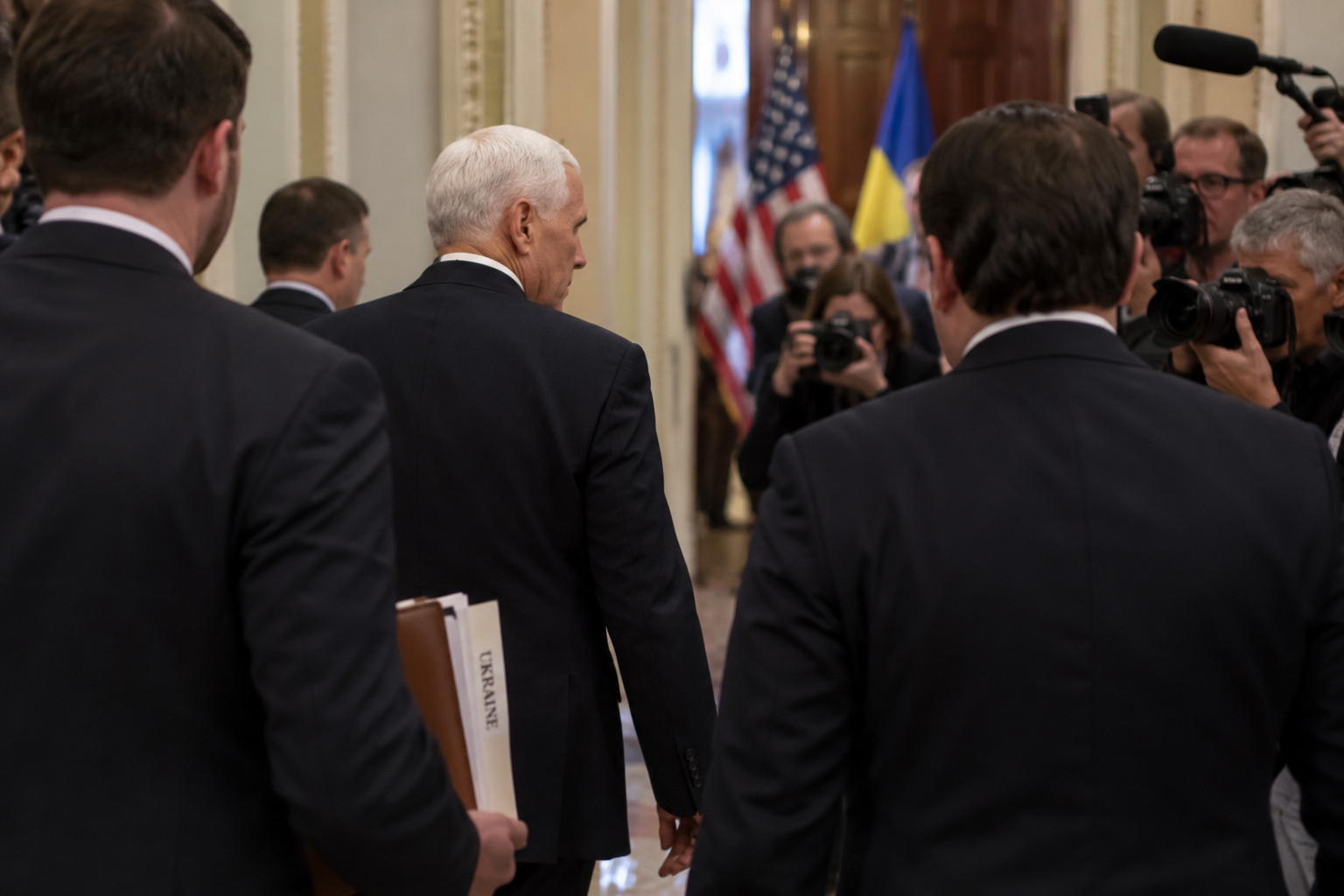
Vice President Mike Pence was pulled more directly into the growing Ukraine impeachment investigation on October 4, 2019, when three House committees formally demanded that his office turn over documents concerning the Trump administration's dealings with Ukrainian President Volodymyr Zelensky.
The request came from House Intelligence Committee Chairman Adam Schiff, Foreign Affairs Committee Chairman Eliot Engel and Oversight Committee Chairman Elijah Cummings.
They gave Pence until October 15 to provide the requested records.
The investigators were looking beyond President Donald Trump's controversial July 25 telephone call with Zelensky.
They wanted to know what the vice president knew, what information had been provided to him, and what role Pence and members of his staff may have played as the administration dealt with Ukraine.
Investigators Turn Their Attention to Pence
In their letter, the committee chairmen told Pence that public reports had raised questions about his involvement in events surrounding Ukraine.
They specifically pointed to reports that a member of Pence's staff may have listened to Trump's July 25 conversation with Zelensky.
Investigators also wanted to know whether Pence had received or reviewed records concerning that call.
But perhaps most importantly, they were interested in Pence's own contacts with Zelensky.
Pence had met personally with the Ukrainian president in Warsaw on September 1, while hundreds of millions of dollars in congressionally approved American security assistance to Ukraine remained on hold.
The committees wanted documents concerning that meeting.
Pence Meets Zelensky in Warsaw
Pence's September 1 meeting with Zelensky became particularly important to investigators because of its timing.
Ukraine was waiting for the United States to release military and security assistance that Congress had approved to help the country resist Russian aggression.
At the same time, Trump and his personal attorney Rudy Giuliani had been pressing for Ukrainian investigations involving the 2016 election and former Vice President Joe Biden and his son Hunter.
Joe Biden was seeking the Democratic presidential nomination and was a potential opponent for Trump in the 2020 election.
The House committees said they wanted to determine whether Pence had played any role in conveying or reinforcing Trump's message to the Ukrainian government.
The letter did not establish that Pence had done so. It sought documents investigators believed could help answer that question.
What Did Pence Know?
The document request covered a broad range of material.
Investigators sought records related to Trump's July 25 call with Zelensky, including information identifying officials who listened to, participated in or later reviewed the conversation.
They also sought records concerning Pence's own communications and meetings with Zelensky and other Ukrainian officials.
The inquiry was increasingly becoming an effort to reconstruct what different administration officials knew at different points in time.
Pence was now part of that effort.
Pence Defends Trump's Conduct
Just one day before receiving the congressional request, Pence had publicly defended the president.
Speaking with reporters on October 3, Pence said Americans had a right to know whether Joe Biden or members of his family had benefited from his position as vice president.
Pence also said Trump believed other countries should examine the issue.
The vice president's office pushed back sharply after receiving the October 4 letter.
Pence spokeswoman Katie Waldman questioned whether the expansive request was serious and characterized it as part of a partisan impeachment effort.
The administration maintained that Trump had done nothing improper in his dealings with Ukraine.
A Busy Day in the Impeachment Investigation
The demand for Pence's documents was only one of several major developments unfolding on October 4.
That same day, House investigators formally subpoenaed the Trump White House for Ukraine-related documents.
Newly disclosed text messages between American diplomats were also dominating Washington.
Those messages included acting U.S. Ambassador to Ukraine William Taylor's warning to Ambassador Gordon Sondland:
"I think it's crazy to withhold security assistance for help with a political campaign."
Sondland disputed Taylor's interpretation and responded that Trump had been clear there would be no quid pro quo.
Taken together, the developments demonstrated how quickly the investigation was expanding beyond Trump's July telephone call.
Investigators were now examining the actions of diplomats, White House officials, Trump's personal attorney—and the vice president.
Pence Refuses the Request
Pence ultimately did not provide the requested documents by the October 15 deadline.
His counsel, Matthew Morgan, responded that the House impeachment inquiry had been structured in a way the vice president's office considered procedurally improper.
Morgan said Pence's office recognized Congress's legitimate oversight role and was prepared to cooperate with appropriate legislative oversight requests, but challenged the legitimacy and procedures of the impeachment inquiry then underway.
The dispute mirrored the broader position adopted by the Trump White House.
The administration and House investigators were no longer simply fighting over Ukraine.
They were fighting over whether—and under what circumstances—the executive branch was required to cooperate with an impeachment investigation.
The Investigation Reaches the Vice President
The October 4 letter represented another significant expansion of the inquiry.
Only weeks earlier, the controversy had centered primarily on Trump's conversation with Zelensky and the whistleblower complaint that brought it to public attention.
Now investigators were tracing communications throughout the administration.
And that trail had reached the second-highest office in the executive branch.
On October 4, 2019, Vice President Mike Pence officially became another focus of Congress's investigation into the Trump administration's dealings with Ukraine.