By October 9, 2020, Americans were learning the extraordinary details of an alleged plot to kidnap Michigan Gov. Gretchen Whitmer.
It wasn't simply angry political rhetoric.
According to state and federal investigators, men involved in the conspiracy had discussed kidnapping the governor, attacking government institutions, targeting law enforcement officers and triggering broader violence.
They trained with weapons.
They conducted surveillance.
They discussed explosives.
They examined Whitmer's vacation home.
And some talked openly about creating enough chaos to ignite a civil war.
The case emerged after months in which Michigan had become one of the country's most visible battlegrounds over COVID-19 restrictions—and after President Donald Trump repeatedly attacked Whitmer and encouraged resistance to state restrictions.
There is no evidence Trump participated in or knew about the kidnapping conspiracy.
But the plot demonstrated how far beyond ordinary politics some elements of America's anti-government movement had traveled.
The FBI Uncovers a Kidnapping Plot
On October 8, federal prosecutors announced that six men had been arrested and charged with conspiring to kidnap Whitmer.
Michigan authorities simultaneously announced terrorism-related and other felony charges against seven additional men identified as members or associates of a militia group known as the Wolverine Watchmen.
By October 9, six of the seven defendants charged by Michigan authorities had been arraigned.
Investigators said the alleged plans went far beyond protesting government policy.
Authorities alleged that participants had discussed attacking the Michigan Capitol, kidnapping government officials and targeting law enforcement officers.
Some wanted to create widespread violence that could lead to societal collapse.
Whitmer was one of their principal targets.
From Political Anger to an Alleged Kidnapping Operation
According to federal prosecutors, the kidnapping conspiracy developed over several months.
Participants met and trained with firearms.
They discussed storming government buildings.
They considered different ways to seize Whitmer.
Eventually, prosecutors said, the group focused on kidnapping the governor from her vacation home in northern Michigan.
Participants conducted surveillance of the property.
They examined nearby roads and bridges.
Prosecutors later presented evidence that conspirators considered destroying a bridge to slow or prevent law enforcement from responding.
The objective wasn't merely to frighten Whitmer.
Prosecutors said some conspirators hoped their actions would trigger a broader uprising against the government.
The political grievance had become an alleged operational plan.
Michigan Had Already Become a Center of Armed Anti-Lockdown Protest
The plot did not emerge in a political vacuum.
Months earlier, Michigan had become a national center of resistance to COVID-19 restrictions.
Whitmer had imposed emergency measures intended to slow the spread of the virus.
Opposition was fierce.
On April 15, protesters descended on Lansing for a demonstration against the restrictions.
Some participants carried firearms.
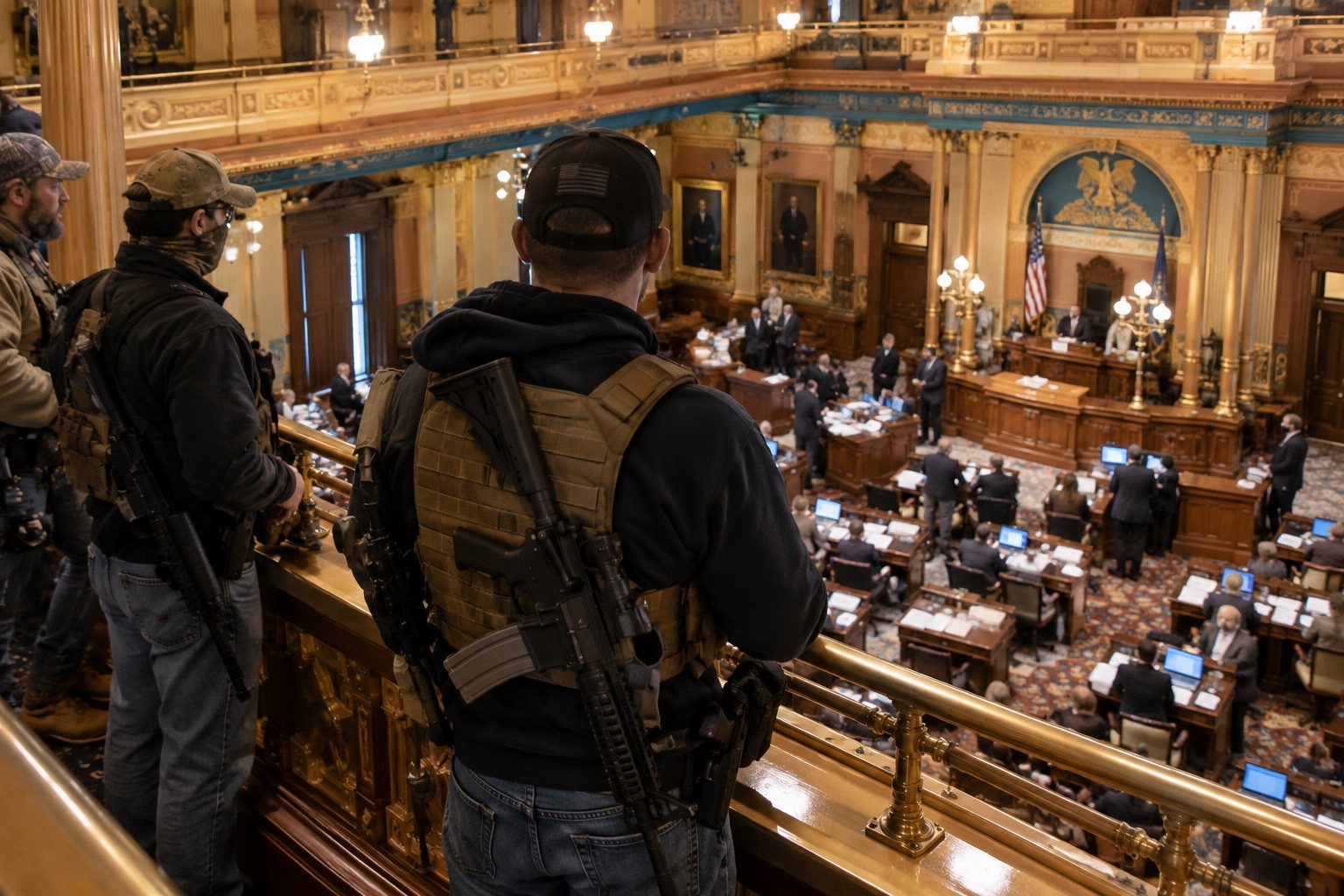
Two weeks later, armed protesters entered the Michigan Capitol as lawmakers debated the governor's emergency powers.
Photographs showing armed men inside the Capitol circulated around the country.
For many Americans, the images were startling.
Men carrying rifles stood above lawmakers conducting the business of state government.
The protesters weren't all members of one organization, nor were the demonstrations themselves equivalent to the later kidnapping conspiracy.
But Michigan had clearly become a focal point for an increasingly confrontational anti-government movement.
Trump: “LIBERATE MICHIGAN!”
President Trump inserted himself directly into the political confrontation.
On April 17, 2020, Trump posted a message that consisted of just two words:
“LIBERATE MICHIGAN!”
He posted similar messages about Minnesota and Virginia.
The president defended the protesters and repeatedly criticized governors whose COVID restrictions he considered excessive.
Whitmer became a frequent target.
Trump called her “that woman from Michigan.”
He criticized her handling of the pandemic.
He clashed publicly with her over the federal response to COVID-19.
Again, there is no evidence that Trump instructed anyone to threaten Whitmer or participate in the kidnapping conspiracy.
The people accused of plotting against her were responsible for their own actions.
But Trump's rhetoric became part of a much larger political environment in which resistance to Whitmer was being celebrated nationally.
The Wolverine Watchmen
Michigan prosecutors tied several defendants to the Wolverine Watchmen.
Authorities alleged that members or associates discussed attacking law enforcement officers, identifying officers' home addresses and provoking violent confrontation.
According to Michigan Attorney General Dana Nessel's office, participants made threats intended to help instigate a civil war and societal collapse.
Investigators alleged that some trained for violent operations.
This wasn't conventional conservative activism.
It wasn't a disagreement over tax rates, regulations or the proper limits of emergency health orders.
Authorities were describing an extremist anti-government network in which some participants contemplated political violence.
The Plot Was Real—But the Trials Became Complicated
The criminal cases that followed were more complicated than the initial headlines suggested.
Defense attorneys argued that FBI informants and undercover operatives had pushed defendants toward criminal conduct and claimed their clients had been entrapped.
In the first federal trial in 2022, two defendants were acquitted and jurors could not reach verdicts against two others.
Those two remaining defendants—Adam Fox and Barry Croft Jr.—were tried again.
This time, a federal jury convicted both.
Fox and Croft were found guilty of conspiracy to kidnap Whitmer and conspiracy to use weapons of mass destruction.
Two other federal defendants, Ty Garbin and Kaleb Franks, pleaded guilty to kidnapping-conspiracy charges and cooperated with prosecutors.
Two others were acquitted.
Michigan's state prosecutions also produced convictions.
Three men associated with the Wolverine Watchmen—Joseph Morrison, Pete Musico and Paul Bellar—were convicted of charges including providing material support for terrorist acts and gang membership.
Other defendants entered guilty pleas.
The final results therefore matter.
The government did not prove every allegation against every defendant.
Some men were acquitted.
But multiple defendants were ultimately convicted or pleaded guilty for their roles in the conspiracy and related conduct.
Whitmer Blames America's Political Climate
After the plot became public, Whitmer spoke about more than the defendants.
She criticized political leaders who used inflammatory rhetoric and specifically attacked Trump for his response to extremist groups.
Just days earlier, during the first presidential debate, Trump had been asked to condemn white supremacist and militia groups.
When the Proud Boys were mentioned, Trump responded:
“Proud Boys, stand back and stand by.”
Trump later said the group should stand down and that he condemned white supremacists.
Whitmer nevertheless argued that rhetoric from national political leaders could encourage extremist organizations.
Trump and his allies rejected efforts to connect his rhetoric to the kidnapping conspiracy.
That distinction remains important.
Political rhetoric is not the same thing as participation in a criminal conspiracy.
But political rhetoric can still become part of the historical context in which extremist movements operate.
The Extremist Fringe Was Becoming Harder to Ignore
The Michigan kidnapping case exposed a phenomenon that extended well beyond one governor or one militia organization.
Anti-government extremism had found new opportunities during the political turmoil of 2020.
Pandemic restrictions generated anger.
Conspiracy theories spread rapidly online.
Militia organizations recruited.
Armed political demonstrations became increasingly visible.
Political opponents were described not simply as misguided but as tyrants, traitors and enemies.
Some extremists began discussing violence as a legitimate political response.
And portions of that anti-government culture overlapped with the populist political movement surrounding Trump—even though the overwhelming majority of Trump supporters never participated in political violence.
That distinction is essential.
A political movement consisting of millions of people cannot fairly be defined by the criminal behavior of a handful of extremists.
But neither can the extremists simply be erased from the history of the era.
They existed.
They organized.
And some of them were preparing to act.
A Warning Three Months Before January 6
In hindsight, the timing is difficult to ignore.
The Michigan plot was exposed in October 2020.
Less than three months later, a violent mob would attack the United States Capitol as Congress met to certify Joe Biden's presidential election victory.
The events were separate.
The people involved were different.
The objectives were different.
There is no evidence that the Whitmer kidnapping conspiracy was part of a plan leading to January 6.
But both episodes demonstrated that politically motivated violence was no longer an abstract possibility in the United States.
It was happening.
Armed political movements were organizing.
Government officials were being threatened.
And increasingly extreme rhetoric about tyranny, stolen freedom and illegitimate government was circulating through parts of American political culture.
October 9, 2020
By October 9, authorities had disrupted the alleged conspiracy before Whitmer could be kidnapped.
That is an important part of the story.
The system worked.
Informants provided information.
The FBI investigated.
Federal and state authorities coordinated their response.
Arrests were made.
And courts eventually sorted through complicated cases in which some defendants were convicted, some pleaded guilty and others were acquitted.
But the investigation revealed something larger.
America's political divisions had produced a fringe willing to move beyond protest and rhetoric toward violence.
Michigan's governor had become more than a political opponent to them.
She had become a target.
And as the country moved toward the 2020 presidential election—and ultimately toward January 6—the Michigan kidnapping plot offered an unmistakable warning about just how dangerous America's increasingly radicalized political environment could become.