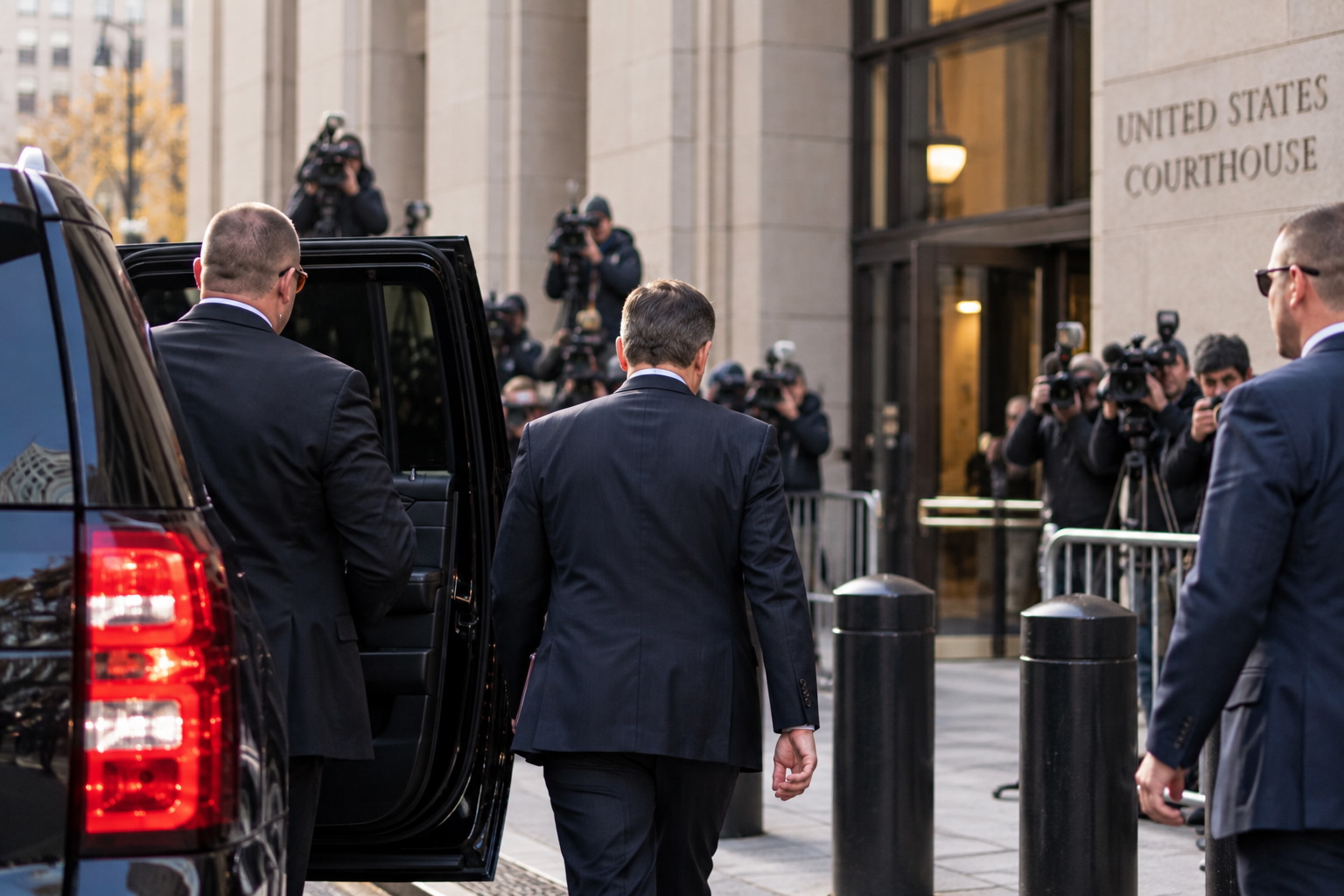
The Russia investigation had now reached someone who had worked at the highest levels of Donald Trump's White House.
On December 1, 2017, retired Army Lieutenant General Michael Flynn, Trump's former National Security Adviser, walked into federal court in Washington and pleaded guilty to making false statements to the FBI.
Flynn admitted that he had lied to federal investigators about conversations he had with Russian Ambassador Sergey Kislyak during the presidential transition.
But the guilty plea contained something potentially more significant than the criminal charge itself.
Flynn had agreed to cooperate with Special Counsel Robert Mueller.
A man who had advised Trump during the campaign, participated in the presidential transition and briefly occupied one of the most powerful national-security positions in the White House was now providing information to the investigation examining Russian interference in the 2016 election.
From General to Trump Adviser
Flynn had spent more than three decades in the U.S. Army.
An intelligence officer, he rose to the rank of lieutenant general and eventually became director of the Defense Intelligence Agency under President Barack Obama.
He left the DIA in 2014.
During the 2016 presidential campaign, Flynn became one of Trump's most visible national-security supporters.
He spoke at the Republican National Convention.
He appeared regularly at Trump campaign events.
He advised the candidate on national-security and foreign-policy issues.
After Trump won the election, Flynn became a senior member of the presidential transition team.
Trump then selected him to serve as National Security Adviser.
The position did not require Senate confirmation.
When Trump took office on January 20, 2017, Flynn entered the White House with direct access to the president and responsibility for coordinating some of the most sensitive national-security issues facing the United States.
His tenure lasted only 24 days.
Conversations With the Russian Ambassador
The events that ultimately produced Flynn's guilty plea began before Trump took office.
On December 29, 2016, the Obama administration announced sanctions and other measures against Russia in response to Russian interference in the presidential election.
That same day, Flynn spoke with Russian Ambassador Sergey Kislyak.
According to Flynn's later statement of offense, a senior member of Trump's presidential transition team discussed with Flynn what he should communicate to Kislyak regarding the sanctions.
Flynn then contacted the ambassador.
He asked Russia not to escalate the situation in response to the Obama administration's actions.
The request mattered.
Russia initially indicated that it might retaliate against the United States.
Instead, Russian President Vladimir Putin announced that Russia would not immediately respond in kind.
Trump publicly praised Putin's decision.
“Great move on delay,” Trump wrote on Twitter.
He called Putin “very smart.”
Behind the scenes, however, Flynn had already communicated with the Russian ambassador.
Flynn Talks to the FBI
On January 24, 2017, FBI agents interviewed Flynn at the White House.
They asked him about his conversations with Kislyak.
Flynn denied asking the ambassador to moderate Russia's response to the Obama administration's sanctions.
That was false.
Flynn also denied remembering that Kislyak later told him Russia had chosen to moderate its response because of Flynn's request.
That was also false.
The conversations were not limited to sanctions.
Flynn had also communicated with Kislyak about a United Nations Security Council resolution concerning Israeli settlements.
According to Flynn's statement of offense, members of the Trump transition team discussed the resolution and directed Flynn to contact foreign governments, including Russia, in an effort to learn how they intended to vote and potentially influence the outcome.
Flynn subsequently gave the FBI false information about aspects of those conversations as well.
The issue was therefore not simply that Flynn had spoken with a Russian diplomat.
Incoming administrations routinely communicate with foreign governments.
The criminal charge was that Flynn lied to FBI agents investigating those contacts.
The Acting Attorney General Warns the White House
Flynn's conversations created another problem.
Acting Attorney General Sally Yates warned the White House in January that statements being made publicly about Flynn's contacts with Kislyak were inconsistent with information available to the Justice Department.
Vice President Mike Pence had publicly said Flynn told him sanctions had not been discussed with Kislyak.
Flynn's conversations showed otherwise.
The discrepancy created concerns that Flynn could potentially be vulnerable to Russian pressure because Russian officials knew the public account was inaccurate.
Yates brought those concerns to White House Counsel Don McGahn.
Flynn remained National Security Adviser for more than two additional weeks.
Flynn Resigns
The controversy became public in February.
On February 13, Flynn resigned.
In his resignation letter, Flynn acknowledged that he had provided Vice President Pence and others with “incomplete information” about his conversations with the Russian ambassador.
The White House initially framed the issue largely as one of trust.
Flynn had misled the vice president.
But the FBI was examining something more serious.
Its agents had already interviewed Flynn.
And investigators knew that some of his answers were false.
Ten months later, Flynn admitted it in federal court.
“Guilty, Your Honor”
Flynn appeared before U.S. District Judge Rudolph Contreras on December 1.
He pleaded guilty to one felony count of making materially false statements to the FBI.
The charge carried a potential prison sentence.
But Flynn's agreement with prosecutors made clear that this was not an ordinary guilty plea.
He was cooperating.
Flynn agreed to provide truthful information to Mueller's investigators and participate in the investigation as required.
That potentially included interviews, documents and testimony.
Mueller now had the cooperation of someone who had participated in three critical periods:
the Trump presidential campaign,
the presidential transition,
and the Trump White House.
That immediately raised an obvious question.
What did Michael Flynn know?
The Investigation Moves Closer to the White House
Mueller's investigation had already produced several criminal cases.
Paul Manafort and Rick Gates had been indicted in October on charges involving their previous Ukraine-related work and financial activities.
Former Trump campaign adviser George Papadopoulos had pleaded guilty to lying to the FBI about contacts with people claiming connections to Russian officials.
Flynn was different.
He had been considerably closer to Trump.
He had attended high-level campaign meetings.
He had advised Trump on national security.
He had participated in transition discussions after the election.
And after inauguration, he had occupied an office in the West Wing.
The fact that Flynn was cooperating did not establish wrongdoing by Trump or anyone else in the administration.
But it meant Mueller's investigators now had access to a witness with firsthand knowledge of important events surrounding the campaign, transition and opening weeks of the presidency.
The Transition Team Enters the Picture
Flynn's statement of offense also contained another important detail.
His contacts with Kislyak had not occurred entirely on his own initiative.
The document described conversations Flynn had with senior members of the presidential transition team.
Before contacting Kislyak about the sanctions, Flynn spoke with a senior transition official at Mar-a-Lago about what to communicate.
Afterward, Flynn reported back about his conversation with the Russian ambassador.
The Mueller investigation later concluded that it did not identify evidence that President-elect Trump personally instructed Flynn to ask Russia to moderate its response to the sanctions.
But the court documents made clear that Flynn's diplomatic contacts occurred within the broader work of the transition team.
That expanded the public understanding of what investigators were examining.
Trump Responds
The White House attempted to distance Trump from Flynn's legal problems.
Officials emphasized that the guilty plea involved Flynn's false statements to the FBI rather than a charge that the Trump campaign had conspired with Russia to interfere in the election.
That distinction was important.
Flynn's guilty plea did not establish that Trump had coordinated with the Russian government's election-interference operation.
It established that Flynn lied to federal investigators about his conversations with the Russian ambassador.
Trump publicly expressed sympathy for Flynn in the days that followed.
He said he felt “very badly” for his former adviser and argued that Flynn had been treated unfairly.
But Mueller now possessed something the White House could not control.
Flynn's cooperation.
Why Cooperation Mattered
A cooperation agreement changes the role of a defendant.
Flynn was no longer simply defending himself against prosecutors.
He was agreeing to assist them.
That meant Mueller's investigators could question him in detail about events he had witnessed.
They could compare his account with emails, phone records, testimony and other evidence.
They could ask about conversations during the campaign.
They could ask about the transition.
They could ask about Russia.
They could ask about events inside the White House.
And Flynn was obligated to answer truthfully.
Cooperation agreements do not guarantee that prosecutors will uncover additional crimes.
Nor does a cooperating witness's testimony automatically prove allegations against anyone else.
But for investigators, Flynn represented an unusually well-positioned source of firsthand information.
A Dramatic Fall
Flynn's guilty plea represented a remarkable reversal.
Less than a year earlier, he had been preparing to become the president's National Security Adviser.
He had entered the White House with extraordinary access to classified intelligence and the president himself.
Twenty-four days later, he was gone.
Ten months after that, he stood in federal court admitting that he had lied to the FBI.
And he was now cooperating with the investigation that had become one of the defining controversies of Trump's presidency.
The Flynn Story Would Continue
The legal story surrounding Michael Flynn would eventually become far more complicated.
His sentencing was repeatedly delayed while he cooperated with investigators.
He later changed lawyers and attempted to withdraw his guilty plea.
In 2020, the Justice Department moved to dismiss the prosecution.
The case then became the subject of additional litigation over whether the court should grant that request.
Before those proceedings reached a final resolution, Trump granted Flynn a full presidential pardon on November 25, 2020.
But none of that was known on December 1, 2017.
What Washington knew that morning was much simpler.
One of Donald Trump's closest former national-security advisers had admitted committing a federal crime.
He had admitted lying about his conversations with Russia's ambassador.
And he had agreed to help Robert Mueller.
Mueller Gains a White House Insider
When Mueller was appointed in May 2017, it was impossible to know where his investigation would lead.
By December, the investigation had produced indictments and guilty pleas.
Now it had something else.
A cooperating witness who had operated near the center of Trump's political and national-security operation.
Michael Flynn had been a campaign adviser.
He had been a presidential transition official.
He had been National Security Adviser.
He had sat inside the White House.
And now he was answering Robert Mueller's questions.
On December 1, 2017, the Russia investigation moved another step closer to the presidency.