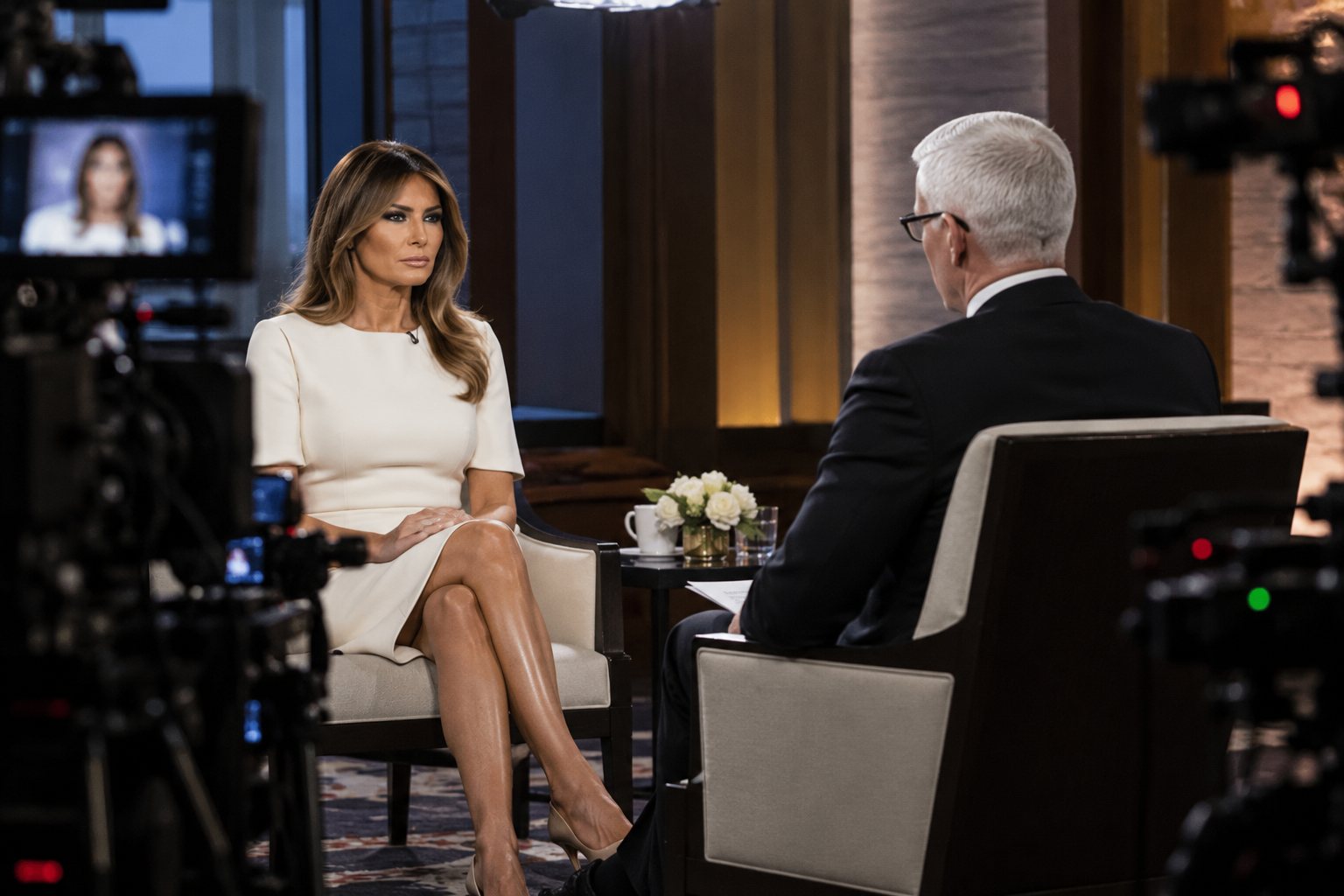
With just three weeks remaining before the presidential election, Melania Trump is defending her husband against mounting allegations of sexual misconduct, describing his recorded comments about women as inappropriate while suggesting he was encouraged by a television host to make them.
In an interview with CNN's Anderson Cooper broadcast Monday evening, the wife of Republican presidential nominee Donald Trump broke her public silence over the 2005 Access Hollywood recording that has thrown her husband's campaign into turmoil.
Melania acknowledged that the language on the recording was offensive but insisted it did not reflect the man she knows.
She also rejected allegations from women who have come forward accusing Trump of unwanted kissing, touching, and other inappropriate behavior.
Her defense comes as the Republican nominee faces growing scrutiny over his treatment of women and questions about whether his explanations are consistent with his own recorded statements.
The Recording That Shook Trump's Campaign
The controversy began October 7, when The Washington Post published a 2005 recording of Trump speaking with television personality Billy Bush before an appearance on Access Hollywood.
Unaware that his conversation was being recorded, Trump described pursuing a married woman and boasted about kissing and touching women.
In one of the recording's most widely condemned remarks, Trump suggested that celebrity status allowed him to touch women without waiting for their consent.
The recording immediately triggered outrage across the political spectrum.
Several prominent Republicans condemned Trump's language, while some withdrew their endorsements or called for him to abandon his presidential campaign.
Trump subsequently apologized for his comments but characterized the conversation as private locker-room banter.
During the October 9 presidential debate, he denied that he had actually engaged in the conduct described on the recording.
That denial has taken on greater significance as women have come forward with allegations of unwanted sexual contact.
Melania Says Trump Was 'Egged On'
In her CNN interview, Melania Trump offered an explanation that shifted some responsibility toward Billy Bush, who was working for Access Hollywood when the conversation occurred.
She suggested that Bush encouraged Trump to make increasingly inappropriate comments.
Melania characterized the exchange as immature conversation between men and said she had never heard her husband speak that way before.
She acknowledged that the comments were unacceptable and said she confronted Trump after learning about the recording.
But she also compared the exchange to the kind of exaggerated conversation sometimes heard between teenage boys.
Cooper challenged that explanation by pointing out that Trump was 59 years old when the recording was made.
Melania acknowledged his age but continued defending the exchange as inappropriate talk rather than evidence of actual misconduct.
The distinction is central to the campaign's response.
Trump and his supporters maintain that the recording captured offensive language, not proof that he committed the acts he described.
Critics argue that Trump's own words warrant serious scrutiny, particularly given the allegations that have surfaced since the recording became public.
Multiple Women Have Accused Trump of Misconduct
The controversy has expanded beyond the Access Hollywood recording.
Several women have publicly accused Trump of unwanted sexual contact, including incidents they say occurred years or decades ago.
Jessica Leeds told The New York Times that Trump touched her inappropriately during an airline flight in the early 1980s.
Rachel Crooks told the newspaper that Trump kissed her without her consent when she encountered him at Trump Tower in 2005.
People magazine writer Natasha Stoynoff has alleged that Trump forcibly kissed her during a 2005 interview at his Mar-a-Lago estate.
Former Apprentice contestant Summer Zervos has accused Trump of kissing and touching her without consent during encounters in 2007.
Trump has denied the allegations and accused his political opponents and news organizations of promoting false stories.
The allegations have not been established through criminal convictions or judicial findings.
However, the women have provided accounts that raise questions about Trump's conduct, particularly when compared with the behavior he described in the 2005 recording.
Melania Questions the Accusers' Credibility
Rather than expressing uncertainty about the allegations, Melania Trump is publicly siding with her husband.
She told Cooper that she believes Trump and suggested the accusations are part of a coordinated political effort to damage his campaign.
She questioned whether journalists had adequately investigated the women making the allegations.
Melania also suggested that the timing of the accusations, so close to Election Day, is suspicious.
In a separate interview with Fox News, she argued that allegations of misconduct should be addressed through the legal system.
Her remarks closely resemble the campaign's broader response: deny the accusations, question the motives of the accusers, and portray the coverage as an effort to influence the election.
But the timing of an allegation does not, by itself, establish whether it is true or false.
Nor does a political campaign's denial resolve the factual disputes raised by those making the accusations.
The allegations remain contested, and each must be assessed on the available evidence.
Michelle Obama Condemns the Recording
Melania's interview follows a forceful speech by first lady Michelle Obama, who last week condemned Trump's recorded remarks without naming him.
Speaking at a campaign event in New Hampshire, Obama rejected the argument that the recording amounted to ordinary locker-room conversation.
She described the behavior Trump discussed as sexually predatory and said the remarks were deeply disturbing.
Her speech drew national attention for its emphasis on how women experience harassment, unwanted touching, and degrading comments.
During the CNN interview, Cooper asked Melania whether the behavior described in the recording would constitute sexual assault.
Melania rejected that characterization, arguing that Trump had not admitted actually carrying out the conduct.
The exchange highlighted the disagreement between Trump's defenders and critics.
Melania focused on the difference between words and actions.
Critics focused on what Trump's words revealed about his attitudes toward women's consent and bodily autonomy.
The Billy Bush Controversy
Melania's decision to blame Bush adds another dimension to the scandal.
Bush participated in the 2005 conversation and laughed along with Trump's remarks.
He has faced significant professional consequences since the recording became public.
NBC announced Monday that Bush is leaving the Today show, where he had been serving as a co-host.
Bush previously apologized for his participation in the conversation, describing his behavior as immature and embarrassing.
His departure has created a contrast between the consequences faced by the television host and the Republican presidential nominee.
Bush is losing his network television position, while Trump continues campaigning for the presidency.
Trump has apologized for the recording but maintains that the controversy should not disqualify him from public office.
Melania's explanation places additional attention on Bush's role without changing the fact that Trump made the statements heard on the recording.
Melania Says She Has Accepted Trump's Apology
Melania also addressed the personal consequences of the controversy.
She said her husband's remarks were offensive to her and that she made her feelings clear when she confronted him.
Trump apologized, she said, and she has accepted that apology.
She rejected suggestions that she should be viewed as a helpless or embarrassed spouse.
Instead, she described herself as confident and capable of handling the intense public scrutiny surrounding her marriage.
Her appearance represents an effort to present a united family front as the campaign enters its final weeks.
But her personal decision to forgive her husband is separate from the questions voters are considering.
A spouse's forgiveness does not establish whether allegations from other women are accurate.
And the existence of a private apology does not settle the broader public debate over a presidential candidate's conduct.
Trump Continues Attacking the Media
The Republican nominee has responded to the allegations by accusing news organizations of publishing politically motivated attacks.
Trump has repeatedly claimed that the media is working with Democratic nominee Hillary Clinton to damage his candidacy.
He has also threatened legal action against The New York Times over its reporting on allegations of unwanted sexual contact.
The newspaper has defended its coverage.
Trump's campaign argues that the accusations are unsubstantiated and that their publication shortly before the election demonstrates political bias.
News organizations reporting the allegations maintain that accusations involving a major presidential candidate are matters of legitimate public interest.
The dispute places additional pressure on journalists to distinguish between documented statements, independently corroborated information, and allegations that remain contested.
A Difficult Moment for the Republican Campaign
The scandal arrives at a particularly sensitive point in the election.
Trump is preparing for Wednesday's third and final presidential debate against Hillary Clinton in Las Vegas.
The campaign is attempting to redirect attention toward immigration, trade, national security, and Clinton's political record.
But the controversy over Trump's treatment of women continues to dominate headlines.
The Access Hollywood recording has already prompted criticism from members of his own party, while the allegations from multiple women have generated additional questions about his credibility.
Trump insists that he has been falsely accused.
His campaign argues that voters should focus on his policy proposals rather than allegations about his private behavior.
For voters, however, questions about character and honesty are part of evaluating someone seeking the presidency.
The Questions Melania's Interview Cannot Resolve
Melania Trump's defense offers a personal perspective on a scandal that has become one of the defining controversies of the 2016 campaign.
She says she knows her husband, believes his denials, and has accepted his apology for the recording.
Those are her stated views.
But the public record also includes Trump's own recorded statements and allegations from women who say they experienced unwanted sexual contact.
Trump denies those allegations.
The available information does not establish that every accusation is true, but neither does Melania's confidence establish that they are false.
Her suggestion that Billy Bush encouraged the conversation also does not erase Trump's responsibility for the words he chose to say.
The central issue is no longer simply whether Donald Trump used offensive language in a private conversation. It is whether his public denials, recorded remarks, and the allegations against him can be reconciled.
With Election Day approaching, the controversy continues to place questions about Trump's conduct and credibility before American voters.
Melania Trump has made clear that she stands by her husband.
Whether her defense changes public perceptions of the allegations remains to be seen.