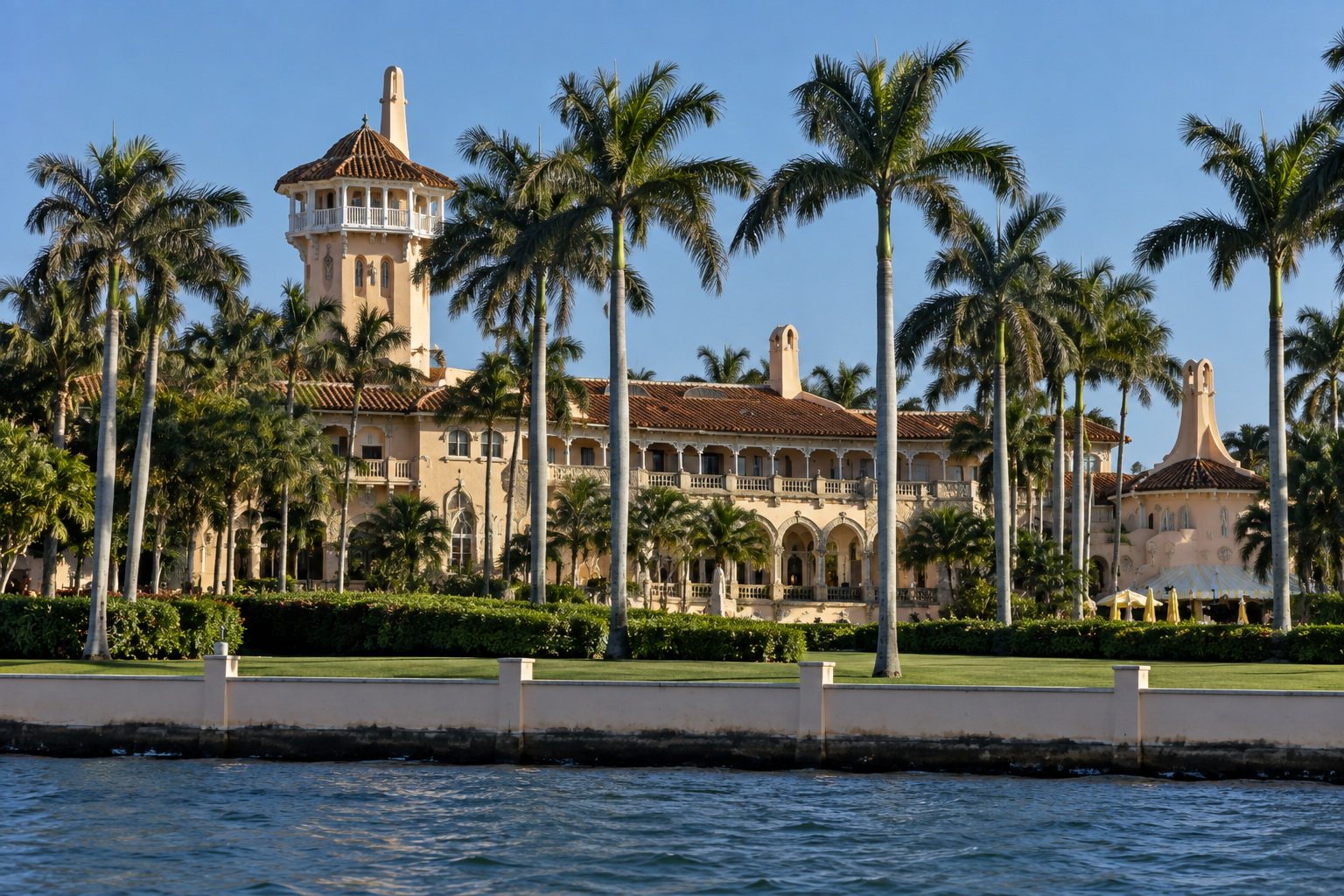
Two months after FBI agents executed a court-authorized search of Donald Trump's Mar-a-Lago estate, the extraordinary investigation into the former president's handling of government records remained locked in a complicated legal battle.
At the center of the case were thousands of government documents recovered from Trump's Florida property — including more than 100 documents bearing classification markings.
Some carried highly sensitive national-security markings.
The Justice Department was investigating why government records had been taken to Mar-a-Lago after Trump left the White House, why documents requested by the National Archives had not all been returned, and whether efforts had been made to obstruct the government's attempts to recover them.
But by October 7, 2022, another issue was consuming the courts:
Who was allowed to examine the evidence?
The FBI Search of Mar-a-Lago
On August 8, 2022, FBI agents searched Trump's Mar-a-Lago residence and club in Palm Beach, Florida.
This was not an unannounced fishing expedition.
Federal investigators had obtained a search warrant from a magistrate judge after submitting evidence establishing probable cause to believe that evidence of potential federal crimes would be found at the property.
The search followed months of efforts by the National Archives and Justice Department to recover presidential records that should have been transferred to the government when Trump left office.
The FBI recovered thousands of government records and other materials.
Among them were more than 100 documents bearing classification markings, including some marked at highly sensitive levels.
The discovery intensified an investigation that had already moved far beyond a simple dispute over presidential paperwork.
These Were Government Records
The Presidential Records Act generally makes presidential records the property of the United States, not the personal property of the departing president.
When a president leaves office, presidential records are supposed to be transferred to the National Archives.
Trump's representatives had already returned 15 boxes to the Archives in January 2022.
The Archives subsequently discovered classified material among those records and referred the matter to the Justice Department.
Investigators then sought additional classified records.
In June, Trump's attorneys turned over another group of documents bearing classification markings in response to a grand-jury subpoena.
A Trump attorney also signed a certification concerning compliance with the subpoena.
But investigators developed evidence suggesting additional government records remained at Mar-a-Lago.
The August search proved that suspicion correct.
More documents bearing classification markings were recovered.
Why Classified Documents Mattered
Classification markings indicate that information has been designated for protection because unauthorized disclosure could damage national security.
Some of the documents recovered at Mar-a-Lago carried markings associated with extremely sensitive information.
The legal investigation was not simply about whether Trump possessed documents stamped “classified.”
Federal laws potentially implicated by the investigation included statutes governing the retention of national-defense information, concealment or removal of government records and obstruction.
That distinction is important because some relevant federal statutes do not depend entirely upon whether a document technically remained classified.
The Justice Department was investigating the circumstances surrounding Trump's possession and retention of the material and the government's attempts to recover it.
Trump denied wrongdoing and publicly maintained that he had broad authority to declassify information while president.
But his attorneys faced a more difficult task in court, where assertions generally must be supported with evidence.
Trump Goes to Court
After the FBI search, Trump filed a lawsuit seeking judicial intervention.
The case landed before U.S. District Judge Aileen Cannon in Florida.
Cannon had been appointed to the federal bench by Trump in 2020.
On September 5, she granted Trump's request for a special master — an independent reviewer who would examine the materials seized by the FBI and determine whether some should be withheld from investigators because of attorney-client privilege, executive privilege or because they were personal property.
Cannon went considerably further.
She temporarily prevented the Justice Department from using the seized materials in its criminal investigation while the special-master review proceeded.
The ruling did allow intelligence agencies to continue conducting classification and national-security assessments.
But the restrictions placed on criminal investigators immediately became controversial.
The Justice Department appealed.
Raymond Dearie Becomes Special Master
Cannon appointed Senior U.S. District Judge Raymond Dearie to serve as special master.
Dearie was not the Justice Department's original choice.
He had actually been proposed by Trump's attorneys.
The government nevertheless agreed to his appointment.
Dearie was a veteran federal judge and former federal prosecutor with experience involving national-security matters.
Once he began overseeing the review, however, Trump's attorneys encountered an unexpected problem.
Dearie wanted them to substantiate some of the claims surrounding the documents.
Trump had publicly suggested that he had declassified the documents.
He had also publicly raised the possibility that FBI agents had planted material during the search.
But making statements in interviews or on social media is very different from making factual representations to a federal court.
Dearie wanted Trump's attorneys to identify inaccuracies they believed existed in the government's inventory of seized property.
That potentially forced Trump's lawyers to choose between Trump's public claims and positions they were prepared to formally defend in court.
Cannon Intervenes Again
Trump's attorneys objected to some of Dearie's requirements.
Cannon intervened.
She ruled that Trump's lawyers did not have to comply with Dearie's October 7 deadline for identifying specific alleged inaccuracies in the government's inventory.
She also extended the timetable for the special-master review.
The development illustrated the unusual procedural fight unfolding around the investigation.
Trump had requested a special master.
Cannon had granted the request.
Trump's own lawyers had proposed Dearie.
But when Dearie began demanding specific information from Trump's team, Cannon limited parts of the process he had established.
Appeals Court Overrules Cannon on Classified Documents
The Justice Department scored a major victory on September 21.
A unanimous three-judge panel of the U.S. Court of Appeals for the Eleventh Circuit ruled that federal investigators could resume using the documents bearing classification markings in the criminal investigation.
The appellate court also ruled that those approximately 100 documents did not need to be provided to Dearie as part of the special-master review.
The decision substantially weakened Cannon's original restrictions.
The appeals court emphasized the government's strong interest in protecting national-security information and investigating whether classified records had been improperly retained.
That meant that by October 7, the broader special-master process continued — but the Justice Department again had access to the documents most important to the classified-records investigation.
An Investigation Into More Than Possession
Another critical part of the investigation involved what happened after the government began asking for its records back.
Possessing government documents was one issue.
How Trump and his representatives responded to efforts to recover them was another.
Investigators were examining whether all responsive documents had been surrendered after a federal grand-jury subpoena demanded classified records.
They were also investigating the movement and storage of boxes at Mar-a-Lago.
That created the possibility of an obstruction investigation in addition to questions surrounding the retention of national-defense and government information.
At this stage, however, Trump had not been charged with a crime.
The investigation was ongoing.
Trump's Defense
Trump consistently portrayed the investigation as politically motivated.
He argued that presidents possess extremely broad authority over classified material and claimed that documents could have been declassified while he was president.
His attorneys also argued that a former president could potentially assert executive privilege over some presidential materials.
The Justice Department disputed those positions.
Prosecutors argued that documents bearing classification markings were government records and that Trump's privilege claims could not prevent the executive branch itself from reviewing executive-branch documents as part of a criminal investigation.
The courts would increasingly side with the government on those questions.
The Larger Constitutional Issue
The case was unprecedented in several respects.
A former president's residence had been searched pursuant to a federal warrant.
Highly sensitive government documents had been recovered.
The former president was challenging the government's ability to examine material recovered during that search.
And a federal judge appointed by that same former president had issued rulings that temporarily restricted the criminal investigation.
That guaranteed enormous scrutiny of every court decision.
But underneath the political controversy was a relatively straightforward question:
What happens when government records — including documents containing some of the nation's most sensitive information — remain in the possession of a former president after he leaves office?
The presidency does not transfer ownership of government secrets to the individual who temporarily occupies the office.
Presidential records belong to the government under federal law.
National-security information remains protected after a president leaves office.
And former presidents do not retain the powers of the presidency indefinitely.
October 7: The Legal Fight Continues
By October 7, the investigation had reached a strange stage.
The FBI had recovered the documents.
The Justice Department was investigating.
Trump was fighting the investigation in federal court.
Cannon had appointed a special master and restricted the government's access to evidence.
An appeals court had already reversed the most consequential portion of that restriction.
And Dearie — the special master Trump's own attorneys had proposed — was pressing Trump's legal team to substantiate positions surrounding the seized material.
The fight was far from over.
But one important question had already been answered.
The Justice Department was again permitted to investigate the documents bearing classification markings recovered from Mar-a-Lago.
The special-master battle would continue.
So would the criminal investigation.
And the dispute over boxes of government records removed from the White House would eventually become one of the most consequential federal investigations ever involving a former American president.