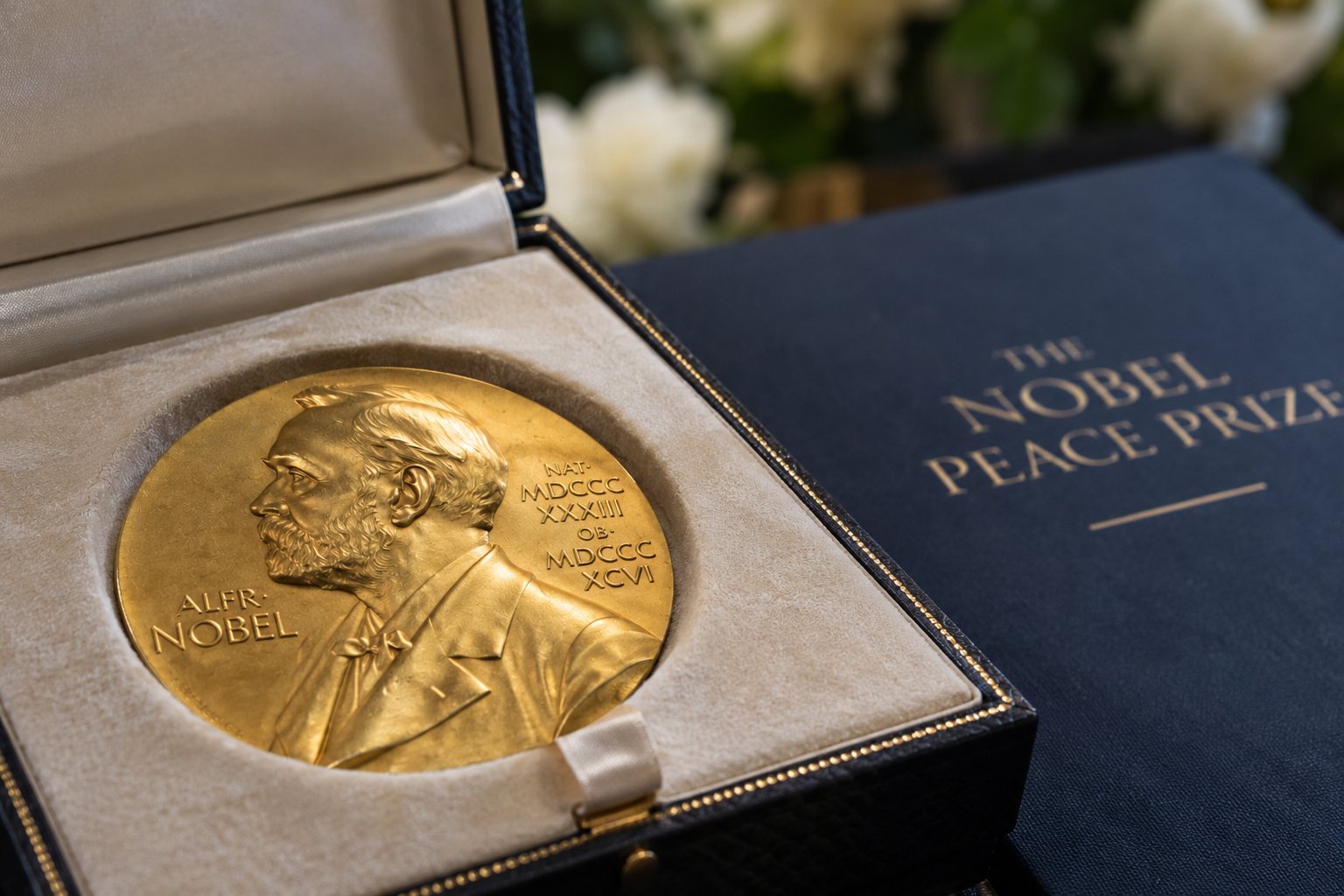
Donald Trump wanted the Nobel Peace Prize.
He had talked about it repeatedly. His allies had promoted the idea. Foreign leaders had nominated him. And after his administration helped broker a new Gaza ceasefire agreement, supporters argued that the case for giving Trump the world's most famous peace award had become overwhelming.
Then, on October 10, 2025, the Norwegian Nobel Committee announced its decision.
The prize wasn't going to Donald Trump.
It was going to Venezuelan opposition leader María Corina Machado.
Trump himself responded relatively calmly.
Many of his supporters did not.
Within hours, prominent MAGA figures, Republican politicians and White House officials were accusing the Nobel Committee of political bias, dismissing the award's credibility and insisting that Trump had been unfairly denied an honor he deserved.
The Prize Goes to Venezuela
The Norwegian Nobel Committee awarded the 2025 Nobel Peace Prize to Machado for her campaign for democracy in Venezuela.
The committee praised her “tireless work promoting democratic rights for the people of Venezuela” and her efforts toward a peaceful transition from authoritarian rule to democracy.
Machado had emerged as one of the most prominent opponents of Venezuelan President Nicolás Maduro.
She had been selected as the opposition's presidential candidate ahead of Venezuela's 2024 election, but the government barred her from running.
The opposition subsequently rallied around Edmundo González Urrutia.
Machado continued organizing despite government repression and threats, eventually going into hiding.
The Nobel Committee described her as a unifying figure in Venezuela's previously fractured opposition movement.
It said she represented the principle that democratic change could be pursued through peaceful political resistance rather than violence.
For the committee, that record earned her the prize.
For many Trump supporters, however, the announcement immediately became about someone else.
Donald Trump.
Trump Had Made No Secret That He Wanted It
Trump's interest in winning a Nobel Peace Prize stretched back years.
He frequently complained that Barack Obama had received the award in 2009 and suggested that his own diplomatic accomplishments were more deserving.
During his second presidency, the campaign intensified.
Trump credited himself with helping resolve or reduce multiple international conflicts and repeatedly suggested that he deserved recognition from the Nobel Committee.
Asked whether he believed he deserved the prize, Trump had responded:
“Everyone thinks so, but I would never say it.”
He then added that if he were named Obama, he believed he would have received the prize almost immediately.
Trump's allies reinforced the message.
Several foreign leaders publicly supported or submitted nominations for him.
His administration pointed to diplomatic efforts involving conflicts in the Middle East, Africa and Asia.
Then came Gaza.
The Gaza Agreement Raises Expectations
Just days before the Nobel announcement, Trump announced that Israel and Hamas had agreed to the first phase of a U.S.-backed ceasefire and hostage-release framework.
The development was significant.
After two years of devastating war following Hamas's October 7, 2023 attack on Israel, the agreement offered the possibility of halting fighting and returning hostages.
Trump described the agreement as the beginning of a lasting peace.
His supporters immediately argued that the breakthrough strengthened his case for the Nobel Prize.
There was, however, a major timing problem.
The Nobel Committee's deliberations had been underway long before the Gaza agreement was announced.
Nominations for the 2025 prize had closed months earlier, and the committee's final decision-making process was already well advanced.
The Gaza breakthrough occurred only days before the public announcement.
That didn't stop Trump's supporters from treating the decision as a deliberate rejection.
“Politics Over Peace”
White House communications director Steven Cheung quickly attacked the decision.
He said Trump would continue “making peace deals, ending wars, and saving lives.”
Then he accused the Nobel Committee directly:
“The Nobel Committee proved they place politics over peace.”
Cheung described Trump as having “the heart of a humanitarian” and said there was no one else capable of moving diplomatic obstacles with the same force.
Trump adviser Richard Grenell went even further.
“The Nobel Prize died years ago,” he wrote.
The reaction spread quickly through Trump's political movement.
Conservative commentator Jack Posobiec blamed “globalists” for denying Trump the award.
Other Trump supporters dismissed the prize itself as meaningless if Trump wasn't going to receive it.
Republican members of Congress joined the criticism.
North Carolina Rep. Richard Hudson called Trump's failure to receive the prize a “disgrace,” pointing specifically to Trump's Middle East diplomacy.
He even posted an AI-generated image depicting himself presenting Trump with a Nobel Peace Prize.
Lara Trump: He Deserves It More Than Anyone Alive
Trump's daughter-in-law Lara Trump also attacked the decision.
She argued that Trump deserved the award “more than anyone alive” and accused those responsible for selecting the winner of hostility toward him.
Her reaction reflected a broader theme emerging throughout Trump's political movement.
The question was no longer simply whether Trump had a legitimate case for receiving the award.
Some supporters treated the fact that he hadn't won as evidence that the institution itself was politically compromised.
Trump deserved the Nobel.
The Nobel Committee didn't give it to him.
Therefore, the Nobel Committee was the problem.
It was a familiar dynamic in Trump's political movement: distrust of an institution intensified when that institution produced an outcome his supporters rejected.
But Machado Wasn't Anti-Trump
There was an awkward complication in the outrage.
The woman who actually won the prize was hardly a Trump adversary.
Machado had repeatedly praised American support for Venezuela's democratic opposition.
After receiving the award, she specifically thanked Trump.
She dedicated the prize to the Venezuelan people—and to Trump for what she called his “decisive support” for their cause.
Machado said Venezuelans counted on Trump, the United States and other democratic nations as allies in their effort to restore democracy.
In other words, the Nobel Committee hadn't chosen an anti-Trump leftist over Trump.
It had chosen a Venezuelan opposition leader whom Trump himself had previously praised as a “freedom fighter.”
And she responded to winning by publicly thanking him.
Trump Reacts Differently Than His Supporters
Trump's own response was noticeably less hostile than that of many people surrounding him.
He shared Machado's statement praising him.
Later that day, Trump said Machado had called him.
According to Trump, she told him she was accepting the award partly in his honor.
Trump described the gesture as “very nice.”
He continued arguing that his diplomatic achievements deserved recognition and suggested that Machado might have given him the prize if he had asked.
But he didn't unleash the kind of direct attack on Machado that some might have expected.
Instead, the sharpest criticism came from his allies.
The White House accused the committee of choosing politics over peace.
Grenell declared the prize effectively dead.
MAGA commentators accused international elites of deliberately snubbing Trump.
Republican politicians insisted Trump was the rightful recipient.
All while the actual winner was thanking Trump.
The Obama Grievance Never Disappeared
Hovering over Trump's pursuit of the Nobel Prize was another president:
Barack Obama.
Obama received the Nobel Peace Prize in 2009, less than a year into his presidency.
The decision was controversial even at the time.
The Nobel Committee said Obama had created a new climate in international politics and cited his efforts toward diplomacy, nuclear disarmament and international cooperation.
Trump never forgot it.
He repeatedly invoked Obama's Nobel when discussing his own record.
The comparison became part of a larger grievance: that institutions celebrated Obama while refusing to give Trump equivalent recognition.
Many Trump supporters shared that resentment.
So when Machado's name was announced instead of Trump's on October 10, the reaction wasn't simply disappointment over one award.
For many in MAGA politics, it reinforced an existing belief that international institutions would never treat Trump fairly.
Trump Had a Case. The Committee Chose Someone Else.
None of this means Trump's supporters had no substantive argument.
Trump's administration had participated in significant diplomatic initiatives.
The Gaza ceasefire agreement announced shortly before the Nobel decision was a major development.
Trump had also been involved in diplomatic efforts surrounding other international conflicts.
Supporters were entitled to argue that those accomplishments merited consideration for the world's most prominent peace prize.
But the Nobel Peace Prize isn't awarded automatically for negotiating a ceasefire.
Nor does a president receive it simply because supporters believe his diplomatic record is superior.
The Norwegian Nobel Committee chooses the recipient according to its own interpretation of Alfred Nobel's criteria.
In 2025, it chose Machado.
The committee cited her years of peaceful resistance to authoritarian rule, her campaign for democratic elections and her efforts to unite Venezuela's opposition.
That wasn't a verdict that Trump had accomplished nothing.
It was a decision to recognize someone else.
For parts of the MAGA movement, that distinction hardly mattered.
A Prize Becomes Another Political Fight
The 2025 Nobel Peace Prize could have been primarily an international story about Venezuela.
María Corina Machado had spent years challenging an authoritarian government.
She had been barred from running for president.
She had faced threats and repression.
She had gone into hiding.
And on October 10, she became the first Venezuelan to receive a Nobel Prize.
Yet in American politics, much of the conversation immediately shifted toward Donald Trump.
Why hadn't he won?
Had the committee deliberately snubbed him?
Was the Nobel Prize politically biased?
Did the award even matter anymore?
Within hours, another international institution had been pulled into America's political divide.
The irony was difficult to miss.
María Corina Machado won the Nobel Peace Prize.
She thanked Donald Trump.
She dedicated part of the honor to him.
Trump congratulated her and spoke with her.
And some of Trump's supporters were still furious that she had won it instead of him.