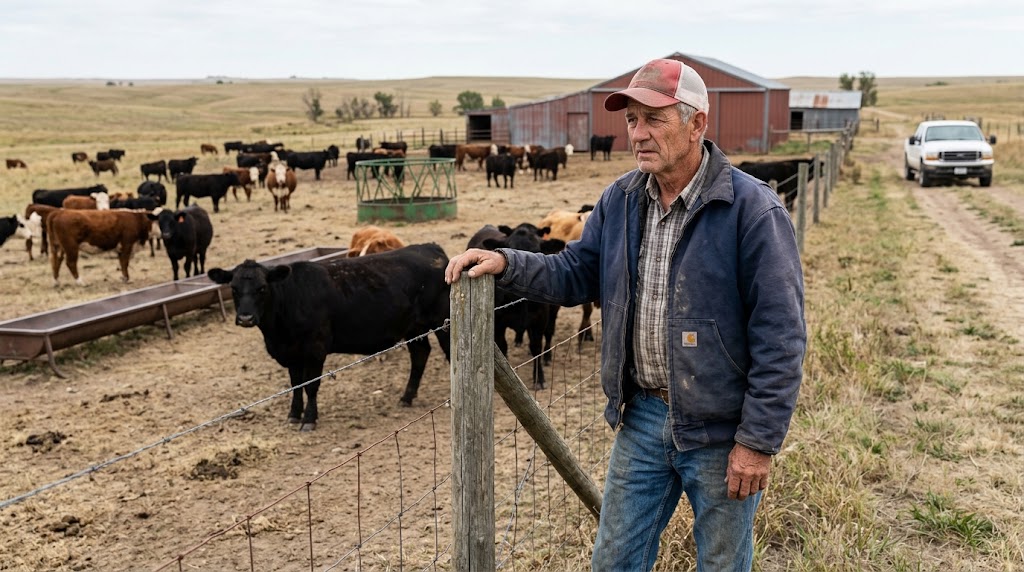
Donald Trump has spent years presenting himself as a champion of America's farmers and ranchers.
Now some of those farmers are furious with him.
The latest source of anger is Trump's decision to temporarily allow hundreds of thousands of metric tons of additional foreign beef into the United States at reduced tariff rates — a policy the administration says will help bring down stubbornly high beef prices for American consumers.
But cattle producers see another side of the equation.
They argue that flooding the market with cheaper imported beef threatens American cattle prices at precisely the moment ranchers are already struggling with soaring fuel and production costs.
And the reaction in farm country has been unusually blunt.
“I've never seen farmers more pissed,” Ryan Marquardt, vice president of the Iowa Farmers Union, told The Washington Sun.
“That was the maddest I've seen farmers in a long time.”
Trump's Solution: More Foreign Beef
Beef prices have become a serious affordability problem.
The United States cattle herd is near historic lows, supplies remain tight and ground beef prices have climbed dramatically.
Trump's response was to temporarily increase the amount of foreign beef that can enter the United States without the higher tariffs that would ordinarily apply.
The administration authorized an additional 300,000 metric tons of lean beef imports during a 90-day period beginning September 1.
That's roughly 661 million pounds of beef.
The White House says the policy is intended as a temporary bridge: increase supply now, provide some relief to consumers and give American cattle producers time to rebuild domestic herds.
But ranchers immediately began asking an uncomfortable question.
If the administration wants to help American agriculture, why is it making it easier for foreign producers to compete with American ranchers?
Republicans Are Complaining Too
This isn't simply criticism coming from Trump's political opponents.
Republican lawmakers from major agricultural states have publicly objected to the policy.
More than a dozen Republican senators criticized the decision after it was announced.
Nebraska Republican Sen. Pete Ricketts warned that bringing large quantities of lower-priced foreign beef into the market could hurt Nebraska farmers and ranchers.
Kansas Republican Sen. Jerry Moran urged Trump to reconsider the decision.
Montana Republican Sen. Tim Sheehy warned that the policy could further harm American ranchers — many of whom, he noted, are themselves MAGA Republicans.
Iowa Republican Sen. Chuck Grassley argued that American cattle producers should come first.
The opposition eventually grew large enough that Grassley, Moran and dozens of other members of Congress sent Trump a letter warning that government intervention in cattle markets could undermine the long-term viability of family-owned cattle operations.
That is an extraordinary political position for Trump to find himself in.
Republicans aren't defending him from angry farmers.
Some of them are joining the farmers.
Ranchers Say They're Already Feeling It
For cattle producers, the debate isn't theoretical.
Nebraska ranchers told Fox News that cattle prices fell after Trump's announcement. One producer said yearling steers she sold shortly afterward brought approximately $175 less per head than she had expected.
Kansas Farm Bureau President Glenn Brunkow described the policy as harmful to ranchers and argued that Trump's announcement itself disrupted cattle markets.
That gets to the heart of ranchers' frustration.
Many cattle producers have endured years of drought, high feed costs, consolidation in the meatpacking industry and volatile cattle markets.
The nation's cattle herd has fallen to levels not seen in decades.
Higher cattle prices finally gave some producers an opportunity to recover.
Then Washington announced that cheaper foreign beef was coming.
Farmers Are Getting Hit From Several Directions
The beef controversy also isn't occurring in isolation.
American farmers are dealing with another enormous expense: diesel fuel.
Farm equipment runs on it.
Trucks transporting livestock and crops run on it.
Much of the machinery responsible for producing and moving America's food depends on it.
Reuters reported last week that average U.S. diesel prices had climbed to $6.29 per gallon, 68 percent higher than a year earlier.
The Iran war and disruptions in global energy markets have contributed to that increase.
Some farmers told Reuters their daily fuel costs had effectively doubled.
That means agricultural producers are being squeezed from both directions.
Their production costs are rising while some government policies are simultaneously putting downward pressure on what producers can earn for their cattle.
Trump Has Tried to Calm the Backlash
The administration has responded.
Trump subsequently announced measures intended to help domestic cattle producers, including efforts involving meat-processing competition, interstate meat sales and country-of-origin labeling.
Grassley publicly praised those actions.
The administration's argument is that the two policies aren't contradictory: temporarily increase beef imports to provide consumers with relief now while simultaneously taking steps to strengthen America's cattle industry over the longer term.
That's the case the White House is making.
Some ranchers remain unconvinced.
Their concern is that decisions intended to produce cheaper hamburger today could discourage producers from rebuilding cattle herds — potentially making America's supply problems worse tomorrow.
An ‘America First’ Problem
Politically, the episode presents Trump with an awkward contradiction.
“America First” is considerably easier to sell in cattle country when it means protecting American producers from foreign competition.
It becomes more complicated when the federal government deliberately makes it easier for hundreds of millions of pounds of foreign beef to enter the country at reduced tariff rates.
Trump is trying to solve a legitimate problem.
Consumers don't like paying record prices for hamburger.
Ranchers don't like being blamed for those prices.
And importing more beef provides the administration with one tool for increasing supply.
But every economic policy creates winners and losers.
In this case, Trump's attempt to provide relief at the grocery store has managed to anger some of the very rural producers who have traditionally been among Republicans' most dependable supporters.
The political significance isn't that every farmer has suddenly abandoned Trump or the Republican Party.
There is no evidence of that.
It's that Republican politicians are publicly acknowledging the anger — and joining calls for changes.
When the vice president of the Iowa Farmers Union says farmers are the angriest he has seen them in years, that's more than another Washington political argument.
It's a warning coming directly from farm country.
And this time, it's aimed at Donald Trump.