It began as a White House meeting about prison reform, manufacturing and violence in Chicago.
It became something entirely different.
On October 11, 2018, rapper and entrepreneur Kanye West sat across from President Donald Trump in the Oval Office wearing a red “Make America Great Again” hat and delivered a sprawling monologue that ranged across politics, race, criminal justice, mental health, American manufacturing, North Korea, education and his own relationship with Trump.
At one point, West pulled out his phone and showed Trump a rendering of a futuristic hydrogen-powered aircraft he believed could replace Air Force One.
At another, he explained that wearing Trump's MAGA hat made him “feel like Superman.”
Trump mostly listened.
When West finally finished one extended stretch of remarks, the president looked around the room.
“That was pretty impressive,” Trump said.
Then, laughing, he turned toward football legend Jim Brown, who was also attending the meeting.
“What do you do after that?”
A Meeting About Criminal Justice
There was a serious purpose behind West's White House visit.
West and Brown had been invited to discuss issues including criminal-justice reform, prison reform, gang violence and manufacturing.
West's then-wife, Kim Kardashian West, had already become involved in criminal-justice advocacy and had met with Trump at the White House earlier that year.
Her advocacy focused considerable attention on Alice Marie Johnson, a 63-year-old grandmother serving a life sentence for a nonviolent federal drug offense.
Trump commuted Johnson's sentence in June 2018.
The administration was also supporting broader criminal-justice legislation that would eventually become the First Step Act, which Trump signed into law in December.
West came to Washington with his own ideas about prisons, employment and opportunities for people in struggling communities.
But once reporters entered the Oval Office, the conversation quickly expanded.
The MAGA Hat
Sitting across from Trump at the Resolute Desk, West explained why he had publicly embraced the president.
The red MAGA hat, he said, represented something deeply personal to him.
West talked about growing up without his father constantly present in his home and described Trump's campaign as projecting a kind of masculine energy that appealed to him.
When he put on the hat, West said, “It made me feel like Superman.”
His support for Trump had already generated enormous controversy.
West was one of the world's most recognizable Black entertainers, and Trump's support among Black voters had been comparatively low in the 2016 election.
West told Trump that people around him had discouraged him from wearing the hat.
“They tried to scare me to not wear this hat,” he said.
But West insisted that his political views could not simply be dictated by expectations associated with race.
Race, Politics and Chicago
West repeatedly returned to conditions in Black communities and particularly his hometown of Chicago.
He discussed violence, employment, policing and the economic conditions that he believed contributed to crime.
He argued that jobs and investment were essential.
He also rejected the idea that Black Americans had to share a single political viewpoint.
That argument was central to West's public embrace of Trump.
But his comments also wandered into other subjects.
He discussed the 13th Amendment, which abolished slavery and involuntary servitude except as punishment for a crime.
West had recently generated controversy by calling for the amendment to be abolished before clarifying that he wanted it amended.
In the Oval Office, he again focused on the amendment's exception involving criminal punishment and connected it to the American prison system.
“The Cheapest Factory Ever”
Manufacturing became another major theme.
West argued that America needed to make more products domestically rather than relying so heavily on manufacturing in China.
America's greatest exports, he suggested, included entertainment and ideas.
But when production moved overseas, he argued, communities at home lost economic opportunities.
He connected that loss of opportunity directly to incarceration.
Without legitimate economic opportunities, West argued, people could be pushed toward illegal activity and eventually into what he described as “the cheapest factory ever” — prison.
Whatever else happened during the meeting, this was one of West's more substantive arguments.
He was connecting deindustrialization, unemployment, crime and incarceration into a single economic argument.
Then Came the Airplane
And then West pulled out his phone.
He showed Trump an image of a futuristic hydrogen-powered aircraft.
West called it the “iPlane 1.”
“This is what our President should be flying in,” he told Trump.
The room laughed.
Trump joined in.
“We'll get rid of Air Force One,” the president joked.
West suggested that Apple could work on developing the aircraft as an American-made presidential plane.
The proposal was not a government aviation program. It was essentially a concept image West had brought into the Oval Office.
But it perfectly illustrated the nature of the meeting.
Within minutes, the conversation had moved from prisons and manufacturing to redesigning presidential aviation.
Mental Health
West also discussed his mental health publicly during the meeting.
He said he had previously been diagnosed with bipolar disorder but told Trump that another doctor had concluded that diagnosis was incorrect.
West described himself instead as having been sleep deprived.
Those were West's own statements about his medical history, not an independent medical determination made during the meeting.
The subject was deeply personal, but West introduced it as part of a broader argument about how other people had attempted to define him and limit what he could say or do.
Trump listened as West continued.
Reporters packed around the Resolute Desk watched the exchange.
Television cameras captured virtually everything.
North Korea
Even nuclear diplomacy entered the conversation.
Trump discussed his administration's relationship with North Korea and his meetings with North Korean leader Kim Jong Un.
Trump argued that his diplomacy had moved the United States away from a potential war.
West enthusiastically praised the effort.
The discussion was another example of how quickly the meeting moved between subjects.
Prison reform became North Korea.
North Korea became politics.
Politics became family.
Family became manufacturing.
Manufacturing became Air Force One.
There was almost no conventional structure.
“That Was Pretty Impressive”
For long stretches, Trump — normally the dominant speaker at public Oval Office appearances — simply watched West.
After one lengthy section of West's remarks, Trump finally responded.
“That was pretty impressive, folks.”
The room laughed.
Trump later described West's performance as “quite something” and said the rapper could speak for him whenever he wanted.
West's enthusiasm for Trump was unmistakable.
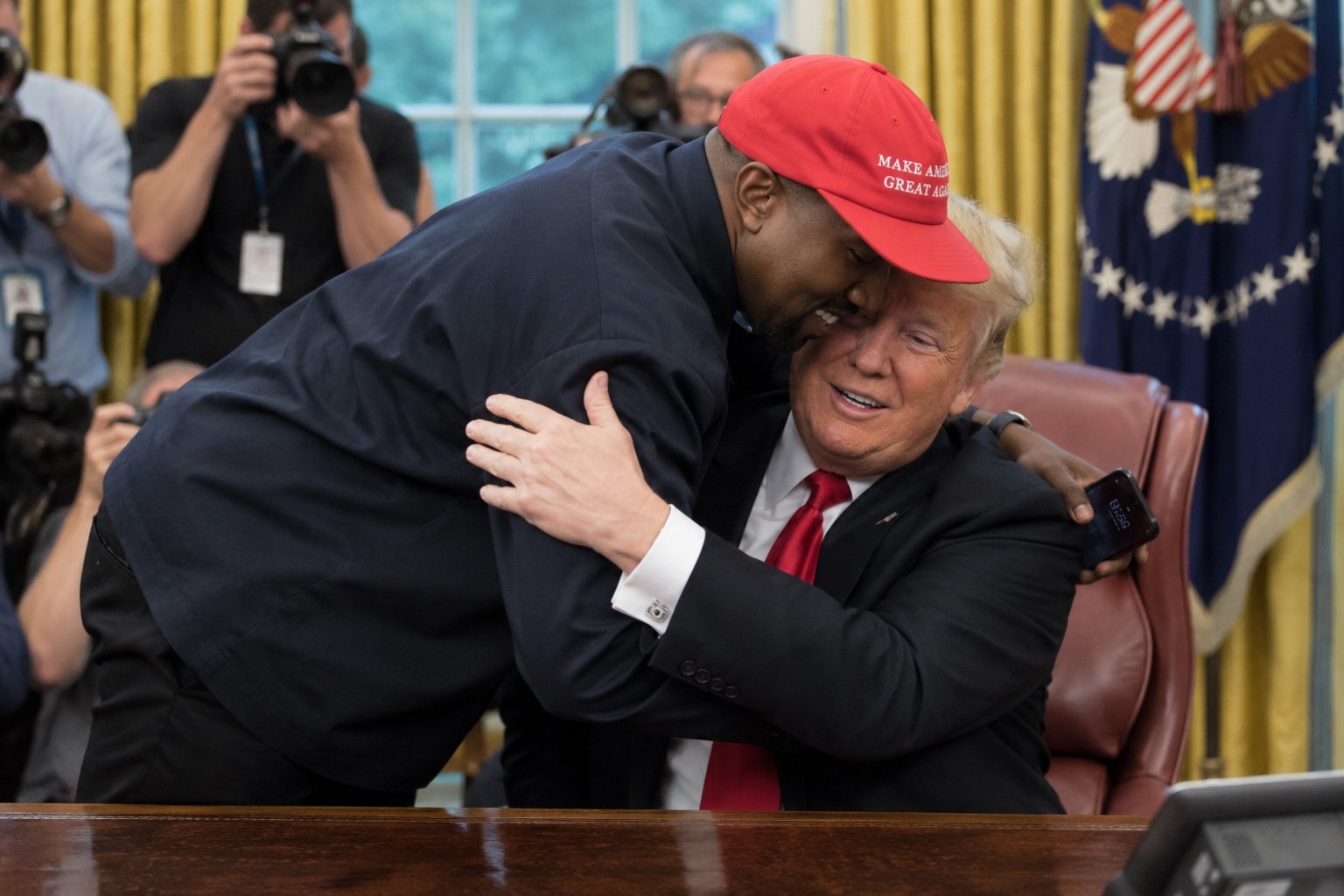
Near the end of the appearance, West walked around the Resolute Desk and embraced the president.
“I love this guy right here,” he said.
The photograph of Kanye West, still wearing his red MAGA hat, wrapping his arms around Donald Trump in the Oval Office became one of the defining images of the meeting.
More Than a Celebrity Photo Opportunity
It would be easy to remember October 11 simply as one of the stranger celebrity appearances of the Trump presidency.
But there were genuine policy issues underneath the spectacle.
Criminal-justice reform was moving through Washington.
Trump would sign the bipartisan First Step Act two months later.
West was talking about employment and manufacturing in communities affected by crime and incarceration.
He was discussing violence in Chicago.
He was questioning assumptions about race and political identity.
And he was advocating for changes to the criminal-justice system.
But those issues became intertwined with an extraordinarily personal and improvisational performance inside America's most recognizable political office.
October 11, 2018
Presidents routinely invite musicians, athletes, actors and activists to the White House.
Few meetings have looked quite like this one.
Kanye West arrived wearing a MAGA hat.
He talked about prisons.
He talked about manufacturing.
He talked about race.
He talked about his family.
He talked about mental health.
He praised Trump's approach to North Korea.
He proposed replacing Air Force One with a futuristic hydrogen-powered airplane.
Then he walked around the Resolute Desk and hugged the president.
For several remarkable minutes on October 11, 2018, the Oval Office became the stage for Kanye West.
Even Donald Trump seemed impressed.