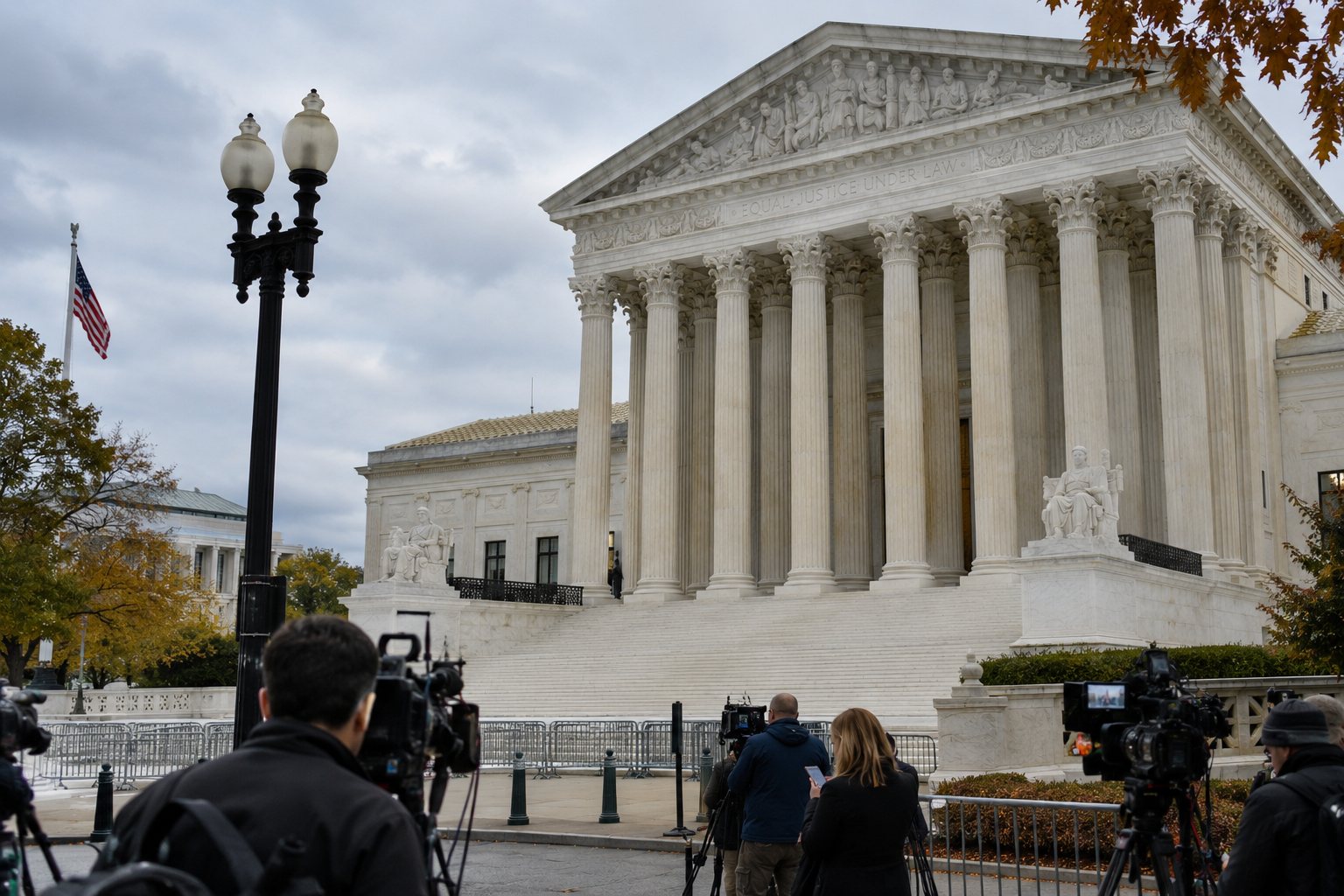
The legal fight over the government documents recovered from Donald Trump's Mar-a-Lago estate reached the nation's highest court.
On October 11, 2022, the Justice Department urged the U.S. Supreme Court to reject Trump's attempt to give a court-appointed special master access to roughly 100 documents bearing classified markings that FBI agents had recovered during the August search of Mar-a-Lago.
Trump's attorneys wanted those documents returned to the special-master review being conducted by federal judge Raymond Dearie.
The Justice Department argued there was no justification for doing so.
The government warned that interfering with its handling of the classified materials could damage both the criminal investigation and the intelligence community's assessment of potential national-security risks.
DOJ told the Supreme Court that Trump's request could “irreparably injure” the government.
The filing marked another escalation in a dispute that had begun with boxes of presidential records at Trump's Florida residence and had now reached the Supreme Court of the United States.
What Trump Wanted From the Supreme Court
Trump wasn't asking the Supreme Court to declare the FBI search illegal.
He wasn't asking the justices to order the government to return everything seized from Mar-a-Lago.
And he wasn't asking the Court to decide whether he had committed a crime.
The dispute was narrower.
Trump wanted the Supreme Court to partially reverse an order from the U.S. Court of Appeals for the 11th Circuit.
That appeals court had allowed the Justice Department to continue using approximately 100 documents bearing classification markings in its criminal investigation and had prevented special master Raymond Dearie from reviewing them.
Trump wanted Dearie to have access to those documents as part of his broader examination of the material seized from Mar-a-Lago.
His lawyers argued that excluding them effectively assumed the documents remained classified — one of the issues Trump believed should be examined.
Trump's attorneys emphasized that as president, Trump had possessed broad authority over classification decisions.
They argued that the status of the documents could not necessarily be determined simply by looking at the classification markings printed on them.
The Justice Department Saw It Very Differently
The government argued that Trump's Supreme Court request lacked any legitimate basis.
The documents bearing classification markings were different from the thousands of other records recovered from Mar-a-Lago, DOJ said, because of the government's compelling national-security interest in controlling and assessing highly sensitive information.
The Justice Department was simultaneously conducting two related processes.
Federal investigators were examining whether crimes had been committed involving the handling, retention or obstruction of government records.
The intelligence community was evaluating whether the storage of sensitive documents at Mar-a-Lago might have created national-security risks.
Those processes overlapped.
Restricting the government's access to the documents, DOJ argued, could interfere with both.
Trump's Ownership Claim Was a Major Problem
One of the most important issues concerned ownership.
Trump had repeatedly characterized materials taken from Mar-a-Lago as his documents.
But the Justice Department argued that he had no plausible claim of ownership over records bearing classification markings.
Presidential records are governed by the Presidential Records Act.
When a president leaves office, presidential records generally become the property of the United States and are transferred into the custody of the National Archives and Records Administration.
Personal records are different.
A former president can retain genuinely personal material.
But documents concerning national defense, intelligence and official presidential responsibilities presented an obvious problem for any argument that they were simply Trump's personal property.
DOJ told the Supreme Court that Trump had not established that the documents bearing classification markings belonged to him.
What About Trump's Declassification Claims?
Outside court, Trump repeatedly suggested that he had declassified the documents.
He even claimed during a television interview that a president could declassify material simply by thinking about doing so.
But Trump's public claims and his legal arguments were not identical.
His lawyers emphasized his former presidential authority over classification and disputed the assumption that markings alone established the documents' current classification status.
Yet they did not provide the Supreme Court with documentation establishing that Trump had actually declassified the approximately 100 records at issue before leaving office.
That distinction mattered.
There was a difference between arguing that Trump had the authority to declassify documents while president and demonstrating that he actually exercised that authority with respect to particular documents.
And classification was not the only issue.
Even if particular documents had been declassified, that would not automatically make them Trump's personal property.
Nor would declassification necessarily resolve questions involving federal laws governing national-defense information or government records.
How the Documents Got to Mar-a-Lago
The dispute had been building for more than a year.
After Trump left the White House in January 2021, boxes of records were transported to Mar-a-Lago.
The National Archives spent months attempting to recover presidential records it believed should have been transferred to the government.
In January 2022, Trump returned 15 boxes to the Archives.
Officials discovered documents bearing classification markings inside them.
That discovery eventually led to the Justice Department investigation.
A federal grand jury issued a subpoena in May seeking additional documents bearing classification markings.
Trump's representatives turned over another group of documents on June 3.
One of Trump's attorneys signed a certification stating that a diligent search had been conducted and that responsive documents had been provided.
But investigators remained concerned that additional documents were still at Mar-a-Lago.
On August 8, FBI agents executed a court-authorized search warrant.
They found more.
More than 100 additional documents bearing classification markings were recovered.
Some were found in Trump's office.
Others were located in a storage room.
The discovery raised an increasingly serious question:
If all responsive documents had supposedly been returned in June, why were more than 100 additional records bearing classification markings still at Mar-a-Lago in August?
Judge Cannon Appoints a Special Master
After the FBI search, Trump filed a civil lawsuit seeking judicial intervention.
U.S. District Judge Aileen Cannon granted Trump's request for a special master.
She appointed Raymond Dearie, a veteran federal judge, to review the seized material for potential claims involving attorney-client privilege and executive privilege.
Cannon also temporarily restricted the Justice Department from using the seized materials in its criminal investigation while the review proceeded.
The Justice Department appealed.
The 11th Circuit then delivered the government an important victory.
A three-judge panel allowed investigators to resume using the roughly 100 documents bearing classification markings and excluded those records from the special master's review.
Trump then turned to the Supreme Court.
Why the Government Said the Documents Were Different
The Justice Department argued that the documents bearing classification markings could not simply be treated like ordinary papers seized during a search.
Some contained highly sensitive national-security information.
The government needed to determine who might have had access to them.
Investigators needed to understand where they had been stored.
Intelligence officials needed to assess whether sensitive information might have been compromised.
And criminal investigators needed to determine why the records remained at Mar-a-Lago after the government had repeatedly sought their return.
Those tasks were interconnected.
The Justice Department argued that disrupting them could cause significant harm.
A Special Master Could Not Resolve the Central Question
There was another weakness in Trump's Supreme Court request.
Even if Dearie examined the documents, it was unclear what that would accomplish.
The special master's role was primarily to determine whether particular seized materials might be protected by privilege or otherwise fall outside the government's legitimate possession.
But Trump had not established that he possessed a personal ownership interest in classified government records.
Nor had he shown that executive privilege would allow a former president to prevent the executive branch itself from reviewing government documents for national-security and criminal-investigative purposes.
The government therefore argued that there was no reason for the Supreme Court to intervene.
The Case Had Reached the Supreme Court
The significance of the October 11 filing extended beyond the narrow procedural question before the justices.
Two months earlier, FBI agents had entered Mar-a-Lago with a search warrant.
Now the dispute had reached the Supreme Court.
Trump was asking the nation's highest court to intervene in a criminal investigation involving government documents recovered from his private residence.
The Justice Department was asking the justices to stay out.
It argued that the appeals court had correctly recognized the government's extraordinary interest in protecting and investigating sensitive national-security records.
What Happened Next
Trump did not have to wait long for an answer.
Two days later, on October 13, the Supreme Court denied his application.
There were no publicly recorded dissents.
There was no lengthy opinion.
The Court simply refused to give Trump the relief he had requested.
The approximately 100 documents bearing classification markings remained outside the special master's review, and the Justice Department retained the ability to use them in its investigation.
October 11, 2022
The Mar-a-Lago documents controversy had begun as a dispute between a former president and the National Archives over missing presidential records.
Then classified markings were discovered.
Then came a grand-jury subpoena.
Then a certification that responsive documents had been returned.
Then the FBI search uncovered more than 100 additional documents bearing classification markings.
Then came the special master.
Then the appeals court.
And on October 11, the Justice Department found itself defending its investigation before the Supreme Court.
Trump wanted the justices to put the classified-marked documents back into the special-master process.
The Justice Department's position was straightforward:
The former president had not demonstrated that the sensitive government records belonged to him, and interfering with the government's ability to investigate them could cause irreparable harm.
Two days later, the Supreme Court refused Trump's request.