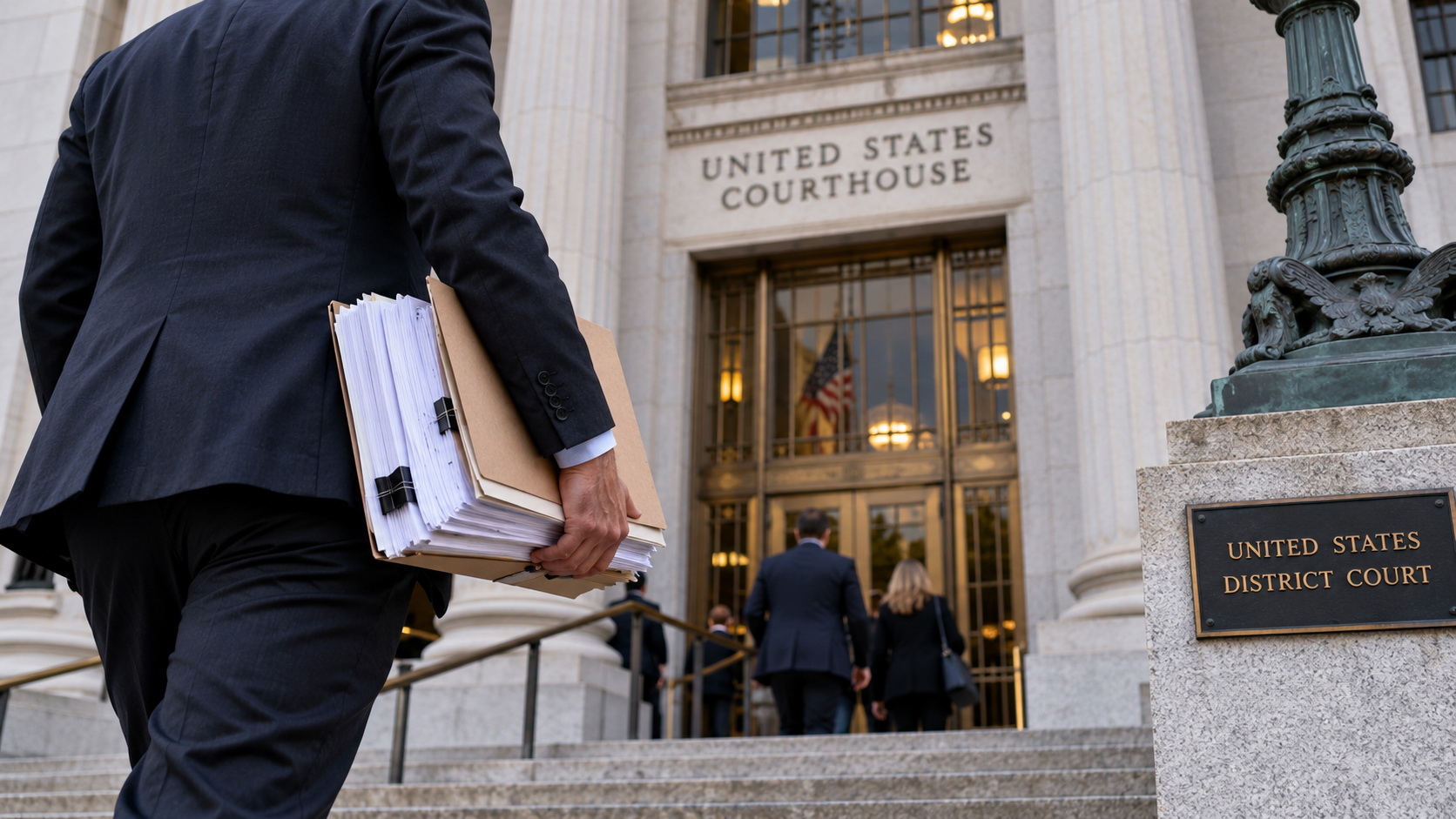
A federal judge has ordered the Justice Department to accelerate its processing of requests for Jeffrey Epstein and Ghislaine Maxwell investigative records that mention Donald Trump or Mar-a-Lago — including records concerning how senior officials handled references to the president inside the files.
The September 30 ruling by U.S. District Judge Colleen Kollar-Kotelly does not require the Justice Department to immediately release every document being sought.
But it does eliminate the ordinary processing track for some of the most politically sensitive Epstein-related records still being pursued through the Freedom of Information Act.
And the reason the judge gave is significant.
The court concluded that the records involve matters of “widespread and exceptional media interest” where there are possible questions about the government's integrity that affect public confidence.
At the center of the case are records that could answer two different questions:
What do the government's Epstein and Maxwell investigative files say about Donald Trump and Mar-a-Lago?
And:
How did senior officials inside Trump's own Justice Department handle those references?
Every Trump and Mar-a-Lago Reference
The case was brought by the Democracy Defenders Fund, which filed a series of Freedom of Information Act requests beginning in July 2025.
One request is remarkably broad.
It seeks records from the beginning of the Justice Department's investigations of Jeffrey Epstein and Ghislaine Maxwell through the time the request is processed.
Specifically, the group requested investigative records mentioning:
Donald J. Trump.
Donald Trump.
President Trump.
Variations of Trump's name.
Mar-a-Lago.
And any code name, pseudonym, code word or other cryptonym used to identify Trump or his Florida property.
The request covers both the Epstein and Maxwell investigative files.
Judge Kollar-Kotelly ruled that the entirety of that request is entitled to expedited processing.
But There's Another Request That May Be Even More Important
The second group of requests doesn't simply ask what the Epstein files contain.
It asks what Trump's Justice Department did with them.
Democracy Defenders Fund requested communications involving senior officials including then-Attorney General Pamela Bondi, Deputy Attorney General Todd Blanche, former senior DOJ official Emil Bove, FBI Director Kash Patel and former FBI Deputy Director Dan Bongino.
Those records potentially include emails, letters, text messages, direct messages, memos, briefing materials, meeting notes, presentations and other communications concerning Epstein and Maxwell.
But one category is particularly significant.
The group requested communications explaining how Justice Department officials were supposed to handle references to Donald Trump or Mar-a-Lago when those references appeared inside Epstein or Maxwell files.
That includes communications describing how Trump references should be:
Flagged.
Categorized.
Or memorialized.
The judge ordered most of those requests expedited as well.
Why Was the FBI Flagging Trump's Name?
That question became important because of allegations that surfaced in 2025.
Senator Richard Durbin said in July 2025 that Attorney General Pam Bondi had pressured approximately 1,000 FBI personnel working around the clock to review an estimated 100,000 Epstein-related records.
According to Durbin's allegation, agents were instructed to flag records in which Trump's name appeared.
The September 30 court opinion recounts that reporting as part of the record considered by the judge.
That does not mean the judge independently determined that Bondi ordered such a review or that anything improper occurred.
But the allegation was one of several circumstances the court considered when deciding whether the public-interest standard for expedited processing had been satisfied.
And that is precisely why the underlying DOJ communications could be important.
They could potentially show whether special instructions existed concerning Trump references — and, if so, what those instructions actually said.
The Court Pointed to a Crisis of Public Confidence
Kollar-Kotelly's decision repeatedly returns to one issue:
Public trust.
The court cited the extraordinary amount of national news coverage surrounding the Epstein files.
It also cited a 2025 Reuters/Ipsos poll in which 69% of Americans said they believed the federal government was hiding information concerning Epstein's clients.
The judge noted the apparent conflict highlighted in media coverage between Trump's promises before returning to the White House and his administration's later handling of the files.
During the 2024 campaign, Trump repeatedly indicated that he favored releasing Epstein-related material.
After taking office, his administration initially appeared to embrace that promise.
In February 2025, Bondi distributed binders labeled “The Epstein Files: Phase 1” to selected conservative influencers at the White House.
The release quickly became controversial when much of the material proved to have already been publicly available.
Bondi later said the FBI's New York office had withheld additional Epstein material and said a “truckload” of evidence was subsequently delivered to Washington.
Then came another reversal.
In July 2025, the FBI and Justice Department issued an unsigned memorandum saying their review had found no incriminating “client list,” no evidence that would justify investigating uncharged third parties and no basis for additional public disclosure.
The reaction was immediate.
And unusually bipartisan.
Trump's Relationship With Epstein Is Part of the Public Record
Donald Trump and Jeffrey Epstein moved in some of the same social circles during the 1980s and 1990s.
Photographs and video show them together.
Trump's name has appeared in previously released Epstein-related material.
Records released by the Justice Department have also documented Trump traveling aboard Epstein's aircraft multiple times during the 1990s.
None of that, by itself, establishes criminal wrongdoing.
Being mentioned in an investigative file, appearing in a photograph, attending the same social events or traveling aboard Epstein's aircraft does not establish participation in Epstein's crimes.
Trump has denied wrongdoing related to Epstein.
That distinction is especially important because the records being sought could contain everything from routine references and previously known information to material that provides additional context about their relationship.
The purpose of the FOIA requests is to find out what those government records actually contain.
The Court Did Not Order the Files Released Tomorrow
There is an important limitation to the ruling.
The court did not order the Justice Department to immediately dump every responsive Epstein document onto the internet.
It did not rule that every requested record must ultimately become public.
And it did not determine that Trump committed wrongdoing.
This is a Freedom of Information Act case about how quickly the government must process the requests.
FOIA contains numerous exemptions that can allow the government to withhold or redact information involving matters such as victim privacy, law-enforcement techniques, grand-jury secrecy and other legally protected material.
Those fights can still occur.
What changed September 30 is the government's ability to treat these requests like ordinary FOIA submissions moving through the normal queue.
The court said they deserve expedited treatment.
DOJ Tried to Narrow the Requests
The Justice Department did win part of the dispute.
Some of Democracy Defenders Fund's requests sought communications involving essentially any Justice Department official.
Kollar-Kotelly concluded that language was too broad.
She therefore limited those portions to specifically identified senior officials whose conduct had been the subject of the news reporting cited in the case.
Those officials include Bondi, Blanche, Bove, Patel and Bongino.
But the judge left the central Trump request intact.
The entire July 22 request seeking Epstein and Maxwell investigative records mentioning Trump or Mar-a-Lago qualifies for expedited processing.
Most of the July 28 requests concerning the government's handling of the Epstein files do as well.
One Question Is Now Moving Toward an Answer
For more than a year, the Epstein files controversy has revolved around competing claims.
Trump promised transparency.
His administration said it reviewed the files.
Officials said no incriminating client list existed.
Critics accused the administration of withholding information.
Administration officials rejected allegations of a cover-up.
Lawmakers demanded additional records.
More documents emerged.
More lawsuits followed.
Now a federal judge has cut through one part of that argument.
The court has not said that allegations against Trump are true.
It has not ruled that the Justice Department concealed incriminating information.
It has not ordered every Epstein file made public.
What it has said is that the public interest surrounding these records is exceptional enough — and the questions about government integrity significant enough — that the Justice Department must process key requests faster.
And those requests are unusually specific.
They aren't simply asking for more Epstein files.
They are asking for every responsive investigative record mentioning Donald Trump or Mar-a-Lago.
They are asking for communications among some of the highest-ranking officials in Trump's Justice Department.
And they are asking for records explaining how government employees were instructed to handle Trump's name when they encountered it inside the Epstein files.
For all the arguments surrounding the Epstein files, that last question may ultimately be one of the most important:
When Trump's own Justice Department found his name in the files, what were officials told to do with it?