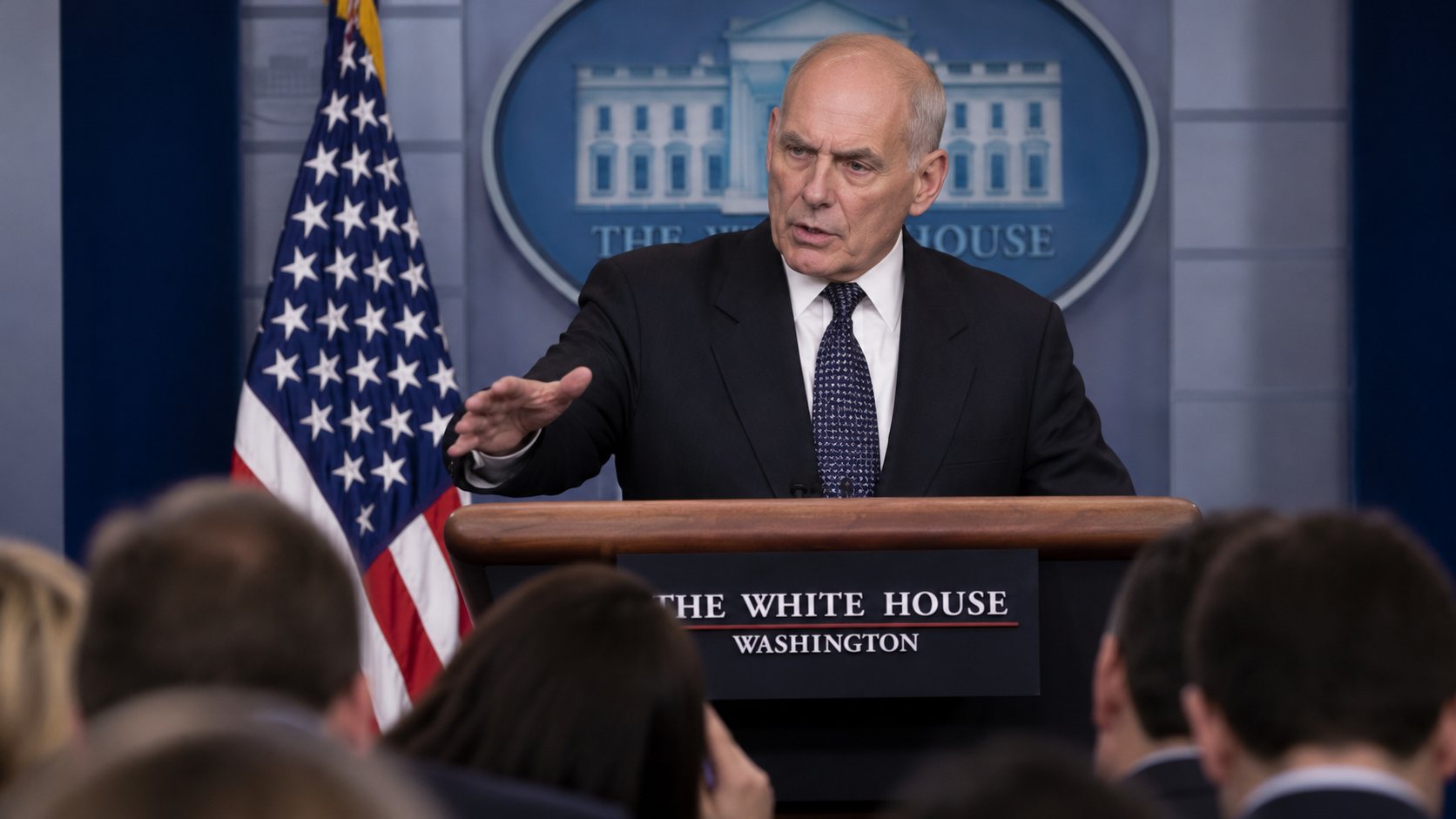
White House Chief of Staff John Kelly delivered an emotional defense of President Donald Trump on Thursday, publicly attacking Democratic Congresswoman Frederica Wilson after she criticized the president's condolence call to the widow of a U.S. soldier killed in Niger.
In an extraordinary appearance in the White House briefing room, Kelly, a retired four-star Marine general whose own son was killed in Afghanistan, accused Wilson of politicizing the death of Army Sgt. La David Johnson.
Kelly said he was stunned that the congresswoman had listened to the president's telephone conversation with Johnson's grieving widow, Myeshia Johnson, and subsequently described the exchange to reporters.
He then broadened his criticism, recounting an encounter with Wilson at a 2015 FBI building dedication in Florida and characterizing her as an attention-seeking politician.
Kelly described Wilson as an "empty barrel," using an expression suggesting that people with little substance make the most noise.
His remarks escalated a controversy that began with questions about Trump's treatment of military families and has now become a bitter confrontation involving the White House, a grieving widow, a member of Congress, and one of the nation's most senior retired military officers.
At the center of the dispute is a family mourning the loss of a 25-year-old American soldier.
The Phone Call That Started the Controversy
Sgt. La David Johnson was one of four American soldiers killed during an October 4 ambush in Niger, where U.S. forces were working with local partners on counterterrorism operations.
Johnson's death left behind his pregnant wife, Myeshia, and their two young children.
On Tuesday, President Trump telephoned the widow to express his condolences.
Wilson, a Florida Democrat who has known Johnson's family for years, was present in the vehicle carrying family members to receive his remains when the call occurred.
According to Wilson, Trump told the widow that her husband knew what he was signing up for when he joined the military, but that his death must still hurt.
Wilson said the remark was insensitive and inappropriate under the circumstances.
The congresswoman argued that a grieving military spouse needed compassion and reassurance rather than language that could sound as though her husband's death was an expected consequence of military service.
Trump disputed Wilson's account.
The president publicly accused her of misrepresenting the conversation and said he had evidence supporting his version of events.
As of Thursday, the White House has not publicly released a recording or transcript establishing precisely what was said during the call.
The dispute has consequently centered on competing accounts of the conversation and whether the president's intended message was received as comforting or hurtful.
Kelly Enters the White House Briefing Room
Kelly's appearance Thursday was unusual.
White House chiefs of staff rarely take the podium to address personal controversies involving the president.
But Kelly explained that he wanted Americans to understand what happens when a service member dies in combat and how the military communicates that loss to a family.
Speaking in a solemn tone, he described the process of recovering a fallen service member's remains, notifying relatives, and returning the deceased to the United States.
He emphasized the emotional toll on families and the military personnel responsible for carrying out those duties.
Kelly also discussed the difficulty of presidential condolence calls.
He said presidents must attempt to comfort families experiencing unimaginable grief, even though no words can undo the loss.
Kelly explained that Trump had asked him for advice before calling the families of the soldiers killed in Niger.
According to Kelly, he suggested language emphasizing that the fallen soldiers had volunteered for military service, understood the dangers involved, and died while serving alongside people they respected.
That explanation was significant because it provided context for the disputed language Wilson attributed to Trump.
Kelly did not establish that Wilson had invented the substance of the remark.
Instead, he defended the sentiment behind the words, arguing that such language could express respect for a soldier's courage and commitment.
Whether those words were appropriate for a particular grieving spouse remains a separate question.
A Father Who Lost His Own Son
Kelly's defense carried particular emotional weight because of his own family history.
His son, Marine First Lieutenant Robert Michael Kelly, was killed in Afghanistan in November 2010.
Robert Kelly died while serving with Marines in Helmand Province.
John Kelly was a senior Marine officer at the time.
His son's death made him a Gold Star father, a designation recognizing families who have lost loved ones during military service.
During Thursday's briefing, Kelly described the pain of losing a child and the difficulty of receiving condolences after such a loss.
He also addressed an earlier controversy involving Trump's suggestion that previous presidents had not always contacted the families of fallen service members.
Kelly explained that President Barack Obama had not called him following his son's death.
But he made clear that he had not expected such a call and did not regard Obama's decision as a personal slight.
The former general's remarks offered an unusually intimate account of military loss from someone who had experienced it both as a commander and as a father.
That experience deserves recognition.
It also explains why Kelly regards the treatment of fallen service members and their families as an intensely personal matter.
But the emotional authority of his experience does not automatically settle the factual dispute over Trump's call or justify every accusation made against Wilson.
Kelly Turns His Anger Toward Frederica Wilson
After explaining the military's traditions surrounding fallen service members, Kelly sharply criticized Wilson.
He said he was shocked that a member of Congress had listened to the president's condolence call and then discussed it publicly.
Kelly argued that the exchange should have remained private and described it as something deserving special respect.
He accused Wilson of turning a solemn moment into a political controversy.
But Wilson's relationship with Johnson's family complicates the suggestion that she was merely an outside politician inserting herself into a private tragedy.
The congresswoman has known Johnson since he was a child.
She founded the 5000 Role Models of Excellence Project, a mentoring initiative for young men in South Florida, and Johnson participated in the program.
Wilson has described him as someone she watched grow up.
Her presence with the family was therefore connected to a longstanding personal relationship, not simply her position in Congress.
Wilson has said she spoke publicly because she believed the president's words had hurt the widow.
Kelly, by contrast, maintained that the congresswoman should not have made the conversation public.
The disagreement raises a broader question: when a grieving family believes a public official has behaved insensitively, who has the authority to speak about that experience?
The president's position does not place his conduct beyond criticism.
At the same time, families should not be compelled to make private grief part of a public political dispute.
The central consideration should be the wishes and well-being of those who suffered the loss.
The 'Empty Barrel' Accusation
Kelly's criticism became more personal when he recalled attending the dedication of an FBI building in Florida in April 2015.
The facility was named in honor of FBI special agents Benjamin Grogan and Jerry Dove, who were killed during a 1986 shootout with bank robbers in Miami.
Kelly said he had attended the ceremony while still serving on active duty.
According to his account, Wilson used the occasion to boast about obtaining federal funding for the building and securing assistance from President Obama.
Kelly portrayed her remarks as inappropriate self-promotion during an event intended to honor fallen law enforcement officers.
He then invoked the expression about empty barrels making the most noise.
The accusation had little direct connection to Trump's condolence call.
Instead, it was an effort to challenge Wilson's character and credibility by citing an event more than two years earlier.
Wilson disputed Kelly's description Thursday.
She denied taking credit for securing the building's construction funding and said the money had been authorized before she entered Congress.
The congresswoman maintained that her role concerned legislation naming the facility in honor of the slain agents.
As of Thursday, Kelly's characterization and Wilson's response remain competing accounts requiring examination of the underlying record.
What is already clear is that the White House chief of staff chose to make a highly personal accusation against an elected official during a briefing ostensibly devoted to respecting military families.
The White House Continues Attacking Wilson
Kelly's appearance did not end the confrontation.
Trump has also publicly criticized Wilson, accusing her of misrepresenting his words to Johnson's widow.
The president's response has shifted national attention toward the congresswoman and away from the family whose loss prompted the original call.
Wilson, meanwhile, has defended her account and continued questioning the president's conduct.
The escalating dispute has produced an unusual spectacle.
A condolence call intended to comfort a military widow has become a confrontation involving the president, his chief of staff, and a member of Congress.
The competing accusations have dominated political coverage while important questions remain about the military operation in Niger that resulted in four American deaths.
Those questions include how the ambush occurred, what intelligence was available to the troops, and whether the mission had adequate support.
The Pentagon is investigating the attack.
The families of the fallen service members deserve answers about those circumstances, independent of the political controversy in Washington.
Four Americans Died in Niger
The soldiers killed in the October 4 attack were Staff Sgt. Bryan Black, Staff Sgt. Jeremiah Johnson, Staff Sgt. Dustin Wright, and Sgt. La David Johnson.
They were serving in Niger as part of an American mission supporting regional efforts against extremist organizations.
Their deaths have drawn renewed attention to the presence of U.S. forces in West Africa and the risks associated with counterterrorism operations that receive relatively little public attention.
The ambush also raises questions about congressional oversight of overseas military missions.
While the White House and Wilson argue over a telephone conversation, military investigators are still working to establish what happened on the ground.
The families of all four soldiers have suffered permanent losses.
Their service and deaths warrant serious attention.
A dispute over presidential language should not eclipse the circumstances in which they were killed.
Military Service Does Not Place Officials Beyond Scrutiny
Kelly's decades of Marine Corps service and his family's sacrifice are important parts of this story.
He has firsthand knowledge of combat, military command, and the grief experienced by Gold Star families.
His explanation of military traditions offered valuable insight into experiences many civilians rarely encounter.
But military service does not remove a government official's statements from public scrutiny.
Kelly is now serving as White House chief of staff, one of the most influential political positions in the executive branch.
When he uses the White House podium to accuse a member of Congress of dishonesty or self-promotion, those allegations can and should be examined.
Respect for military service and accountability for public statements are compatible principles.
Neither requires dismissing the other.
Likewise, Wilson's status as an elected official does not automatically establish that her account of Trump's telephone call is correct.
The competing claims must be assessed against the available evidence.
The question is not which participant deserves automatic deference because of a title, office, or personal history.
It is what can be established about the events being disputed.
The Widow Remains at the Center of the Story
Amid the escalating confrontation, the person most directly affected by the original call has received comparatively little attention in the political arguments.
Myeshia Johnson is mourning her husband while preparing for the birth of their third child.
She and her family must now endure their loss under intense national scrutiny.
The purpose of a presidential condolence call is to acknowledge that sacrifice and offer comfort.
It is not supposed to create another burden for a grieving family.
Trump maintains that he intended to honor Johnson's service.
Kelly says the president was expressing the respect due to a soldier who knowingly accepted the dangers of military duty.
Wilson says the language was hurtful.
Those positions are not necessarily incompatible in every respect: words can be intended as praise yet received as insensitive, especially in moments of profound grief.
That possibility deserves consideration rather than dismissal.
A Solemn Moment Becomes a Political Confrontation
Thursday's White House briefing began with Kelly describing the extraordinary sacrifices made by American service members and their families.
It ended with the chief of staff attacking a congresswoman's character.
The contrast illustrated how far the controversy has moved from its original purpose.
Kelly's personal experience made his account of military loss especially moving.
But his defense of Trump did not resolve the disagreement about the condolence call, and his separate accusations against Wilson introduced another factual dispute.
The White House could have focused on acknowledging the Johnson family's grief, explaining the president's intended message, and addressing questions about the Niger ambush.
Instead, the administration has continued its confrontation with the congresswoman who criticized the call.
The result is a controversy in which the public argument threatens to overwhelm the human tragedy at its center.
Four American soldiers are dead. Their families are grieving. And the nation's senior political officials are publicly arguing over who has the right to describe a widow's painful experience.
The sacrifice of Sgt. La David Johnson and his fellow soldiers deserves more than a prolonged exchange of personal accusations.
It deserves compassion for their families, an honest accounting of their deaths, and a government capable of distinguishing the solemn obligations of military service from the demands of political combat.