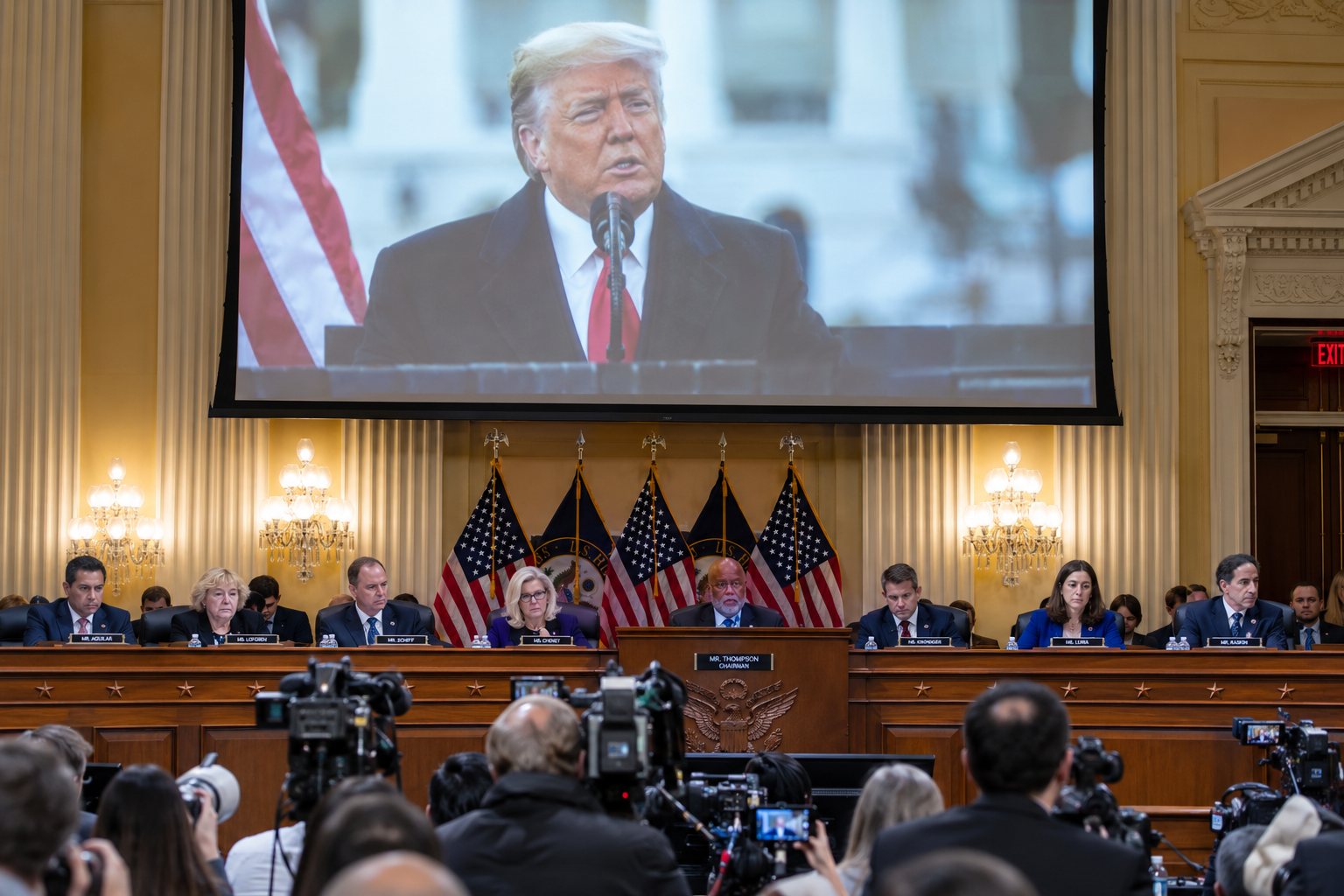
After months of public hearings examining the effort to overturn the 2020 presidential election and the attack on the U.S. Capitol, the House January 6 Committee took its most dramatic step yet: all nine members voted to subpoena former President Donald Trump for documents and sworn testimony. The committee argued that Trump wasn't a peripheral figure in the events it was investigating—he was at the center of them.**
For months, the House committee investigating January 6 had questioned Trump's aides, lawyers, campaign officials, administration officials and members of his inner circle.
On October 13, 2022, committee members decided they wanted to hear from the man himself.
Donald Trump.
At the conclusion of a lengthy public hearing, Republican Vice Chair Liz Cheney introduced a resolution directing Chairman Bennie Thompson to subpoena the former president.
The vote was unanimous.
Nine members. Nine votes in favor. Zero opposed.
The committee was demanding testimony under oath from a former president about an unprecedented effort to overturn an American presidential election.
“Our Duty Today Is to Our Country”
Chairman Bennie Thompson framed the decision as larger than partisan politics.
The committee, he said, needed to hear from Trump because he was the person whose conduct sat at the center of the investigation.
The subpoena would seek both documents and testimony.
Cheney made the committee's reasoning explicit.
The panel had interviewed more than 1,000 witnesses and collected enormous amounts of documents, emails, text messages and other evidence.
Many of the most damaging accounts hadn't come from Democrats.
They came from Republicans.
Trump administration officials.
White House lawyers.
Campaign officials.
Trump aides.
Members of Vice President Mike Pence's staff.
And people who had supported Trump.
The committee argued that those witnesses had collectively described a president repeatedly told that he had lost the election but who continued trying to remain in power.
Now investigators wanted Trump's answers under oath.
The Committee Reconstructed the Effort to Overturn the Election
The October 13 hearing essentially assembled the committee's previous hearings into a single narrative.
Trump had been told repeatedly that his claims of widespread election fraud weren't supported by evidence.
His own Justice Department rejected them.
Members of his campaign rejected many of them.
State officials rejected them.
Courts rejected challenges to the election results.
Nevertheless, Trump continued claiming the election had been stolen.
The committee reviewed efforts to pressure state officials, the attempt to organize alternate slates of electors and the campaign to pressure Vice President Mike Pence into refusing or delaying certification of electoral votes on January 6.
The committee also presented testimony indicating Trump had been told that Pence did not possess the legal authority Trump wanted him to exercise.
Yet Trump continued pressuring him.
New Evidence About an Armed Crowd
One of the most troubling portions of the October 13 hearing concerned what the government knew about the crowd gathering in Washington before January 6.
The committee presented newly obtained Secret Service communications showing the agency had received warnings about potential violence.
One December 24 intelligence alert carried the heading:
“Armed and Ready, Mr. President.”
Another warning involving the Proud Boys was even more alarming.
The Secret Service had received information indicating that individuals were discussing plans to kill people.
By January 5, officials were receiving information about extremist groups establishing “quick reaction forces.”
On the morning of January 6, agents were reporting people in the crowd with firearms and other weapons.
Secret Service personnel also noticed something unusual.
Thousands of people were remaining outside the secure area where Trump's Ellipse speech was taking place.
Why?
The committee presented communications suggesting agents suspected some attendees were avoiding the magnetometers—the security screening checkpoints—because they possessed items that couldn't pass through them.
Later evidence assembled by the committee documented firearms and numerous other weapons or prohibited items in and around the crowd.
Trump Knew People Were Armed
The committee had previously presented testimony from former White House aide Cassidy Hutchinson that Trump knew some members of the crowd were armed.
According to Hutchinson's testimony, Trump was angry that the security screening made the crowd inside the controlled rally area appear smaller.
She testified that Trump demanded that the magnetometers be removed.
His reasoning, according to her account:
The armed people weren't there to hurt him.
The October hearing returned to that evidence.
Trump subsequently addressed the crowd and urged supporters to march toward the Capitol.
The committee argued that this sequence was critical.
The president had information that some people in the crowd were armed.
He knew thousands were remaining outside the security checkpoints.
And he still encouraged his supporters to head toward Congress while lawmakers were certifying Joe Biden's victory.
Trump Wanted to Go to the Capitol
The committee also revisited evidence that Trump himself wanted to accompany his supporters to Capitol Hill.
Secret Service communications presented during the hearing showed officials remained concerned that Trump might insist on being taken there even as the situation deteriorated.
Other testimony had described Trump as angry when his security detail refused to take him to the Capitol.
Instead, Trump returned to the White House.
Then the Capitol was breached.
Congress Was Under Attack
The committee showed previously unseen footage of congressional leaders being evacuated as rioters overwhelmed police and entered the building.
The footage showed Speaker Nancy Pelosi, Senate Democratic Leader Chuck Schumer and other congressional leaders desperately attempting to obtain additional security assistance.
They called officials.
They discussed the National Guard.
They spoke with governors.
They worked on plans to secure the Capitol and resume the certification of the election.
Vice President Pence also remained engaged in the effort to restart the constitutional process.
The contrast was central to the committee's presentation.
While congressional leaders were trying to restore order and continue certification, Trump remained at the White House.
The committee had previously documented that Trump spent much of the afternoon watching television as the attack unfolded.
For hours, he did not publicly tell the rioters to leave the Capitol.
Pence Was in Danger
The stakes were not theoretical.
Vice President Mike Pence was inside the Capitol.
Some members of the mob chanted:
“Hang Mike Pence.”
A gallows had been erected outside the Capitol.
Pence and his security detail were evacuated from the Senate chamber as rioters entered the building.
Yet Trump continued attacking Pence publicly during the crisis.
At 2:24 p.m., Trump tweeted that Pence “didn't have the courage to do what should have been done.”
The committee argued that Trump knew Pence was in danger when he continued criticizing him.
Trump Didn't Call Off the Attack for Hours
The committee had devoted an earlier hearing to Trump's actions during the 187 minutes between the end of his Ellipse speech and the video he eventually released telling supporters to go home.
During that period, advisers, family members and Republican lawmakers urged Trump to publicly intervene.
He could have gone to the White House briefing room.
He could have addressed the nation.
He could have immediately told supporters to leave the Capitol.
Instead, the committee found that he remained in the White House dining room watching television for much of the attack.
Trump eventually released a video telling rioters to go home.
Even then, he repeated the false claim that the election had been stolen.
The Committee Wanted Trump Under Oath
By October 13, investigators had heard from nearly everyone surrounding the president.
They had testimony about what Trump said.
They had testimony about what Trump was told.
They had testimony about what advisers urged him to do.
They had emails.
They had text messages.
They had phone records.
They had Secret Service communications.
They had White House records.
What they didn't have was Donald Trump's sworn testimony.
The committee wanted to ask him directly.
What did he know?
When did he know it?
Why did he continue claiming the election had been stolen after advisers told him otherwise?
Why did he pressure Pence?
Why did he want to go to the Capitol?
Why did he wait so long to tell his supporters to leave?
And what was his role in the broader effort to prevent the peaceful transfer of presidential power?
Trump Fought the Subpoena
Trump did not ultimately testify.
The committee formally issued its subpoena later in October, demanding documents and testimony.
Trump sued to block it.
Time was running out.
Republicans had won control of the House in the November midterm elections, meaning the committee would cease operating when the new Congress convened in January.
In late December, Chairman Thompson formally withdrew the subpoena.
The committee explained that because its investigation was ending, it could no longer pursue Trump's testimony.
Trump had successfully avoided appearing before the panel.
But the Investigation Didn't End There
Before shutting down, the January 6 Committee released its final report.
It concluded that Trump had engaged in a multi-part effort to overturn the legitimate results of the 2020 presidential election and prevent the peaceful transfer of power.
The committee also made criminal referrals to the Justice Department concerning Trump.
Those referrals were recommendations.
Congress does not decide whether someone is criminally prosecuted.
That decision belongs to the Justice Department.
But the October 13 vote carried enormous historical significance regardless of what happened afterward.
Nine Votes to Demand Answers
January 6 wasn't simply a riot that unexpectedly erupted outside Congress.
The committee's investigation examined a much broader sequence of events:
False claims that the election had been stolen.
Pressure on state officials.
Efforts involving alternate electors.
Pressure on the Justice Department.
Pressure on Vice President Pence.
Plans surrounding January 6.
Advance warnings of violence.
An armed crowd.
The attack on Congress.
And Trump's conduct while the Capitol was under siege.
After examining that evidence for more than a year, the committee reached October 13, 2022 with one person left at the center of the story whom it wanted to question.
Donald Trump.
Liz Cheney made the motion.
The clerk called the roll.
Every Democrat voted yes.
Both Republicans on the committee voted yes.
9–0.
For the first time in the investigation, the January 6 Committee formally demanded that the former president himself answer questions under oath.