Deep inside the State Department is an office most Americans have probably never heard of.
Its name is the Office of Remigration.
Its mission is now coming into public view.
Leaked government documents obtained by The Washington Post describe an expanding network through which the Trump administration has negotiated agreements with foreign governments to accept people deported from the United States—including people who have no connection to the countries receiving them.
At least $410 million has reportedly been committed to the effort.
More than 30 countries have participated in agreements or negotiations.
And according to current and former officials interviewed by the Post, one of the driving forces behind the operation is White House Deputy Chief of Staff Stephen Miller.
Deportation to a Country You've Never Called Home
Ordinarily, when Americans think about deportation, they imagine someone being returned to the country where that person is a citizen.
The system being constructed by the Trump administration can work differently.
When the government cannot return someone to their country of origin, officials have increasingly sought agreements allowing the United States to deport that person somewhere else.
These are known as third-country deportations.
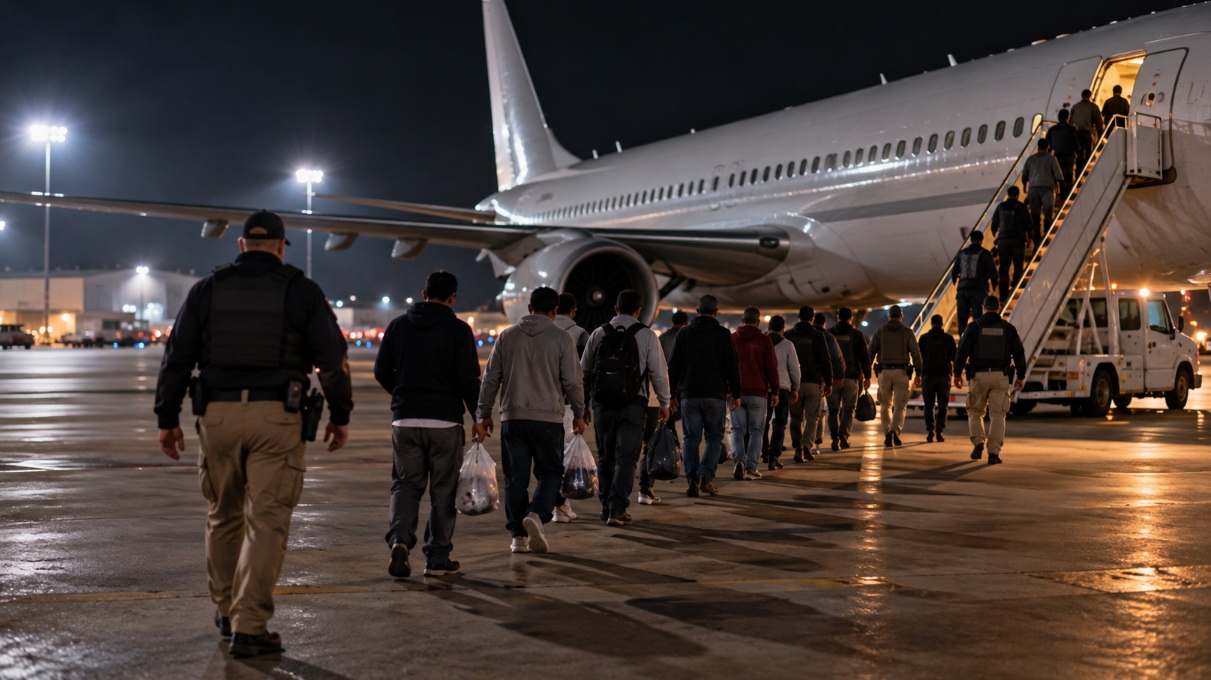
The Post documented migrants being transported to countries with which they had no previous connection.
Migrants from China, Russia, Iran and Afghanistan were flown to Costa Rica.
Migrants from Vietnam, Laos, Cuba and Jamaica were sent to Eswatini, a small country in southern Africa.
The administration says these arrangements provide another mechanism for removing people who otherwise cannot readily be deported.
Critics see something far more troubling: a global system in which the United States can effectively pay governments to accept people who aren't their citizens.
More Than $400 Million
The scale of the operation is striking.
According to the leaked documents reviewed by the Post, the administration has authorized or pledged at least $410 million in connection with its third-country deportation network.
Some of the governments involved have themselves been criticized by the U.S. government for human-rights abuses.
The arrangements also raise questions about what happens after someone arrives.
Where will that person live?
Can they legally work?
Can they be detained?
Can the receiving country deport them somewhere else?
And what protections exist if returning them to another country would put them in danger?
Those aren't theoretical questions.
They are precisely the kinds of concerns now being fought over in federal court.
The Courts Are Already Pushing Back
On September 18, a federal appeals court rejected a Trump administration policy allowing migrants to be rapidly deported to third countries without sufficient opportunity to argue that they could face persecution, torture or other dangers there.
The First U.S. Circuit Court of Appeals largely upheld an earlier ruling finding that migrants must receive meaningful notice and an opportunity to raise safety concerns before being sent somewhere else.
More than 25,000 migrants have reportedly already been affected by third-country removals.
The litigation may ultimately reach the Supreme Court.
That means one of the administration's most aggressive immigration strategies is simultaneously expanding internationally and facing serious legal challenges at home.
Why Call It “Remigration”?
Then there is the name.
“Remigration” isn't a neutral bureaucratic term invented by the State Department.
It has been used for years by far-right political movements in Europe advocating large-scale removal of immigrants and, in some versions, citizens of immigrant backgrounds.
Trump and Miller began publicly using the terminology during the 2024 campaign.
According to reporting about the Office of Remigration, career officials inside the government questioned the terminology.
The answer from leadership was reportedly straightforward.
The name wasn't changing.
The office was placed inside the State Department's Bureau of Population, Refugees, and Migration—an organization historically associated with helping refugees and displaced people.
Now some of that government infrastructure is being used to help negotiate agreements for deportations.
For former officials who spent careers working on refugee protection, the transformation has been jarring.
Stephen Miller's Influence
Miller's influence over Trump's immigration policy is hardly new.
He was one of the principal architects of the administration's immigration agenda during Trump's first presidency and returned to the White House with substantially greater authority in the second.
According to the Post's reporting, Miller has pushed State Department personnel and appointments toward one overriding objective:
Increase deportations.
That effort now extends far beyond ICE officers making arrests inside the United States.
It involves diplomats.
Foreign governments.
Hundreds of millions of dollars.
State Department personnel.
International agreements.
And an office specifically dedicated to expanding the government's ability to remove people.
What This Does—and Doesn't—Mean for Green-Card Holders
The aggressive nature of the administration's immigration campaign has understandably created anxiety far beyond the undocumented population.
That includes families with lawful permanent residents.
A green card, however, remains lawful permanent resident status.
The government cannot simply declare every green-card holder deportable because it has created an Office of Remigration.
Permanent residents can face removal under circumstances established in immigration law, including certain criminal convictions, immigration fraud and other statutory grounds.
They also generally have rights in immigration proceedings, including the ability to challenge the government's case.
Those distinctions matter.
But so does the larger environment.
For families containing immigrants—even immigrants legally residing in the United States—the expansion of detention, deportation and increasingly aggressive immigration enforcement can make what once seemed like abstract political rhetoric suddenly feel personal.
A Government Infrastructure Built Around Removal
The significance of the Office of Remigration isn't simply its unusual name.
It's what the office represents.
The Trump administration isn't treating mass deportation merely as an enforcement campaign.
It is building an infrastructure around it.
Diplomats negotiate agreements.
Government agencies coordinate removals.
Foreign governments receive American money.
New offices are created.
Flights carry deportees thousands of miles.
And when someone's home country cannot—or will not—take them back, the administration is attempting to create another destination.
The leaked documents provide an unusually detailed look inside that system.
They also raise a much larger question.
America has always had immigration enforcement.
But when the government creates an office specifically devoted to “remigration,” commits hundreds of millions of dollars to agreements with foreign governments, and constructs an international network capable of sending people to countries where they have never lived, immigration enforcement has become something considerably larger.
It has become an institution of its own.