President Donald Trump returned to office promising lower prices, cheaper energy and an economic boom.
Instead, the Federal Reserve is once again confronting an uncomfortable problem:
Inflation remains too high.
Consumer prices were 3.4 percent higher in August than a year earlier, according to the Bureau of Labor Statistics. The Federal Reserve's preferred inflation measure, the Personal Consumption Expenditures Price Index, was running at 3.7 percent in the latest available annual reading.
Both remain well above the Federal Reserve's long-term 2 percent inflation target.
More troubling may be what is happening further up the economic pipeline.
Producer prices—the prices businesses pay before products and services reach consumers—were 5.4 percent higher in August than a year earlier.
That raises the possibility that businesses still facing higher costs will continue passing at least some of those increases on to their customers.
The result is a difficult economic problem for the Trump administration and an even more difficult one for the Federal Reserve.
The Tariff Bill Doesn't Stop at the Border
Trump has made tariffs one of the foundations of his economic agenda.
The president has repeatedly described tariffs as money paid to the United States by foreign countries.
That's not how tariffs actually work.
A tariff is collected by the U.S. government from the American importer bringing a foreign product into the country.
What happens next varies.
Sometimes the importer absorbs the additional expense.
Sometimes the foreign supplier reduces its price.
Sometimes an American business absorbs part of the cost by accepting a smaller profit margin.
And sometimes the cost gets passed along to the consumer.
The economic question isn't whether tariffs can raise prices.
It's how much of the cost ultimately reaches American consumers, and how quickly.
That process can take time.
Businesses may initially sell products imported before a tariff took effect. Companies may temporarily absorb additional costs rather than immediately raising prices. Existing contracts may delay increases.
Eventually, however, inventories turn over and contracts expire.
That is one reason economists watch producer prices closely.
Businesses Are Paying More
The August Producer Price Index provides an important warning sign.
Final-demand producer prices increased 0.4 percent during the month and 5.4 percent over the previous 12 months.
Prices for final-demand goods jumped 1.1 percent in August alone.
Energy played a major role.
Diesel fuel prices increased sharply, while gasoline and other energy products also contributed to the increase.
That matters far beyond the gas station.
Diesel powers trucks.
Trucks transport food, clothing, building materials, consumer products and industrial supplies across the country.
Higher transportation expenses can eventually work their way into the price of almost everything those trucks carry.
This Isn't All About Trump
Blaming every increase in inflation on the president would be misleading.
Energy prices have been a major factor in 2026.
The Consumer Price Index shows energy prices were 16.3 percent higher in August than a year earlier.
Gasoline was up 27.4 percent.
Fuel oil was up 52 percent.
Those increases have been influenced by geopolitical instability and disruptions in global energy markets, including the Iran war.
Artificial-intelligence investment has also created extraordinary demand for computer chips, servers, electricity, data-center construction and other resources.
Housing costs remain another source of inflation.
Trump's policies therefore aren't the only reason inflation remains elevated.
But tariffs can add another layer of price pressure at precisely the moment the Federal Reserve is trying to bring inflation back down.
The Federal Reserve's Problem
The Federal Reserve has a relatively straightforward tool for fighting inflation.
It can raise interest rates.
Higher rates make borrowing more expensive.
Mortgages become more expensive.
Auto loans become more expensive.
Credit-card debt becomes more expensive.
Businesses face higher financing costs.
Eventually, consumers and companies spend less money.
Lower demand can help slow price increases.
The problem is that the same medicine used to fight inflation can also weaken the economy.
Raise rates too little and inflation may remain elevated.
Raise them too aggressively and the Fed risks slowing economic growth, damaging the labor market and putting pressure on financial markets.
That's the trap policymakers now face.
Wall Street Has Another Problem
The stock market has performed extraordinarily well during Trump's second term.
Through September 22, according to figures cited by The Motley Fool, the Dow Jones Industrial Average had gained approximately 19 percent since Trump returned to office, while the S&P 500 had risen about 29 percent and the Nasdaq Composite roughly 39 percent.
But persistent inflation threatens one of the assumptions supporting high stock valuations: that borrowing costs will eventually become cheaper.
Higher interest rates make bonds and other interest-bearing investments more attractive compared with stocks.
They also increase borrowing costs for corporations.
And high-growth companies—particularly technology companies whose valuations depend heavily on expectations of future profits—can be especially sensitive to higher interest rates.
That doesn't mean inflation guarantees a stock-market crash.
Markets are influenced by corporate earnings, economic growth, investor sentiment, technological developments and countless other factors.
But persistent inflation removes one potential tailwind.
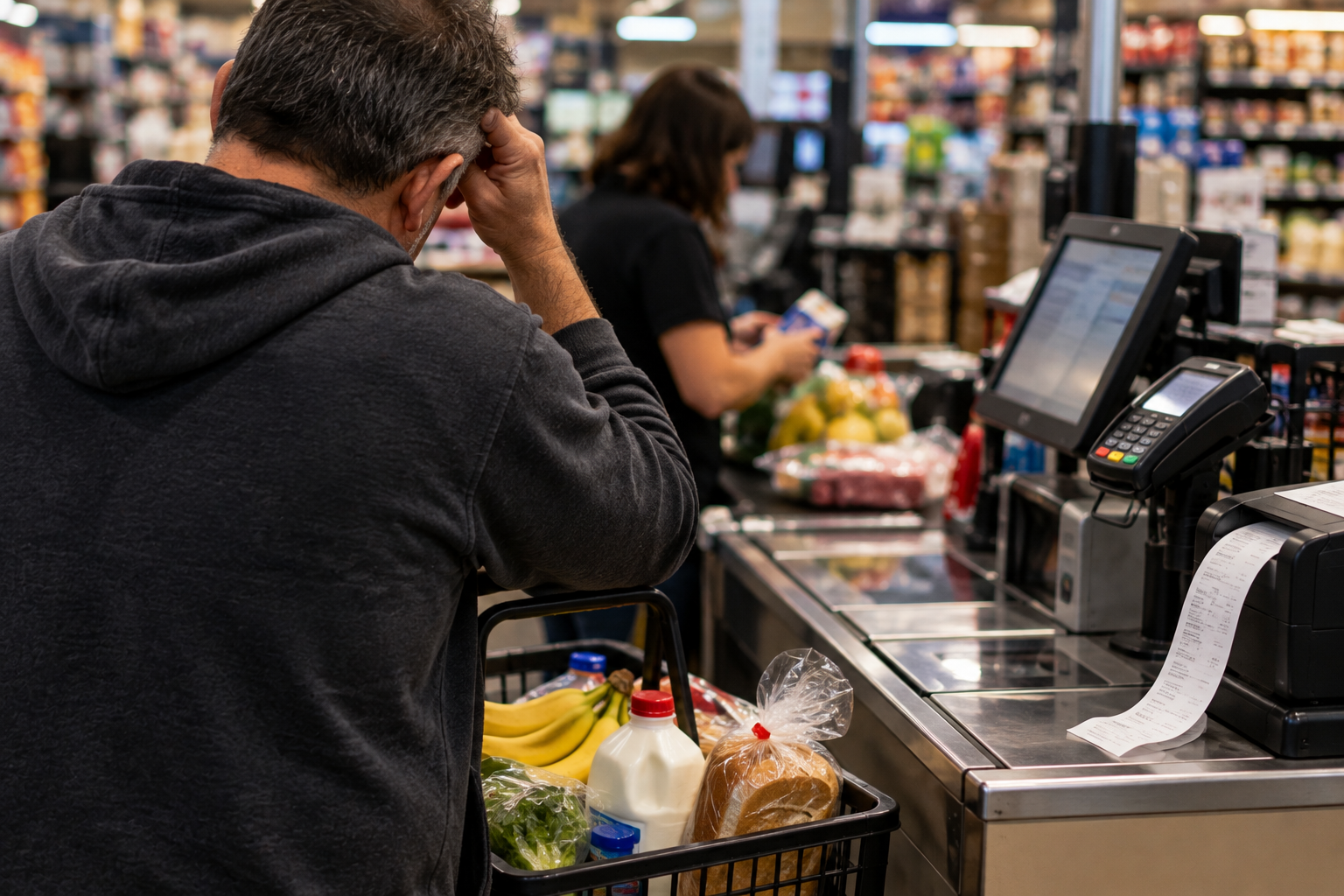
The Grocery Store Test
For most Americans, however, the Dow Jones Industrial Average isn't the inflation measurement that matters.
The grocery receipt is.
The electric bill is.
The restaurant check is.
The monthly rent or mortgage payment is.
And the gasoline pump is.
Food prices were 2.7 percent higher in August than a year earlier.
Food purchased at restaurants was up 3.4 percent.
Shelter costs were up 3 percent.
Those percentages may sound modest compared with the enormous price increases Americans experienced earlier in the decade.
But inflation compounds.
A 3 percent increase doesn't mean prices returned to where they were before the previous increases.
It means already-higher prices became higher again.
Trump Promised Lower Prices
That creates a political problem for an administration that repeatedly promised Americans relief from the cost of living.
Presidents don't control every price in the economy.
Joe Biden didn't.
Donald Trump doesn't.
Global energy markets, wars, weather, housing shortages, supply chains, wages, consumer demand and Federal Reserve policy all influence inflation.
But presidents do control policies that can affect prices.
Tariffs are one of them.
When the government deliberately makes imported goods more expensive, businesses somewhere in the supply chain must absorb that additional cost.
The administration's argument is that the long-term benefits—more domestic manufacturing, increased tariff revenue and reduced dependence on foreign suppliers—justify those costs.
Critics argue American households and businesses are paying for that experiment through higher prices.
The Next Phase
The most concerning possibility isn't simply that inflation remains above the Federal Reserve's target.
It's that several different inflationary forces are operating at the same time.
Tariffs are increasing costs for some imported products.
Energy prices remain elevated.
Producer prices are rising.
Housing remains expensive.
Massive investment in artificial intelligence is creating intense demand for technology and electricity.
Any one of those problems might be manageable.
Together, they make the Federal Reserve's job considerably harder.
Trump has repeatedly argued that his economic agenda will ultimately produce lower prices and greater prosperity.
The coming months will provide an increasingly important test of that claim.
Because Americans don't experience inflation as a government statistic.
They experience it every time they open their wallets.