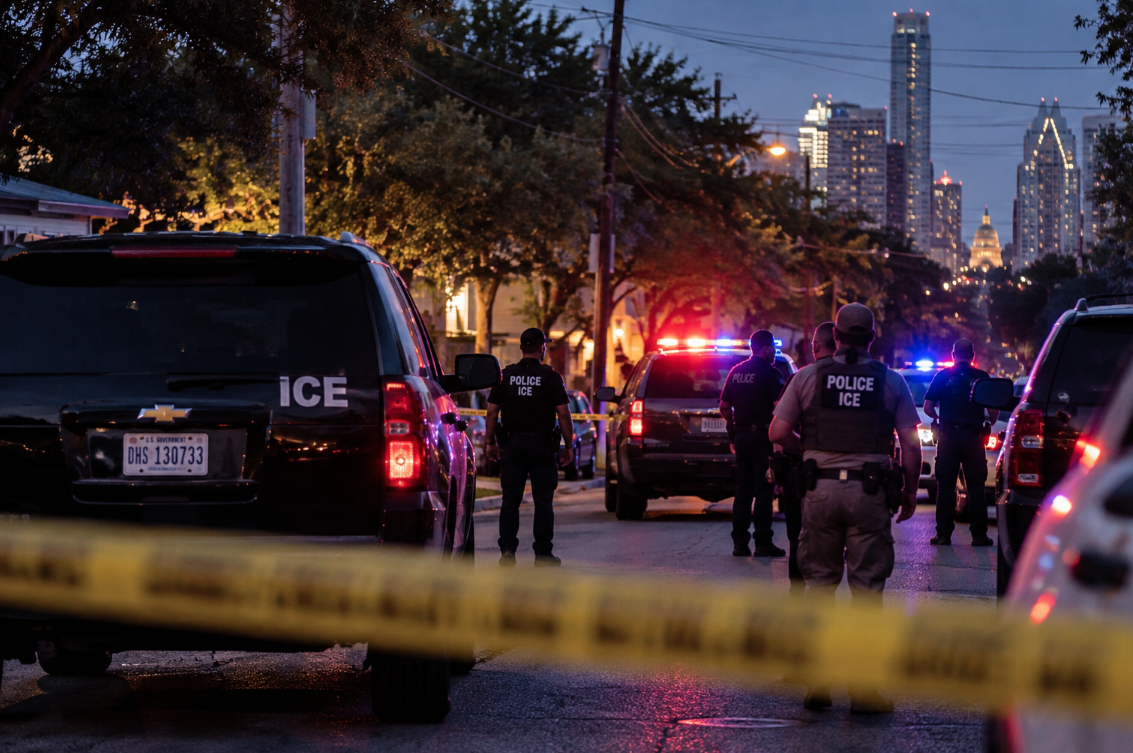
Another person has been shot during an Immigration and Customs Enforcement operation.
This time it happened in Austin, Texas.
An ICE officer shot 28-year-old Wilber Rafael Garces Perez during an immigration enforcement operation Sunday afternoon in North Austin, leaving him with a gunshot wound to the torso.
He was taken to a hospital in serious but stable condition.
Hours later, according to his attorney, his wife learned that he had been released from the hospital into ICE custody.
Exactly what happened before the officer opened fire remains unclear.
And that uncertainty is becoming an increasingly familiar part of shootings involving federal immigration officers.
What Happened in Austin?
The shooting occurred shortly before 1 p.m. following a traffic stop in North Austin.
Austin Police Chief Lisa Davis said preliminary information indicated there may have been a brief foot pursuit.
Austin police were not involved in either the immigration operation or the shooting.
The Texas Department of Public Safety said ICE requested assistance with a vehicle pursuit at approximately 12:50 p.m., but state troopers did not arrive until after the shooting had already occurred.
Garces Perez was shot once in the torso.
His attorney identified him as a 28-year-old Venezuelan man.
His precise immigration status remained unclear Sunday night. His attorney has said he entered the United States legally, while federal law-enforcement sources have provided a different account.
Those discrepancies are among the many questions investigators will now have to resolve.
Austin Officials Want an Independent Investigation
Austin Mayor Kirk Watson has made clear that he does not want ICE investigating itself without outside scrutiny.
Watson called for Austin police and other state and local authorities to participate in the investigation.
The Travis County District Attorney's Office similarly requested access to evidence and asked that local authorities be included.
The reason is straightforward.
An armed federal officer shot someone in an American city.
Local officials want to know exactly why.
They want access to the evidence.
And they want investigators outside ICE involved in determining whether the shooting was justified.
This Isn't the First ICE Shooting
The Austin shooting comes after a series of shootings involving federal immigration enforcement officers during the Trump administration's expanded immigration crackdown.
By July, the Associated Press reported that ICE had used deadly force at least nine times since the crackdown began.
Some of those encounters ended with people dead.
Others left people wounded.
And several produced serious disputes between the government's initial description of events and evidence that subsequently became public.
Houston — Lorenzo Salgado Araujo
In July, an ICE officer shot and killed 52-year-old Lorenzo Salgado Araujo in Houston.
Salgado Araujo, a Mexican national who had lived in the United States for decades, was driving a construction crew to a job site when federal agents in unmarked vehicles pursued him.
His family said he had no criminal convictions and was working toward obtaining legal status.
The Department of Homeland Security said Salgado Araujo ignored officers' commands and attempted to ram an officer with his vehicle.
The officer fired, striking him in the abdomen.
He later died at a hospital.
His family challenged the government's description and demanded an independent investigation.
Federal officials had not initially released video or photographic evidence supporting their account of the shooting.
Hundreds of people subsequently marched through Houston's Magnolia Park neighborhood protesting his death.
Maine — A 25-Year-Old Colombian Man Is Killed
Days after the Houston shooting, another ICE operation ended with another driver dead.
An ICE officer shot and killed a 25-year-old Colombian man in Biddeford, Maine.
Federal officials said the officer fired because he feared for public safety.
But questions quickly emerged.
The man reportedly was not the person ICE had originally been targeting.
The officers involved were not wearing body cameras.
Photographs showed bullet holes in the windshield of the man's vehicle, but without body-camera footage there were immediate questions about the officer's location, what commands had been given and exactly what threat existed when the shots were fired.
The shooting was significant enough that ICE subsequently suspended most immigration-related vehicle stops, with exceptions for certain circumstances.
Minneapolis — Renee Good
Perhaps the most controversial immigration-enforcement shooting of the year occurred January 7 in Minneapolis.
ICE officer Jonathan Ross shot and killed 37-year-old Renee Good, a U.S. citizen, while she was sitting behind the wheel of her vehicle.
The Department of Homeland Security initially said Ross fired defensive shots after Good attempted to run him over.
But videos of the encounter raised questions about that description.
The footage became central to a national dispute over whether the officer had faced an immediate deadly threat when he opened fire.
Good's death triggered protests and intensified scrutiny of the rapidly expanding federal immigration operation taking place in Minneapolis.
Minneapolis — Alex Pretti
Just 17 days later, another U.S. citizen was killed by federal immigration officers in Minneapolis.
Alex Pretti, a 37-year-old intensive-care nurse at the Minneapolis VA Medical Center, was shot and killed by Border Patrol officers on January 24.
Administration officials initially said Pretti had approached officers with a handgun and violently resisted efforts to disarm him.
Bystander videos provided a more complicated picture.
Pretti was legally carrying a handgun, but video showed that he did not brandish it during the confrontation.
Instead, he appeared to be holding a cellphone when officers tackled him.
An officer then discovered his firearm.
Seconds later, officers opened fire.
Pretti was shot multiple times and died.
His killing intensified an already enormous controversy surrounding federal immigration enforcement in Minnesota.
Another Minneapolis Shooting Is Now a Criminal Case
One shooting has gone even further.
ICE officer Christian Castro is now facing both state and federal criminal proceedings stemming from the January 14 shooting of 24-year-old Julio Cesar Sosa-Celis in Minneapolis.
Prosecutors say Castro fired through the front door of a residence and shot Sosa-Celis in the leg.
Castro later told investigators that he had been attacked with a broom handle and snow shovel before firing.
Federal prosecutors now accuse him of lying about what happened.
He has pleaded not guilty.
The case is particularly significant because it represents the first Justice Department prosecution of a federal officer for actions taken during this year's massive Minneapolis immigration enforcement operation.
A Pattern of Questions After the Gunfire
These shootings did not all occur under identical circumstances.
Each encounter needs to be evaluated on its own evidence.
Federal immigration officers can encounter dangerous situations, and officers are legally permitted to use deadly force when they reasonably believe someone presents an immediate threat of death or serious bodily injury.
But the growing number of shootings has created another issue.
Trust.
In several cases, federal authorities issued confident descriptions of shootings almost immediately.
Later, videos, witnesses or other evidence raised questions about those initial accounts.
That history is one reason Austin officials are demanding outside participation in the investigation of Sunday's shooting.
They don't simply want ICE's version of what happened.
They want the evidence.
ICE Has Expanded Dramatically
All of this is happening as the Trump administration dramatically expands immigration enforcement.
ICE recorded more than 50,000 arrests per month in both July and August, the first time the agency had reached that level.
The administration argues that aggressive enforcement is necessary to carry out immigration law and fulfill Trump's campaign promise to conduct mass deportations.
The rapid expansion has also generated questions about recruitment, training, supervision and the tactics being used by officers operating in American communities.
Those questions become considerably more serious when encounters end with gunfire.
Now Austin Wants Answers
The most important question about Sunday's shooting remains unanswered:
Why did the ICE officer shoot Wilber Rafael Garces Perez?
There may ultimately be evidence showing that the officer faced an immediate threat.
There may be evidence pointing in another direction.
At this point, the public does not know.
That is precisely why Austin officials are demanding an investigation that includes authorities outside ICE.
A man was shot in the torso.
His family says it struggled to obtain information about where he was.
Federal officials had provided little public explanation immediately after the shooting.
And this happened against the backdrop of multiple other immigration-enforcement shootings across the country.
Austin does not need speculation.
It needs evidence.
Body-camera footage, if it exists, should be preserved and reviewed. Surveillance and cellphone video should be collected. Witnesses should be interviewed. The officer's account should be compared against the physical evidence.
And investigators should determine exactly what happened before an ICE officer pulled the trigger on an Austin street.
Because after Houston, Maine and Minneapolis, Sunday's shooting is no longer simply another isolated encounter.
It is another test of whether the federal government's rapidly expanding immigration enforcement operation can provide the transparency and accountability that the public has a right to expect when its officers use deadly force.