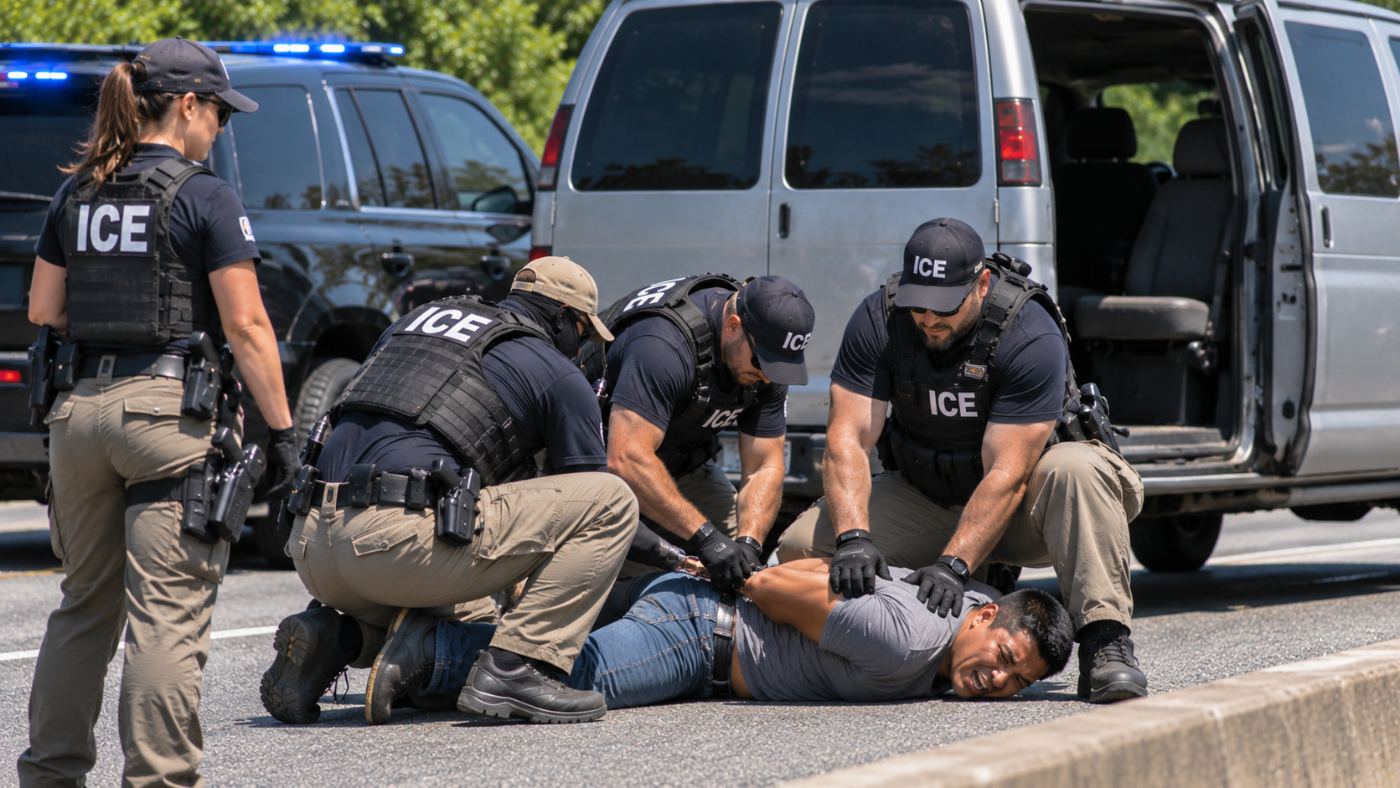
A new federal lawsuit accuses Immigration and Customs Enforcement agents of carrying out violent, warrantless arrests across Virginia, including an incident in which officers allegedly smashed vehicle windows, sprayed occupants with chemical irritants, and broke a man's collarbone.
The lawsuit, filed November 16 in federal court, alleges that ICE has adopted an unlawful approach to immigration enforcement under President Donald Trump, detaining people without first establishing the legal justification required for warrantless arrests.
The allegations include excessive force, racial profiling, and the detention of an American citizen.
A Violent Encounter on a Virginia Highway
On June 27, 24-year-old Jose Rosito Roca Estrada was traveling to work with friends when an unmarked vehicle allegedly stopped abruptly in front of their van, causing a collision.
According to the lawsuit, several additional vehicles surrounded the van, and approximately 10 to 12 federal officers emerged.
The men inside were ordered to exit while traffic continued moving nearby.
When they hesitated, agents allegedly smashed the rear windows and sprayed chemical irritants into the vehicle.
Roca Estrada says officers dragged him from the van and violently forced him to the ground, fracturing his collarbone and injuring his lung.
He told The Intercept that the officers initially failed to identify themselves, leaving him afraid he was being kidnapped.
DHS disputes the allegations of excessive force, denies that officers broke his collarbone, and maintains that agents properly identified themselves.
An American Citizen Detained
The lawsuit also describes the detention of Britney Ramirez Corona, an 18-year-old American citizen from Norfolk.
According to the complaint, immigration agents detained her following a traffic stop despite her citizenship.
She was reportedly held for hours before a family member produced her birth certificate.
Her experience raises questions about the safeguards intended to prevent American citizens from being swept into immigration enforcement operations.
What Federal Law Actually Requires
Federal law does not give ICE unlimited authority to arrest people without warrants.
Under federal immigration law, officers generally must establish probable cause that someone is unlawfully present and is likely to escape before a warrant can be obtained.
The lawsuit alleges that agents have repeatedly ignored the second requirement.
Attorneys describe the administration's enforcement strategy as an approach in which officers make arrests first and investigate legal justification afterward.
The complaint also alleges that pressure to meet aggressive immigration arrest targets has encouraged these practices.
According to figures cited in the lawsuit, ICE arrests in Virginia and Washington, D.C., increased to approximately 970 per month in 2025, nearly five times the previous year's monthly average.
DHS Rejects the Accusations
The Department of Homeland Security denies that its agents routinely engage in unlawful or abusive conduct.
Responding to The Intercept, a department spokesperson defended the officers' actions and said they followed their training to obtain compliance.
The department also disputed claims that agents failed to identify themselves.
These allegations have not yet been established by a court.
A Growing Legal Challenge
The Virginia lawsuit joins similar legal challenges in other states questioning the Trump administration's immigration enforcement practices.
Earlier this month, a federal judge in Oregon found that ICE officers had continued making warrantless arrests in violation of a court order and had failed to properly document those arrests.
The Virginia plaintiffs are asking a federal judge to require immigration officers to comply with existing legal restrictions before making arrests.
The case presents a fundamental question about federal law enforcement: whether aggressive immigration enforcement can be conducted without disregarding the legal protections that apply to everyone in the United States.
For the people describing broken bones, frightening encounters, and detention without adequate justification, the consequences are already deeply personal.