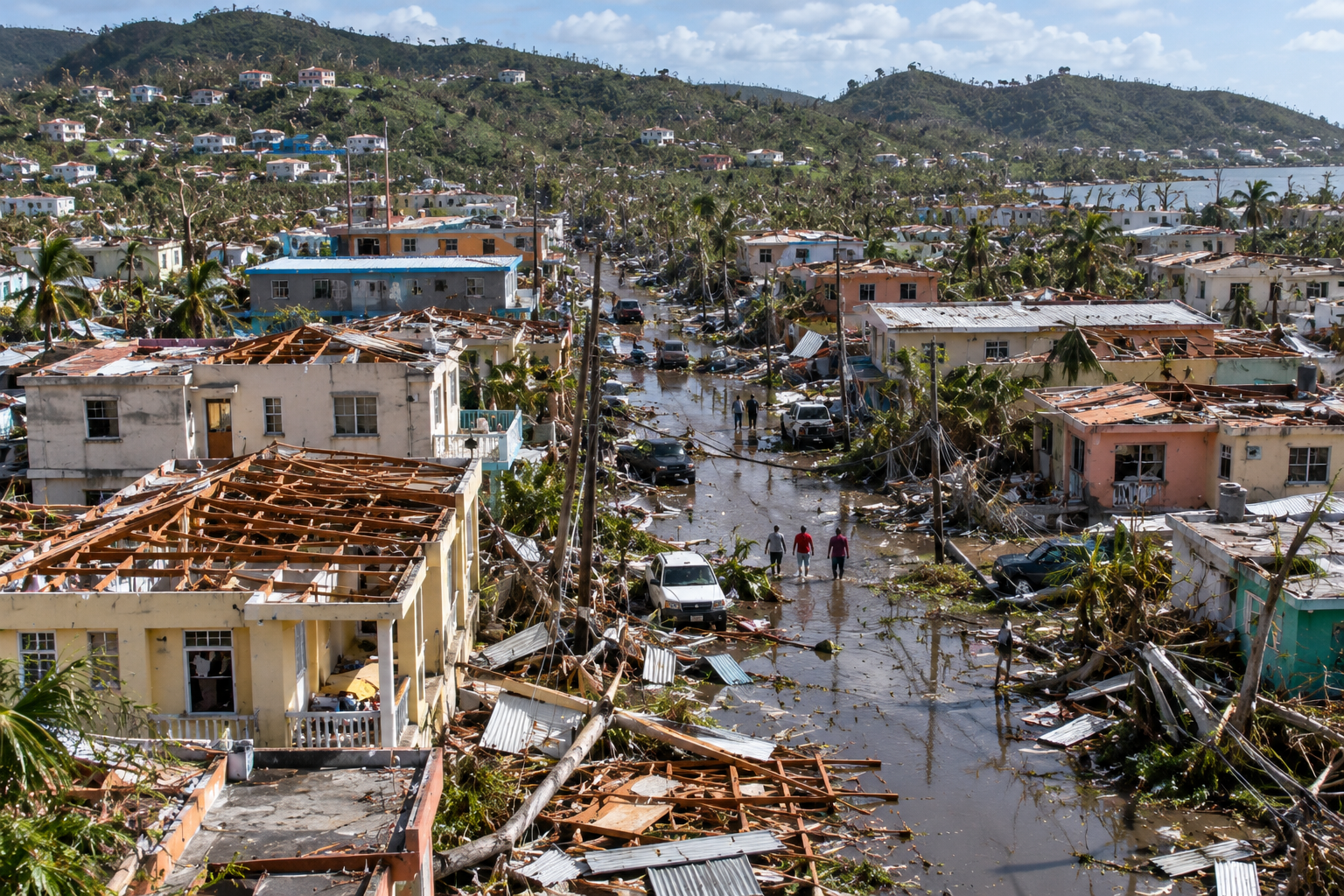
Before sunrise on September 20, one of the most powerful hurricanes ever to strike Puerto Rico was bearing down on the island.
Hurricane Maria had intensified explosively while crossing the Caribbean, reaching Category 5 strength before weakening slightly as it approached Puerto Rico.
At approximately 6:15 a.m. local time, the center of Maria crossed the southeastern coast near Yabucoa.
Maximum sustained winds were approximately 155 mph — just below Category 5 strength.
Then Maria began cutting diagonally across Puerto Rico.
By the time the hurricane emerged from the island's northwestern coast hours later, Puerto Rico had been devastated.
Homes were destroyed.
Communications collapsed.
Roads and bridges became impassable.
Communities were flooded or isolated.
And Puerto Rico's already fragile electrical system suffered catastrophic damage, eventually leaving essentially the entire island without electricity.
For the roughly 3.4 million Americans living in Puerto Rico, the hurricane itself was only the beginning.
Maria Comes Ashore
Puerto Rico knew Maria was coming.
But knowing a hurricane was approaching could do little to prepare the island for the extraordinary power of the storm.
Shortly before landfall, the National Hurricane Center described Maria as an “extremely dangerous” Category 4 hurricane.
The storm had maximum sustained winds near 155 mph as its center approached the southeastern coast.
Maria came ashore near Yabucoa and moved northwest across Puerto Rico's mountainous interior.
The hurricane's path meant that enormous portions of the island experienced destructive winds while torrential rain produced flash flooding and landslides.
Maria weakened while crossing Puerto Rico, but not before inflicting catastrophic damage.
The Electrical Grid Collapses
Among Maria's most consequential effects was the destruction of Puerto Rico's electrical system.
The island's power grid had already been vulnerable before Maria arrived.
Hurricane Irma had passed near Puerto Rico less than two weeks earlier, knocking out electricity to a large portion of the island.
Maria delivered a far more destructive blow.
Transmission lines fell.
Utility poles snapped.
Generating and distribution infrastructure was damaged.
Eventually, virtually the entire island was without electrical service.
This wasn't simply a matter of people sitting in dark homes.
Electricity powered hospitals.
It powered water pumps.
It powered refrigeration.
It powered communications systems, businesses and medical equipment.
Without a functioning electrical grid, nearly every aspect of Puerto Rico's recovery became more difficult.
Restoring that grid would eventually become one of the largest and most complicated challenges following the disaster.
Communications Disappear
Maria also crippled Puerto Rico's communications network.
Cell towers were damaged or destroyed. Telephone and internet service disappeared across much of the island.
Radio and television stations struggled to remain operational.
Families could not reach relatives.
Government officials had difficulty communicating with municipalities.
Emergency responders had difficulty determining what was happening in isolated communities.
For people outside Puerto Rico, the communications blackout created another frightening problem.
They knew the island had been hit by an enormous hurricane.
But many couldn't find out whether their families had survived it.
Flooding Cuts Off Communities
The wind was only part of the disaster.
Maria produced extraordinary rainfall across Puerto Rico.
Rivers rose rapidly, communities flooded and roads washed away. Bridges were damaged or destroyed.
In some areas, residents climbed onto rooftops while floodwaters surrounded their homes.
Mountainous communities became particularly difficult to reach as debris, landslides and destroyed roads blocked access.
The hurricane was moving away.
The emergency was not.
An Island Already in Crisis
Maria also struck Puerto Rico at an exceptionally difficult moment.
The territory was already struggling through a severe financial crisis and had entered a form of bankruptcy months earlier under federal oversight.
Its electrical utility was deeply in debt.
Parts of its infrastructure had suffered from years of deferred maintenance.
Then came Maria.
The hurricane transformed existing infrastructure problems into an enormous humanitarian and logistical emergency.
Puerto Rico would need food.
Water.
Fuel.
Medical supplies.
Generators.
Communications equipment.
Heavy machinery.
Electrical equipment.
And thousands of people capable of distributing those resources across an island where roads, power and communications had all been severely damaged.
The Scale Wasn't Yet Clear
On September 20, nobody yet understood the full human cost of Hurricane Maria.
Initial official death counts would prove to be a severe underestimate.
Determining deaths associated with the hurricane was particularly difficult because many people did not die directly from wind or flooding.
Some died in the weeks and months afterward as prolonged power outages, transportation problems and disruptions to medical care compounded the disaster.
Puerto Rico eventually revised its official estimate to 2,975 excess deaths associated with the period following Hurricane Maria.
That number would become one of the most consequential and controversial measures of the disaster's human toll.
But on September 20, those arguments were still in the future.
Puerto Rico was simply trying to determine what remained.
The Hurricane Was Over. The Crisis Was Beginning.
By the evening of September 20, Maria's center had moved away from Puerto Rico.
The rain continued.
Floodwaters continued rising in places.
Much of the island remained unreachable.
The electrical grid was devastated.
Communications were crippled.
Hospitals and emergency services faced enormous challenges.
And millions of American citizens were beginning what would become an extraordinarily long recovery.
The political controversy surrounding Hurricane Maria would come later.
Questions would soon emerge about federal preparations, the speed and scale of the response, the distribution of food and water, restoration of electricity and the relationship between President Trump and Puerto Rican officials.
Trump himself would eventually travel to the island.
His October 3 visit — including the unforgettable images of the president tossing rolls of paper towels into a crowd — would become one of the defining visual moments of the federal response.
But that story had not happened yet.
On September 20, 2017, there was only the destruction.
Hurricane Maria had crossed Puerto Rico and left an American territory facing one of the worst disasters in its modern history.
The storm had passed.
Puerto Rico's crisis was just beginning.