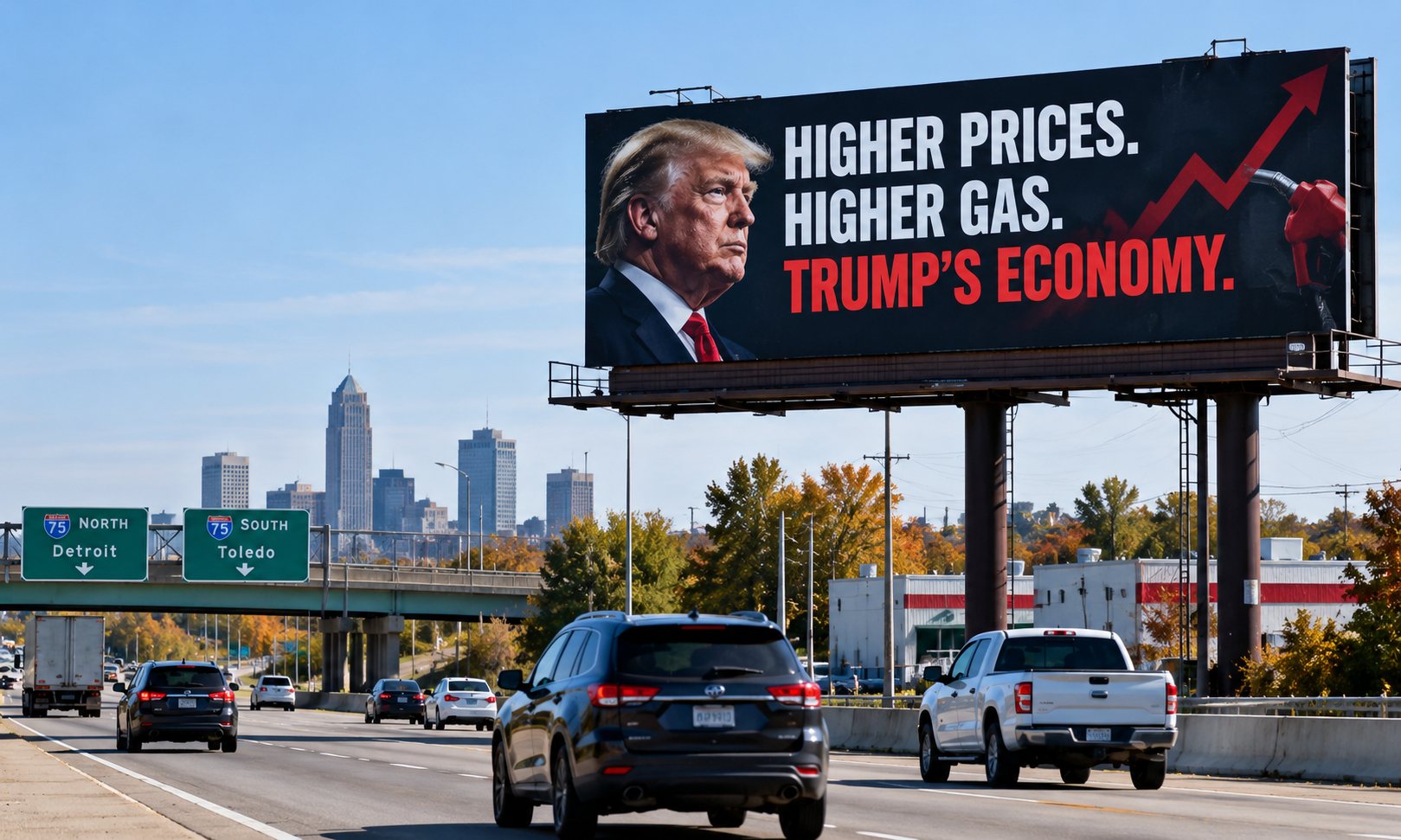
President Donald Trump's handling of the economy is becoming the focus of a multimillion-dollar billboard campaign across the American heartland, as political organizers seek to connect rising household expenses, tariffs, and gasoline prices directly to his administration's policies.
The campaign, organized by the political advocacy group Home of the Brave and supported by former Republican strategist Sarah Longwell, is expanding across Michigan, Ohio, and Iowa just weeks before the November 3 midterm elections.
According to reporting by Semafor, the organization is adding another $1 million in billboard advertising to an existing $1.25 million effort, bringing the total number of billboards in those three states to more than 350.
The advertisements focus on a subject that has become increasingly difficult for the White House to escape: the cost of everyday life.
Taking the Economic Argument to America's Highways
The billboards confront motorists with messages about grocery prices, gasoline costs, and tariffs imposed under Trump's administration.
Rather than relying exclusively on television commercials or social media advertisements, organizers are placing their messages along highways and heavily traveled roads where commuters encounter them during their daily routines.
The strategy is designed to connect national economic policies with household expenses.
Grocery bills, fuel costs, and the prices of imported goods are central themes.
The campaign also links gasoline prices to the ongoing war with Iran, an international conflict that has contributed to volatility in global energy markets.
For motorists already paying more at the pump, the advertisements seek to make that connection visible.
A Former Republican Helps Lead the Campaign
One of the notable figures behind the effort is Sarah Longwell, a longtime Republican strategist who became a prominent critic of Trump.
Longwell serves on Home of the Brave's advisory board and has argued that economic dissatisfaction presents an opportunity for opponents of the administration.
The organization has made clear that its political objective is to help change control of Congress in November.
The billboard campaign is therefore more than a general protest against economic conditions. It is a coordinated effort to influence the national debate in competitive congressional states.
Its emphasis on Michigan, Ohio, and Iowa reflects the importance of Midwestern voters in determining the balance of power in Washington.
Trump's Economic Promises Face Scrutiny
Trump returned to the White House promising economic improvement, lower costs, and renewed American prosperity.
His administration has promoted tariffs as a way to protect domestic industries, encourage manufacturing investment, and reduce dependence on foreign producers.
The White House has also defended its tax policies as measures intended to stimulate economic growth and benefit American workers.
But those policies have faced criticism from economists, businesses, and consumers concerned about their effect on prices.
Tariffs can increase costs for American importers, which may pass some of those expenses on to consumers.
Meanwhile, the war with Iran has placed additional pressure on energy markets, complicating Trump's promises to make fuel more affordable.
The Los Angeles Times reported in September that trade disputes, elevated consumer prices, and rising gasoline costs were creating political difficulties for Republicans approaching the midterms.
The administration argues that its economic agenda will deliver longer-term benefits, but the immediate financial pressures facing households remain a major source of public dissatisfaction.
Polling Shows Frustration With Washington
The advertising expansion comes amid growing evidence of public dissatisfaction with the country's direction.
An Associated Press-NORC poll released October 15 found widespread frustration with Trump's performance and a strong desire for change in Washington.
Economic conditions, the cost of living, and the war with Iran were among the issues contributing to negative assessments of the administration.
Only about one-third of respondents viewed Trump favorably, while many expressed dissatisfaction with the country's political leadership more broadly.
The findings also showed that skepticism extends beyond the president. Democrats face unfavorable perceptions of their own, indicating that public frustration does not automatically translate into support for the opposition party.
For Home of the Brave, the billboard campaign represents an effort to turn economic concerns into a more direct political message.
Republicans Face Difficult Questions About Affordability
Republican candidates are entering the final weeks of the campaign confronting questions about prices and the administration's economic record.
Some continue to emphasize Trump's tax reductions, manufacturing initiatives, and immigration policies.
Others face the challenge of explaining how those policies have affected consumers in their districts.
The economic debate is particularly significant in industrial and agricultural states where tariffs, international trade, transportation costs, and energy prices can directly affect businesses and employment.
The billboard campaign attempts to bring those issues into a single argument about presidential responsibility.
At the same time, Republicans maintain that their policies are intended to strengthen domestic production and create more favorable economic conditions over time.
Whether voters accept that argument or the criticism advanced by Home of the Brave remains an open question.
A Multimillion-Dollar Battle Over Trump's Economic Record
The expansion is part of a broader effort by political organizations to shape public perceptions of the economy before Election Day.
With more than 350 billboards planned across Michigan, Ohio, and Iowa, Home of the Brave is investing heavily in messages designed to be encountered repeatedly by drivers.
The approach reflects a familiar political calculation: voters may hear competing claims about economic growth and government policy, but they also experience the economy through their own bills and purchases.
For Trump, the campaign represents another challenge to his administration's economic messaging.
For his critics, it offers a way to highlight the gap they perceive between the president's promises and the financial pressures Americans continue to experience.
The billboards cannot establish which policies are responsible for every price increase, and their ultimate electoral effect remains uncertain.
What they demonstrate is that Trump's economic record has become a central subject of the closing weeks of the 2026 midterm campaign.
Across the heartland, the political argument is now appearing not just in campaign speeches and television advertisements, but alongside the highways Americans travel every day.