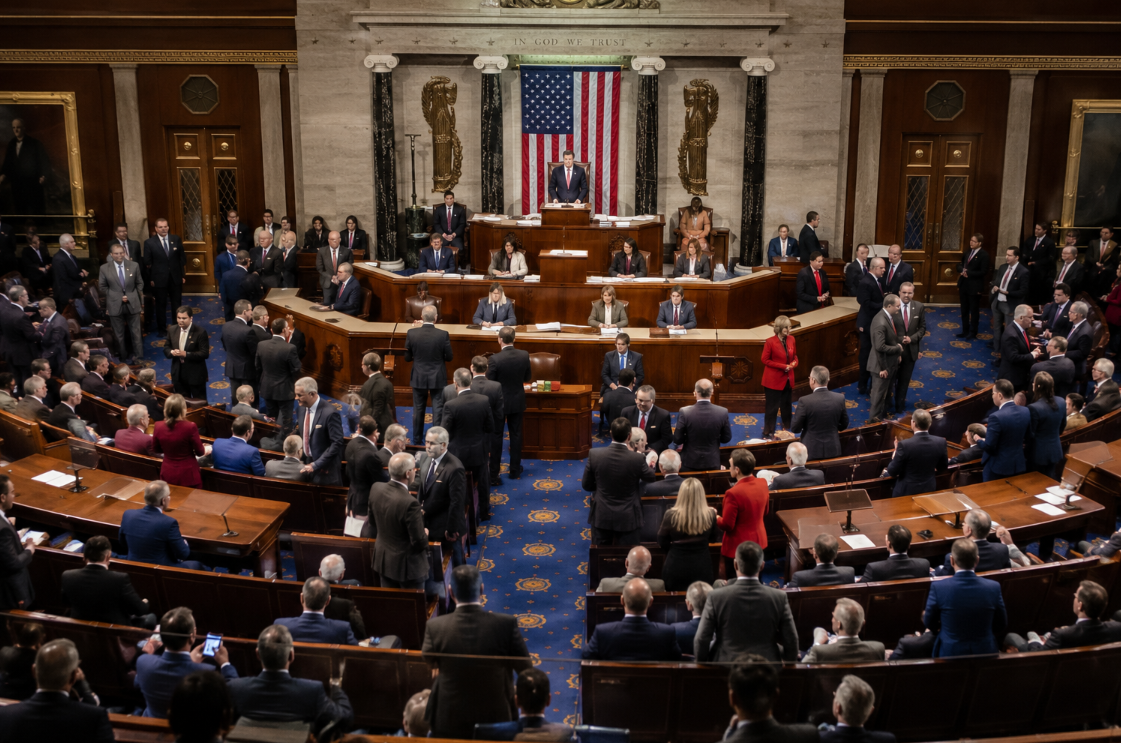
For the third time, the United States House of Representatives has voted to tell President Donald Trump to end American military involvement in the war with Iran.
And this time, more Republicans joined the effort.
On September 15, the House approved a War Powers resolution directing the president to remove U.S. armed forces from hostilities with Iran.
The vote was 220-204.
All 213 Democrats who voted supported the resolution.
They were joined by seven Republicans, the largest Republican defection yet on a House vote challenging Trump's authority to continue the conflict.
The vote does not immediately end the war. But nearly seven months after the conflict began, it represents another attempt by Congress to assert its constitutional authority over American military action.
Seven Republicans Break With Trump
The seven Republicans voting with Democrats were:
Tom Barrett of Michigan
Warren Davidson of Ohio
Brian Fitzpatrick of Pennsylvania
Thomas Massie of Kentucky
Zach Nunn of Iowa
Mariannette Miller-Meeks of Iowa
Nancy Mace of South Carolina
The number is significant because Republican opposition to the war has grown.
Four Republicans supported previous House efforts to halt the conflict. That number increased to seven in the latest vote.
The overwhelming majority of House Republicans still backed Trump's position, with 203 Republicans voting against the resolution.
Supporters of the administration argue that Iran continues to pose a serious threat to the United States and its interests and that the president needs sufficient military authority to respond.
Opponents argue that a conflict lasting this long requires explicit authorization from Congress.
This Wasn't the First Vote
Congress has repeatedly attempted to limit Trump's ability to continue military operations against Iran without congressional authorization.
The House passed an Iran War Powers resolution in June.
It passed another in July.
Now it has passed a third.
The margins have gradually shifted.
On June 3, the House approved an Iran resolution 215-208.
On July 23, another passed 214-208.
The latest measure passed 220-204.
The repeated votes reflect a larger constitutional dispute that has followed American presidents of both parties for decades: how much authority does a president have to conduct sustained military operations without Congress formally authorizing them?
The Constitution Gives Congress War Powers
The Constitution divides military authority between the executive and legislative branches.
The president serves as commander in chief of the armed forces.
But Congress possesses the power to declare war, fund military operations and establish rules governing the armed forces.
After the Vietnam War, Congress enacted the War Powers Resolution of 1973 in an effort to place clearer limits on prolonged military action initiated by presidents without congressional authorization.
The law generally requires presidents to notify Congress when U.S. forces are introduced into hostilities and establishes time limits for military involvement without congressional approval.
The latest House resolution invokes that law.
Its instruction is straightforward: remove U.S. armed forces from hostilities with Iran.
A War That Was Supposed to Be Short
Trump launched the military campaign against Iran on February 28.
Nearly seven months later, American forces remain involved.
The conflict has included repeated missile attacks and military operations across the region.
It has also affected something Americans experience much closer to home: energy prices.
Disruptions surrounding the Strait of Hormuz have contributed to higher oil prices, pushing up gasoline and transportation costs.
Those increases can spread throughout the economy because nearly everything Americans purchase must be manufactured, transported or delivered using energy.
The economic consequences have therefore become increasingly intertwined with the political debate over the war.
The Price Tag Is Growing
The financial cost is also becoming substantial.
The Congressional Budget Office estimated this week that the Iran war had cost the Pentagon more than $38 billion through August 1.
The CBO projected that continued military operations could cost another $2 billion to $3 billion every month, depending on the intensity of the fighting.
The agency also estimated that disruptions associated with the conflict could leave inflation approximately half a percentage point higher than previously expected heading into 2027.
That connects the Iran war directly with another problem confronting the Trump administration: the cost of living.
Americans are already dealing with elevated energy costs, expensive housing and persistent inflation.
A prolonged Middle Eastern conflict adds another source of economic uncertainty.
Republicans Defend the War
Republicans supporting Trump reject the argument that the United States should simply withdraw.
House Foreign Affairs Committee Chairman Brian Mast has argued that Iran remains a continuing threat and that American military operations are necessary to confront that threat.
House Speaker Mike Johnson has said the conflict is moving into a new phase as American allies take on greater responsibility in the region.
Supporters of the administration also argue that restricting the president's military authority while hostilities continue could undermine U.S. forces and American national-security interests.
Those arguments continue to command the support of most congressional Republicans.
But not all of them.
And the number willing to vote against the administration has increased.
The Senate Is Next
The House vote by itself does not end American military involvement in Iran.
For Congress to send a measure to Trump, the Senate must also act.
The Senate has agreed to consider an earlier House-passed Iran War Powers resolution no later than October 2.
That will put senators on record over whether the president should continue military operations without additional congressional authorization.
Even if both chambers approve a measure, Trump could veto it.
Overriding a presidential veto would require a two-thirds majority in both chambers — a threshold substantially higher than the support demonstrated by the latest House vote.
So American military operations are not ending simply because of Tuesday's vote.
But politically and constitutionally, the vote matters.
Congress Keeps Asking the Same Question
The Iran conflict has now lasted long enough for the House to vote repeatedly on whether it should continue without explicit congressional authorization.
The answer from a majority of representatives has now been the same three times.
Stop.
The White House disagrees.
Most congressional Republicans disagree.
But the coalition challenging the war is no longer composed exclusively of Democrats.
Seven Republicans have now joined them.
The House vote therefore does not end Trump's Iran war.
But it sends an increasingly difficult message for the administration to ignore:
For the third time, a majority of the House of Representatives has voted to bring U.S. involvement in the conflict to an end.