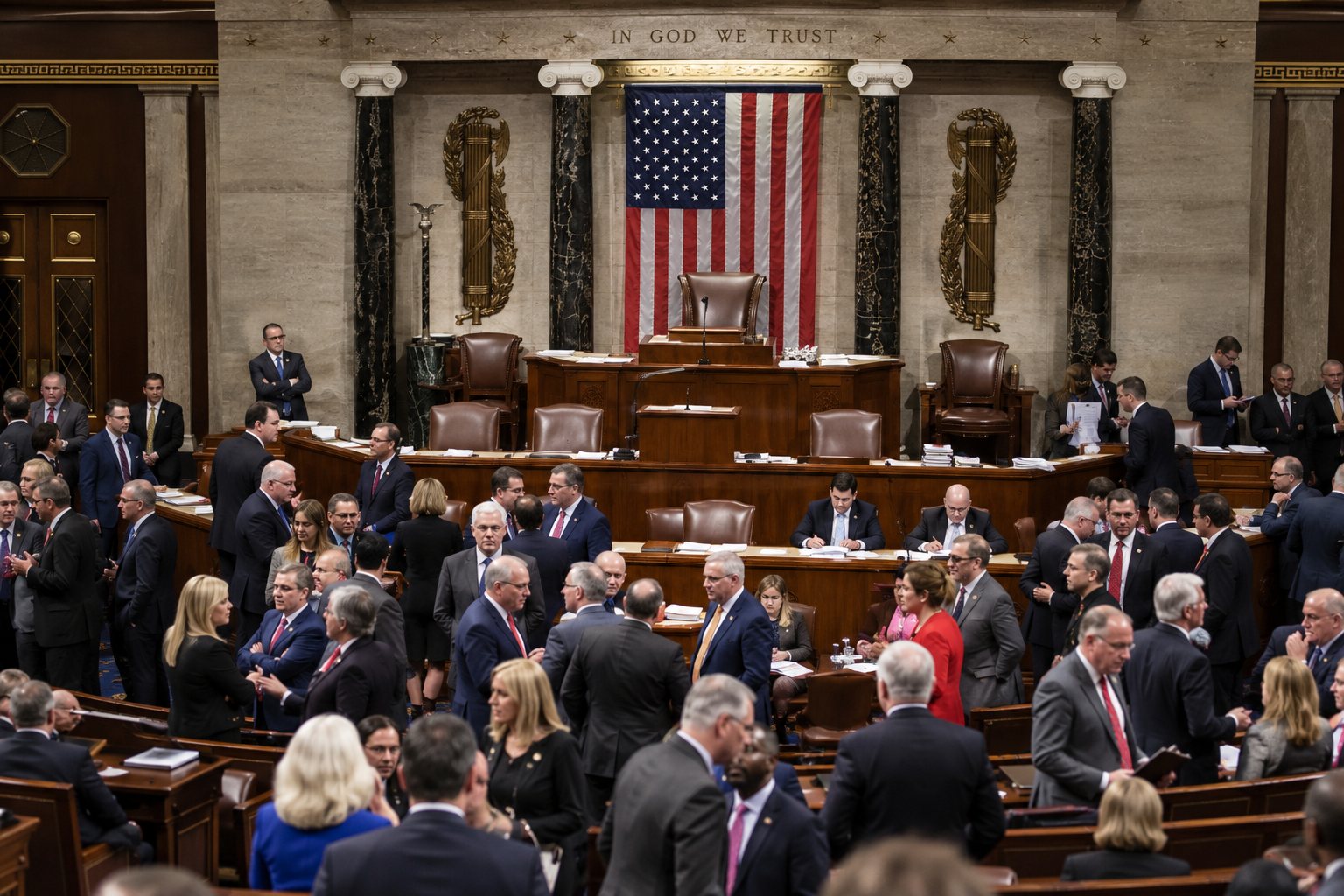
One week after Republicans made history by removing their own speaker of the House, they still couldn't agree on who should replace him.
On October 10, 2023, House Republicans gathered behind closed doors as two candidates—Majority Leader Steve Scalise of Louisiana and Judiciary Committee Chairman Jim Jordan of Ohio—made their final pitches for the speakership.
The meeting was supposed to help Republicans find a way out of the crisis created by Kevin McCarthy's removal.
Instead, it exposed just how divided the Republican conference had become.
And Donald Trump had already chosen his side.
The former president had given Jordan his “Complete & Total Endorsement,” throwing his weight behind one of his most loyal congressional allies.
But even Trump's endorsement couldn't immediately bring Republicans together.
Republicans Had Just Fired Their Own Speaker
The crisis began October 3.
Florida Republican Matt Gaetz introduced a motion to remove McCarthy as speaker following months of tension between McCarthy and the party's hard-right faction.
Eight Republicans ultimately joined every Democrat who voted to remove him.
The final vote was 216-210.
For the first time in American history, the House removed its speaker through a motion to vacate.
The consequences were immediate.
With the speaker's chair vacant, Rep. Patrick McHenry became speaker pro tempore with sharply limited authority.
The House couldn't simply continue conducting business normally.
Republicans first had to solve the problem they had created:
Who could possibly unite their fractured conference?
Trump Picks Jim Jordan
Trump quickly entered the fight.
On October 6, he endorsed Jordan.
“Congressman Jim Jordan has been a STAR long before making his very successful journey to Washington, D.C.,” Trump wrote.
Trump declared that Jordan would make a “GREAT Speaker of the House” and gave him his “Complete & Total Endorsement.”
Jordan was an obvious choice for Trump.
Few members of Congress had defended Trump as consistently or aggressively.
Jordan had been one of Trump's strongest allies during his presidency.
He defended Trump during congressional investigations and impeachment proceedings.
He challenged the investigation into Russian interference in the 2016 election.
He supported efforts challenging the results of the 2020 presidential election.
And just days before Trump left office in January 2021, Trump awarded Jordan the Presidential Medal of Freedom.
Now Trump wanted Jordan running the House.
But Republicans Had Another Candidate
Trump's endorsement did not clear the field.
Steve Scalise wanted the job too.
Unlike Jordan, Scalise was already part of the formal House Republican leadership structure.
As majority leader, he was the second-ranking Republican in the House.
Scalise therefore represented something closer to continuity with the existing Republican leadership.
Jordan represented another powerful faction.
He had helped found the House Freedom Caucus and had built his reputation as a combative conservative closely aligned with Trump.
The contest became more than a simple leadership election.
It reflected a larger argument about what kind of Republican Party would control the House.
October 10: Make Your Case
On October 10, Republicans gathered for a closed-door candidate forum.
For more than two hours, Scalise and Jordan answered questions and attempted to convince their colleagues that they could unite the conference.
They had a difficult assignment.
To become speaker, a Republican candidate would ultimately need enough support on the House floor to win a majority of votes cast for a person.
With the Republican majority extraordinarily narrow, that left almost no room for defections.
Yet Republicans leaving the October 10 meeting were openly acknowledging that neither candidate had unified the conference.
Some lawmakers wouldn't even promise to support whichever Republican won the party's internal nomination.
Rep. Dan Bishop of North Carolina told reporters he couldn't guarantee that he would automatically support the conference winner.
That was precisely the problem.
Republicans didn't merely disagree over which candidate they preferred.
Some weren't prepared to accept the decision of their own conference.
The McCarthy Wounds Were Still Open
The fight wasn't occurring in a vacuum.
Many Republicans remained furious about McCarthy's removal.
Only eight Republicans had voted to oust him.
But because Democrats also voted against McCarthy, that tiny Republican faction had been enough to remove the speaker.
Some McCarthy allies wanted consequences for the members who had forced him out.
Others still wanted McCarthy returned to the speakership.
McCarthy himself attempted to shut that possibility down during the October 10 meeting.
“There’s two people running in there, and I’m not one of them,” he told reporters.
Inside the meeting, McCarthy explicitly told Republicans not to nominate him.
The party had to move on.
The problem was that Republicans couldn't agree where to go.
Trump's Endorsement Wasn't Enough
Trump's endorsement of Jordan demonstrated both his influence over the Republican Party and the limits of that influence.
Jordan entered the race with the backing of the party's dominant political figure.
Trump had praised him publicly.
Trump's supporters strongly favored him.
Jordan had deep relationships with the conservative wing of the conference.
But House Republicans still didn't simply fall into line.
Moderate Republicans had reservations about Jordan.
Some members preferred Scalise's leadership experience.
Others were angry with the hard-right members associated with McCarthy's removal.
Still others wanted an entirely different candidate.
The result was remarkable.
The Republican Party's leading presidential candidate had explicitly told congressional Republicans whom he wanted as speaker.
They still couldn't agree.
And Then Scalise Beat Trump's Candidate
The following morning, October 11, Republicans held their internal vote.
Trump's endorsement did not carry Jordan to victory.
Scalise defeated him 113-99.
Jordan said he would support Scalise.
Normally, that might have ended the contest.
It didn't.
Scalise still needed enough Republicans to support him on the House floor.
Almost immediately, several Republican lawmakers announced that they would not vote for him.
The party's nominee couldn't secure enough votes to actually become speaker.
A day later, Scalise withdrew.
The Republican conference was back where it started.
Then Jordan Couldn't Get the Votes Either
With Scalise gone, Republicans turned again to Jordan.
This time Jordan secured the Republican nomination.
But winning an internal Republican contest was one thing.
Winning the House was another.
Jordan went to the floor.
He lost.
Republicans tried again.
He lost again.
They tried a third time.
He lost again—and his support actually declined.
Republicans eventually dropped Jordan as their nominee.
Trump's chosen candidate was finished.
Three Weeks Without a Speaker
The spectacle continued.
Republicans considered additional candidates.
Another nominee, Tom Emmer of Minnesota, lasted only hours after winning the conference nomination. Trump publicly attacked him, and Emmer withdrew.
Eventually, Republicans settled on Louisiana Rep. Mike Johnson.
On October 25—more than three weeks after McCarthy's removal—Johnson finally won the speakership.
He received the support of every Republican voting.
The House finally had a speaker again.
A Republican Civil War
The October 10 meeting therefore represented something much larger than a contest between Jim Jordan and Steve Scalise.
It exposed the structural problem facing the Republican House majority.
A small faction had enough power to destroy the existing leadership.
But no faction had enough power to easily replace it.
McCarthy couldn't hold the conference together.
Scalise couldn't assemble enough votes.
Jordan couldn't assemble enough votes.
Trump could endorse a candidate, but even Trump's endorsement couldn't manufacture a House majority.
For three weeks, Republicans cycled through candidates while the House remained without an elected speaker.
And it had begun because a handful of Republicans decided that their own Republican speaker had to go.
The Trump-Era Republican House
The speaker crisis illustrated how dramatically Republican politics had changed.
The fight was no longer simply between Republicans and Democrats.
Some of the most consequential battles were taking place inside the Republican Party itself.
Traditional leadership Republicans competed with members of the Freedom Caucus.
Trump loyalists battled institutionalists.
Members from competitive districts faced different political pressures than members representing overwhelmingly Republican districts.
And Donald Trump remained at the center of the party even though he held no government office.
On October 10, his preferred candidate was Jim Jordan.
But Trump's endorsement couldn't solve the fundamental problem.
House Republicans had removed Kevin McCarthy.
Now they had to find someone capable of replacing him.
Steve Scalise couldn't do it.
Jim Jordan couldn't do it.
And for another two weeks, neither could anyone else.
The fight over the speaker's gavel had become a public demonstration of just how difficult the Republican conference had become to govern—even by itself.