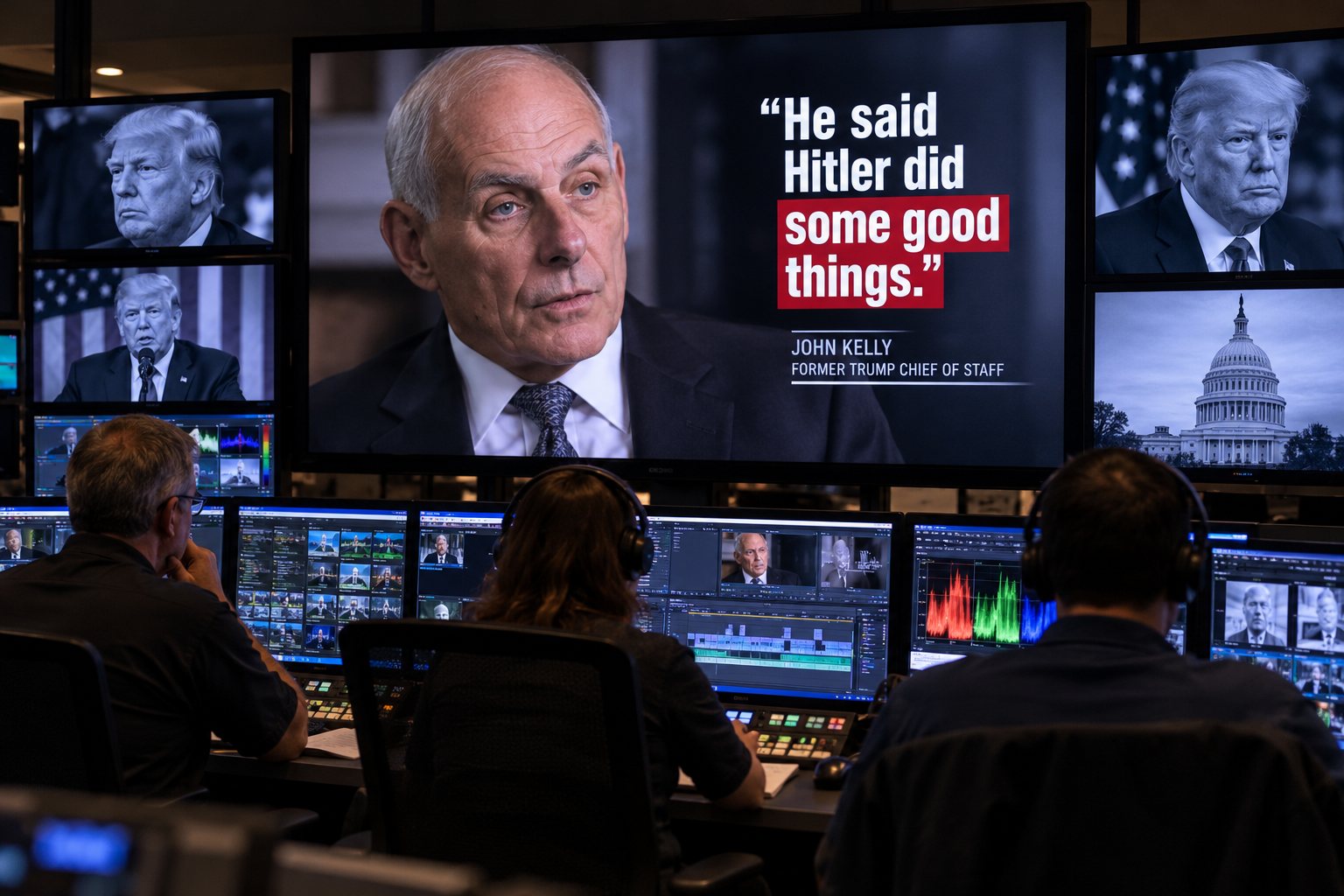
Vice President Kamala Harris's presidential campaign is launching new advertisements featuring the words of retired four-star Marine General John Kelly, Donald Trump's former White House chief of staff, who has accused the former president of praising Adolf Hitler and displaying authoritarian tendencies.
The advertisements, released as the presidential election enters its final 12 days, feature audio recordings of Kelly discussing Trump's conduct during his first administration.
Rather than relying exclusively on Democratic criticism, Harris's campaign is presenting voters with the testimony of a senior military officer who worked directly for Trump inside the White House.
Kelly served as Trump's secretary of homeland security before becoming his longest-serving White House chief of staff.
His allegations have triggered an extraordinary confrontation between the former president and one of the most senior military figures to serve in his administration.
A Four-Star Marine General Delivers the Warning
The new advertisements begin by identifying Kelly as Trump's former chief of staff and a four-star Marine general.
They then play excerpts from Kelly's interviews with New York Times reporter Michael Schmidt.
In those interviews, Kelly described conversations in which Trump allegedly expressed admiration for aspects of Adolf Hitler's leadership.
Kelly recalled Trump saying that Hitler had done some good things.
He also described the former president's apparent fascination with the loyalty Hitler demanded from his military commanders.
The allegations are particularly serious because they concern the relationship between the president, the armed forces, and the constitutional limits of executive power.
Kelly's statements are presented in his own voice, giving viewers an opportunity to hear his account directly.
Trump Allegedly Praised Hitler
Kelly's allegations include an account of Trump making favorable remarks about Hitler despite the Nazi dictator's responsibility for the Holocaust and the devastation of World War II.
According to Kelly, Trump repeatedly raised the subject during conversations about leadership and military loyalty.
Kelly said he challenged the former president's comments and attempted to explain why admiration for Hitler was inappropriate.
The retired general also described Trump expressing frustration with American military officers who did not demonstrate the personal loyalty he wanted.
In a separate report published by The Atlantic this week, Kelly recalled Trump expressing a desire for generals resembling those who served Hitler.
The accounts raise questions about Trump's understanding of the military's obligations under the Constitution.
American service members swear an oath to defend the Constitution, not to provide unquestioning personal loyalty to a president.
Trump has denied Kelly's allegations.
Kelly Says Trump Fits the Definition of Fascism
Kelly's criticism extends beyond the reported Hitler comments.
During his interview with The New York Times, the retired general was asked whether he believed Trump met the definition of a fascist.
Kelly said the former president fit the general definition.
His assessment was based on what he described as Trump's authoritarian tendencies, his approach to political opponents, and his expectations of personal loyalty from government officials.
The word carries significant historical meaning.
Fascism is commonly associated with authoritarian leadership, extreme nationalism, suppression of political opposition, and the concentration of power in a single leader.
Kelly's characterization is his assessment of Trump's behavior, not a legal finding or an established diagnosis of the former president's political ideology.
Nevertheless, the accusation is remarkable coming from a retired Marine general who worked closely with Trump for approximately 18 months as White House chief of staff.
Harris Makes Kelly's Words a Campaign Message
The Harris campaign is distributing 30-second and 60-second advertisements built around Kelly's recorded statements.
The advertisements are part of a broader effort to focus attention on warnings issued by former Trump administration officials.
Harris has increasingly argued that the people who worked most closely with Trump provide important evidence about how he might govern if returned to office.
At a CNN town hall Wednesday evening, Harris was asked directly whether she believed Trump was a fascist.
"Yes, I do," she responded.
Harris also characterized Kelly's statements as an urgent warning to Americans about the consequences of another Trump presidency.
Her campaign is now carrying that message into paid advertising.
The strategy places the words of Trump's former advisers at the center of the closing campaign rather than treating their criticism as isolated news stories.
Trump Attacks His Former Chief of Staff
Trump has responded to Kelly's allegations with personal insults and categorical denials.
The former president accused Kelly of fabricating the accounts and attacked his intelligence and character.
Trump also claimed that Harris had compared him directly to Adolf Hitler.
That characterization misrepresented her remarks.
Harris cited Kelly's allegations about Trump's comments concerning Hitler and agreed with Kelly's assessment that Trump displayed fascist tendencies. She did not say that Trump was Hitler.
Trump's campaign has dismissed Kelly's statements as false and politically motivated.
Campaign representatives have accused the retired general of attempting to damage Trump shortly before the election.
The competing accounts present voters with sharply different descriptions of Trump's conduct during his presidency.
Warnings From Other Former Trump Officials
Kelly is not the only former senior official to raise concerns about Trump's approach to presidential authority.
Retired General Mark Milley, who served as chairman of the Joint Chiefs of Staff, has also been sharply critical of the former president.
Former Defense Secretary Mark Esper has expressed concerns about Trump's approach to the military and the use of presidential power.
Former National Security Adviser John Bolton has publicly criticized Trump's conduct and judgment.
These officials held important national security responsibilities during Trump's administration.
Their assessments are not identical, and they have not all endorsed Harris.
But their public criticisms have become a prominent element of the Democratic campaign's argument about the risks of another Trump presidency.
Harris is attempting to draw a distinction between ordinary partisan opposition and criticism originating from officials Trump himself selected for positions of authority.
The Question of Military Loyalty
One of the most significant issues raised by Kelly concerns Trump's expectations of military commanders.
The United States military operates under civilian control, with the president serving as commander in chief.
However, military officers remain bound by the Constitution and federal law.
They are not required to carry out unlawful orders, and their professional obligations extend beyond loyalty to any individual officeholder.
Kelly's account suggests that Trump sometimes viewed those institutional limitations as obstacles to his personal authority.
Trump's campaign disputes that characterization.
The issue has gained additional attention because Trump has recently discussed using military forces to address what he calls the "enemy from within."
His comments have generated debate about the circumstances under which a president could deploy federal forces domestically.
Twelve Days Before the Election
The timing of the advertisements is significant.
Americans will vote on November 5, and both campaigns are concentrating resources on states where the presidential contest remains competitive.
Harris's campaign is using the final days to emphasize concerns about executive power, democratic institutions, and Trump's conduct during his first term.
Trump is focusing heavily on immigration, inflation, and criticism of the Biden-Harris administration.
The new advertisements add another dimension to the campaign's closing arguments by placing a former senior Trump official's allegations directly before voters.
They also extend a controversy that has dominated political discussion throughout the week.
Three Days of Escalating Accusations
On October 22, Kelly's allegations about Trump's comments concerning Hitler and his expectations of military loyalty became public.
On October 23, Harris addressed the allegations and warned about the implications of returning Trump to the presidency.
Trump responded by attacking Kelly and rejecting his account.
Now, on October 24, the Harris campaign is transforming those allegations into advertisements intended to reach a wider audience.
The controversy has moved rapidly from interviews with a former White House official to a central issue in the final days of the presidential campaign.
An Unusual Voice in a Presidential Campaign
Presidential elections routinely feature harsh criticism from opposing candidates.
It is far less common for a former White House chief of staff, particularly a retired four-star Marine general, to become the central voice in campaign advertisements criticizing the president he once served.
Kelly's military career and senior White House position give his statements a significance distinct from ordinary partisan attacks.
His allegations remain disputed by Trump, who denies making the remarks attributed to him.
But the Harris campaign has made a deliberate decision to place Kelly's words before the electorate.
With less than two weeks remaining until Election Day, voters are being presented with conflicting accounts of Trump's conduct from the former president and a senior official who served alongside him.
The new advertisements ensure that Kelly's warnings will remain part of the national political conversation as Americans prepare to choose their next president.