As Israel struggled to comprehend one of the most devastating attacks in its history, Donald Trump wasted little time assigning political blame in the United States.
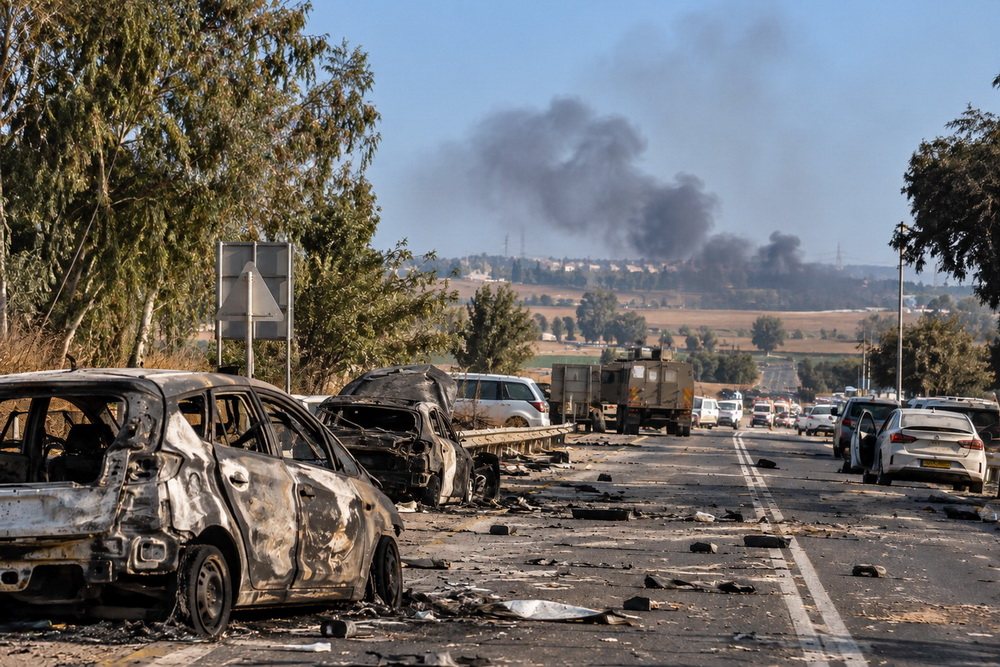
Hamas militants had launched a massive surprise assault from Gaza early on October 7, firing thousands of rockets and breaching the border into southern Israel.
Gunmen attacked Israeli communities, military positions and a music festival.
Civilians were murdered.
Others were taken hostage and carried into Gaza.
The scale of the attack stunned Israel and the world.
Within hours, former President Donald Trump blamed President Joe Biden.
Trump claimed that American taxpayer dollars had helped finance the attack and argued that it would never have happened if he were still president.
There was no evidence supporting either assertion.
And Trump's effort to assign responsibility to Biden largely ignored a much more complicated history of American policy in the region — including Trump's own consequential decisions involving Israel, the Palestinians and Iran.
Trump Immediately Blames Biden
Trump issued a statement on October 7 declaring his support for Israel while attacking the Biden administration.
He claimed that American taxpayer dollars had helped fund the assault.
Other Republican presidential candidates quickly made similar arguments, focusing particular attention on a recent agreement involving approximately $6 billion in Iranian assets.
The implication was straightforward:
Biden had given Iran billions of dollars.
Iran supported Hamas.
Therefore Biden had helped finance the attack.
There was a major problem with that argument.
The money had not been spent.
The $6 Billion Wasn't American Taxpayer Money
The $6 billion repeatedly mentioned by Trump and other Republicans did not come from American taxpayers.
It belonged to Iran.
The money consisted of proceeds from Iranian oil sales that had been frozen in South Korean accounts because of U.S. sanctions.
As part of a September 2023 prisoner-exchange agreement that secured the release of five Americans detained in Iran, the funds were transferred to restricted accounts in Qatar.
Iran was not simply handed $6 billion in cash.
Under the arrangement, the money was restricted to humanitarian purchases such as food and medicine and remained subject to oversight.
More importantly, Treasury officials said on October 7 that none of the money had been spent.
The agreement had occurred only weeks before the Hamas attack.
An operation as complex as October 7 required extensive planning long before those funds were transferred to Qatar.
There was therefore no evidence that the $6 billion financed the attack.
Iran's Relationship With Hamas Was Real
That doesn't mean concerns about Iran were invented.
Iran had supported Hamas for years.
It provided Palestinian militant organizations with money, weapons, training and other assistance.
Iran's broader strategy included supporting armed groups throughout the Middle East that could challenge Israel and American influence without requiring Iran itself to directly fight those countries.
So questioning Iran's role was entirely legitimate.
But that was different from claiming that Biden had recently handed Iran money that financed October 7.
Those were two separate questions.
Iran's longstanding support for Hamas was well documented.
The claim that the $6 billion prisoner-exchange arrangement financed the October 7 attack was not.
Trump Says It Wouldn't Have Happened Under Him
Trump also claimed the attack would not have happened if he had remained president.
That assertion cannot be proven.
Presidents routinely claim that wars, terrorist attacks or international crises would not have occurred under their leadership.
There is no way to test a hypothetical alternate history.
What can be examined is Trump's actual record.
And Trump's Middle East policies were far more complicated than his October 7 statement suggested.
Trump Dramatically Changed U.S. Policy Toward Jerusalem
One of Trump's most consequential decisions involving Israel came in December 2017.
He formally recognized Jerusalem as the capital of Israel.
The United States subsequently moved its embassy from Tel Aviv to Jerusalem in May 2018.
The decision fulfilled a longstanding promise strongly supported by Israel's government and many of Israel's American supporters.
But Jerusalem is one of the most sensitive issues in the Israeli-Palestinian conflict.
Palestinians also claim East Jerusalem as the capital of a future Palestinian state.
For decades, American administrations had avoided making unilateral changes to Jerusalem's diplomatic status because its ultimate status was expected to be resolved through negotiations between Israelis and Palestinians.
Trump changed that policy.
Palestinian leaders condemned the decision.
Critics warned that it could further damage America's ability to serve as a mediator and inflame tensions throughout the region.
Supporters argued that recognizing Jerusalem simply acknowledged political reality and corrected an outdated American policy.
What cannot responsibly be claimed is that moving the embassy caused Hamas to attack Israel five years later.
There is no evidence establishing that connection.
But Trump's own record makes his attempt to portray Middle East instability as something that suddenly appeared under Biden far too simplistic.
Trump's Policies Had Consequences Too
Trump's administration took several other major steps that reshaped America's relationship with Israelis and Palestinians.
His administration cut hundreds of millions of dollars in aid to Palestinians.
It closed the Palestine Liberation Organization's diplomatic mission in Washington.
Trump recognized Israeli sovereignty over the Golan Heights.
His administration proposed a Middle East peace plan strongly rejected by Palestinian leaders.
At the same time, Trump helped broker the Abraham Accords, which normalized relations between Israel and several Arab countries.
Those agreements represented a significant diplomatic achievement.
But they largely bypassed the unresolved Israeli-Palestinian conflict.
The Palestinian issue did not disappear simply because Israel was establishing diplomatic relationships with other Arab governments.
The tensions remained.
So did Hamas.
Trump Also Abandoned the Iran Nuclear Agreement
Trump's attempt to blame Biden's Iran policy also omitted another major part of his own record.
In 2018, Trump withdrew the United States from the Joint Comprehensive Plan of Action — the Iran nuclear agreement negotiated under President Barack Obama.
Trump then imposed a campaign of “maximum pressure” sanctions against Tehran.
Trump argued that the nuclear agreement was fundamentally flawed and that stronger economic pressure would force Iran into a better deal.
That new agreement never materialized during his presidency.
Instead, tensions between Washington and Tehran increased substantially.
None of this means Trump's withdrawal from the nuclear agreement caused the October 7 attack either.
It does mean that American policy toward Iran in 2023 did not begin with Joe Biden.
Both administrations inherited consequences from decisions made by their predecessors.
Biden Responds to the Attack
While Trump was blaming Biden, the sitting president publicly pledged American support for Israel.
Biden spoke with Israeli Prime Minister Benjamin Netanyahu and condemned the Hamas attack.
“The United States stands with Israel,” Biden said.
He pledged that the United States would provide Israel with assistance needed to defend itself.
There was no hesitation in the administration's public response about which side had initiated the violence that morning.
Hamas had attacked Israel.
The Attack Had Been Planned Long Before October 7
The emerging evidence also made the political argument surrounding the $6 billion increasingly difficult to sustain.
October 7 was not an operation improvised during the few weeks after the Iranian prisoner exchange.
Hamas had prepared extensively.
Fighters had trained.
Weapons had been accumulated.
Israeli surveillance and defensive systems had been studied.
Plans had been developed to breach the border.
Targets had been selected.
The operation involved coordinated rocket attacks, drones, explosives, vehicles, paragliders and armed assault teams.
Whatever role Iran's longstanding support for Hamas ultimately played, the attack was the product of preparation that preceded Biden's September prisoner-exchange agreement.
The $6 billion could not plausibly have financed an operation that was already being planned before the money was moved into restricted Qatari accounts.
Politics Begins Before the Smoke Clears
There would eventually be enormous questions about how October 7 had been allowed to happen.
Israel would face questions about intelligence failures.
Prime Minister Benjamin Netanyahu's government would face scrutiny over security policy toward Gaza and Hamas.
Iran's relationship with Hamas would be investigated.
American policy toward Israel, Iran and the Palestinians would again become part of a much larger debate about decades of unsuccessful attempts to stabilize the region.
Those were legitimate questions.
But on October 7 itself, many facts were still unknown.
Israel was still fighting Hamas militants inside its territory.
Hostages were being taken into Gaza.
Families were searching for missing relatives.
The full death toll wasn't yet known.
And Trump had already turned the attack into an argument against Joe Biden.
Trump's Claim Ignored His Own Record
Trump's statement presented a simple political story.
The Middle East had supposedly been stable under him.
Biden changed American policy.
Iran received billions of dollars.
Hamas attacked Israel.
Therefore Biden was responsible.
The historical record was considerably more complicated.
Trump himself had dramatically altered U.S. policy toward Jerusalem.
He moved the American embassy.
He withdrew from the Iran nuclear agreement.
He imposed sweeping sanctions on Iran.
He cut Palestinian assistance.
He sidelined Palestinian leaders while pursuing normalization agreements between Israel and Arab governments.
Some of those policies were praised by Israel and Trump's supporters.
Others were strongly criticized by Palestinians, American diplomats and Middle East analysts.
Their long-term consequences remain debated.
But they demonstrate why responsibility for decades of Israeli-Palestinian conflict cannot credibly be assigned to a single American president.
What Could Be Said With Certainty
On October 7, 2023, Hamas launched a deliberate and devastating attack against Israel.
Iran had a longstanding history of supporting Hamas.
The Biden administration had recently negotiated an agreement involving $6 billion in frozen Iranian oil revenue.
But that money wasn't American taxpayer money.
It remained in restricted accounts.
And Treasury officials said none of it had been spent.
There was no evidence that it financed the October 7 attack.
Trump nevertheless blamed Biden almost immediately.
He also claimed the attack would never have happened during his presidency — an assertion that is impossible to prove and one that overlooked the profound changes Trump himself had made to American Middle East policy.
The history leading to October 7 stretched across governments, countries, militant organizations and decades.
It could not honestly be reduced to one president, one prisoner exchange or one $6 billion bank account.