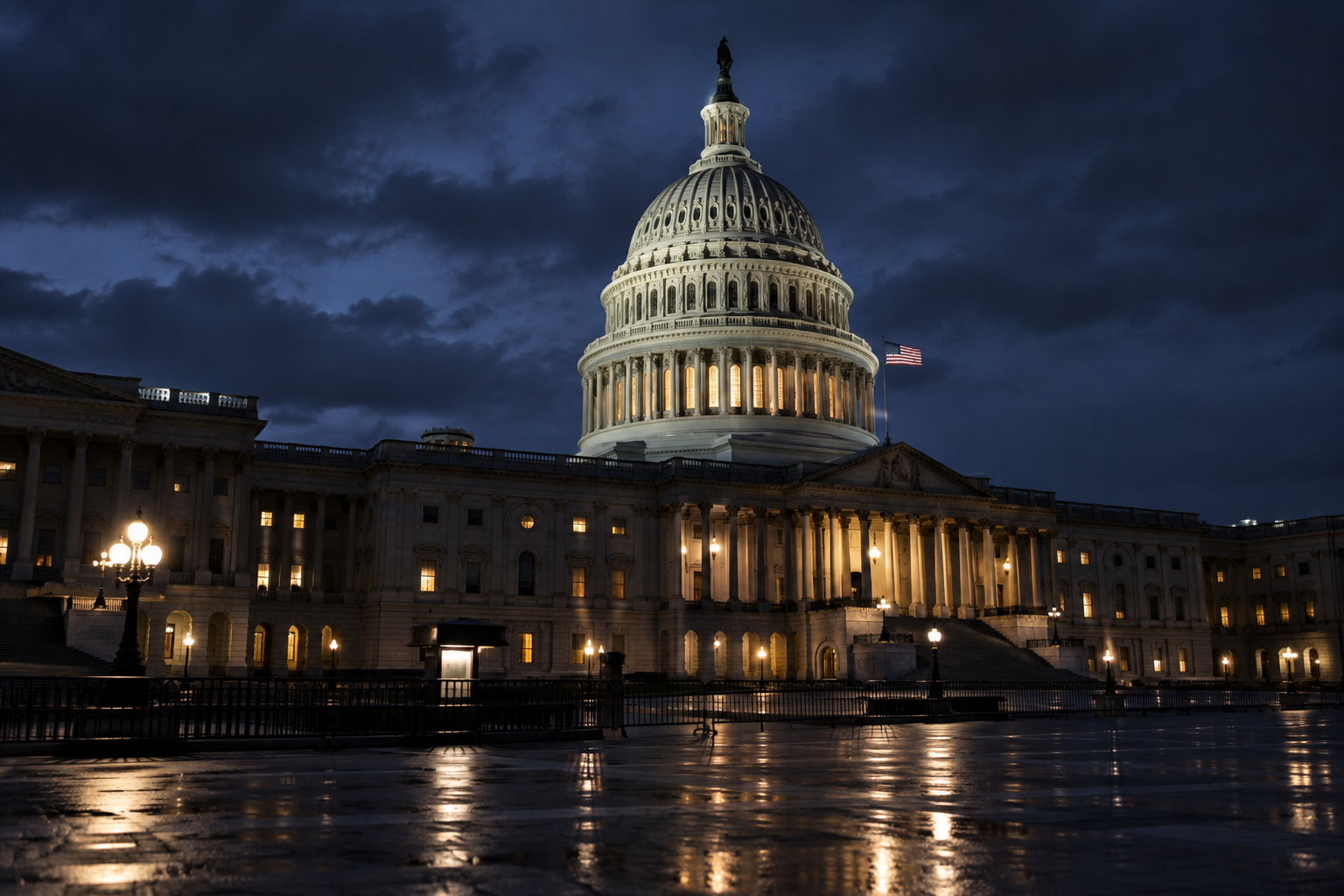
Exactly one year after Donald Trump took the oath of office, the federal government shut down.
At midnight on January 20, government funding expired after the Senate failed to advance a temporary spending bill. Republicans controlled the White House, House of Representatives and Senate, but their 51-seat Senate majority was not enough to overcome the 60-vote threshold needed to advance the legislation.
The timing was impossible to ignore.
Instead of celebrating the first anniversary of his inauguration with a legislative victory, Trump began his second year in office presiding over a government shutdown.
Congress Hits a Wall
The immediate problem was government funding, but the confrontation had become intertwined with a much larger fight over immigration.
Months earlier, the Trump administration had announced that it was ending Deferred Action for Childhood Arrivals, or DACA, the Obama-era program providing temporary protection from deportation to hundreds of thousands of undocumented immigrants who had been brought to the United States as children.
Democrats wanted legislation protecting those immigrants — commonly known as Dreamers — included as part of negotiations over government funding.
Republicans and the White House wanted immigration negotiations handled separately and sought additional concessions involving border security and other immigration policies.
The House passed a temporary funding measure, but it stalled in the Senate. Five Democrats supported advancing the House bill while four Republicans opposed it, leaving supporters short of the required 60 votes.
At midnight, funding expired.
Both Sides Point Fingers
Almost immediately, Washington turned to the question of blame.
Trump and Republican leaders branded the standoff the “Democrat Shutdown,” arguing that Democrats had withheld the votes necessary to keep the government operating because of their demands concerning immigration.
Democrats countered that Republicans controlled the presidency and both chambers of Congress and had failed to produce a funding and immigration agreement capable of passing the Senate.
The reality was more complicated than either slogan.
Republicans possessed unified control of the elected branches but lacked the 60 Senate votes necessary to advance the funding measure on their own. Most Democrats refused to provide those votes without progress on DACA, while several Republicans also opposed the legislation.
The shutdown was the first since 2013.
Trump’s Anniversary Celebration Disappears
The shutdown also disrupted Trump's plans.
The president had been expected to travel to his Mar-a-Lago resort in Florida, where supporters were planning an event marking the first anniversary of his inauguration.
Instead, Trump remained in Washington as negotiations continued.
The symbolism was striking.
One year earlier, Trump had stood on the steps of the Capitol promising to transform Washington.
Now, on the anniversary of that speech, parts of the federal government were closing because Washington could not agree on how to keep them funded.
Government Workers Caught in the Middle
As happens during federal shutdowns, agencies began implementing contingency plans.
Federal employees considered essential remained on the job, while other workers faced furloughs. The practical effects were somewhat limited because the shutdown began over a weekend and ultimately extended into only one normal federal workday.
But for federal employees, the political fight created immediate uncertainty over when they would return to work and how long the confrontation might last.
Meanwhile, lawmakers remained in Washington through the weekend trying to find a way out.
A Three-Day Shutdown
The standoff finally broke on January 22.
Senate Democrats agreed to advance a temporary spending measure after Majority Leader Mitch McConnell committed to allowing the Senate to address immigration legislation.
The Senate ultimately approved the funding legislation 81–18. The House followed, and Trump signed the measure that evening, reopening the government and funding it through February 8.
The agreement did not resolve the underlying immigration fight.
It merely ended the immediate shutdown.
One Year In
The January shutdown lasted only three days, but its timing gave it significance beyond its duration.
Trump had reached the first anniversary of his presidency with Republicans controlling the White House and both houses of Congress.
Yet Washington still could not keep the federal government funded.
Immigration remained unresolved. DACA remained unresolved. Congress was relying on another temporary spending measure rather than a long-term funding agreement.
And the president who had campaigned as a dealmaker began the second year of his presidency with the federal government closed.
One year after Donald Trump promised a new era in Washington, the lights were going out in parts of the government.