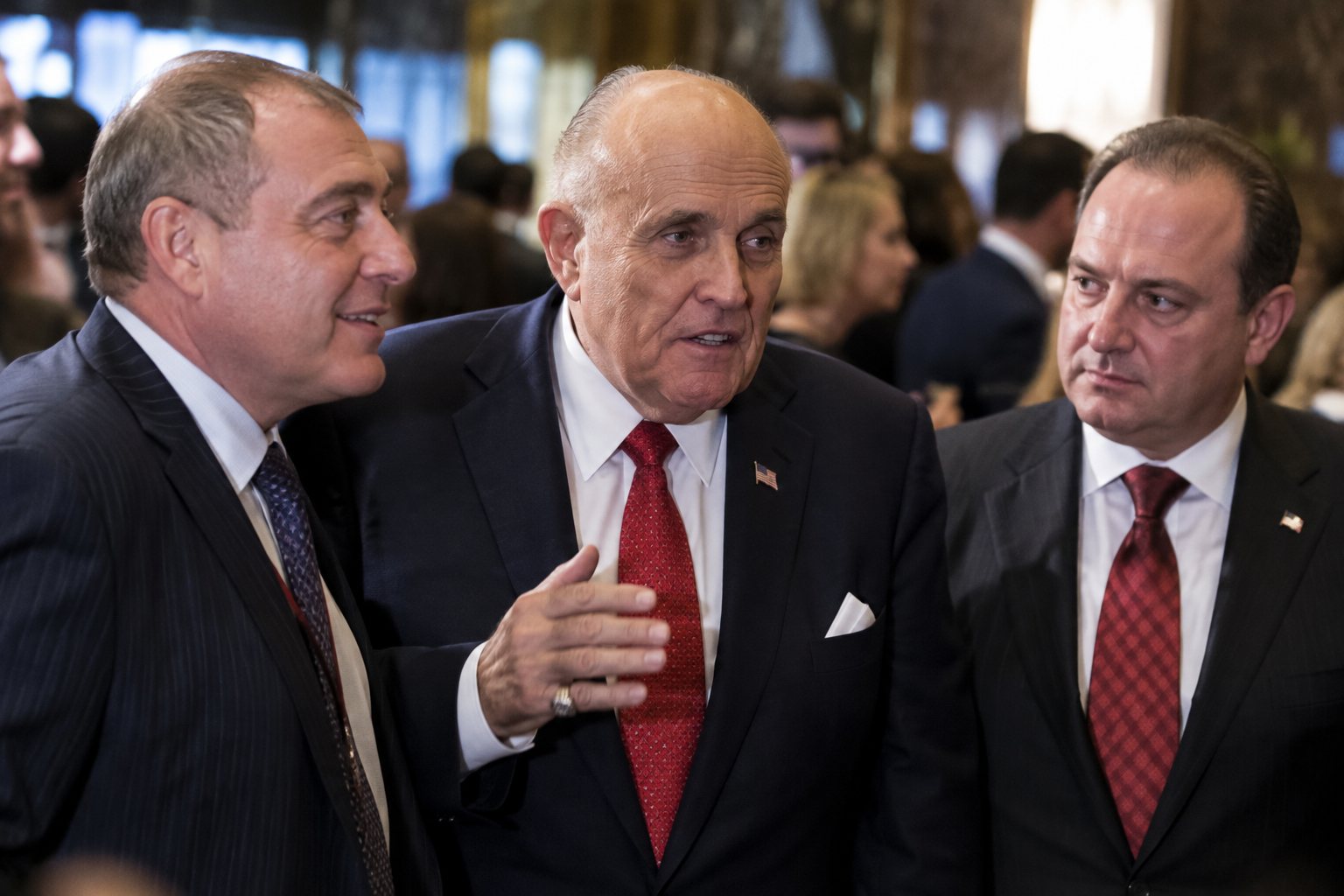
The Ukraine scandal surrounding President Donald Trump was already consuming Washington when, on October 10, 2019, it took another extraordinary turn.
Two associates of Trump's personal attorney Rudy Giuliani had been arrested at Washington Dulles International Airport.
Lev Parnas and Igor Fruman weren't peripheral strangers who happened to stumble into the story.
The two businessmen had been assisting Giuliani as he pursued efforts in Ukraine connected to investigations that could politically benefit Trump—including efforts involving former Vice President Joe Biden, who was seeking the Democratic presidential nomination.
Now Parnas and Fruman themselves were facing federal criminal charges.
And on the same day those charges were publicly announced, congressional investigators conducting Trump's impeachment inquiry subpoenaed them.
The Ukraine scandal was no longer simply about a controversial presidential phone call.
The people operating around Trump's personal attorney were now being arrested, indicted and summoned before Congress.
Arrested at Dulles
Parnas and Fruman were arrested on the evening of October 9 at Washington Dulles International Airport.
Federal prosecutors announced the charges the following day.
According to contemporary reporting, the men had one-way tickets for an international flight.
Federal prosecutors in the Southern District of New York accused Parnas, Fruman and two other men of participating in schemes designed to circumvent campaign-finance laws and conceal the actual sources of political contributions.
The indictment alleged that Parnas and Fruman had used political donations to gain access and influence within Republican political circles.
Among the transactions prosecutors highlighted was a $325,000 contribution to an independent expenditure committee made in the name of a company called Global Energy Producers.
Prosecutors alleged the money did not actually come from the company.
They said Parnas and Fruman used the company's name to conceal the true source of the funds.
But the allegations went considerably further.
Foreign Money and American Politics
Federal prosecutors also alleged a separate scheme involving money from a foreign national.
According to the indictment, Parnas, Fruman and their associates pursued plans for a recreational marijuana business that would require obtaining licenses in several states.
The venture was to be financed by a Russian national.
Prosecutors alleged that foreign money was then used to fund political contributions intended to help gain influence with politicians who might assist their business interests.
Federal law prohibits foreign nationals from contributing money to American political campaigns.
U.S. Attorney Geoffrey Berman said the defendants had allegedly attempted to gain political influence while concealing who was actually supplying the money.
But another portion of the indictment was particularly significant because of what was simultaneously happening in Washington.
Ukraine appeared in the allegations.
The Ambassador to Ukraine
According to federal prosecutors, Parnas and Fruman were not simply seeking political connections for business purposes.
They were also working to advance the interests of at least one Ukrainian government official.
The indictment said Parnas met with a sitting member of Congress and sought assistance in having the U.S. government remove or recall America's ambassador to Ukraine.
That ambassador was Marie Yovanovitch.
Prosecutors alleged that Parnas's effort to remove her was undertaken, at least partly, at the request of one or more Ukrainian government officials.
Yovanovitch had already become an important figure in the rapidly expanding Trump-Ukraine scandal.
She was abruptly recalled from her post earlier in 2019 following a campaign of criticism from Trump allies.
Giuliani acknowledged that he had played a role in pushing for her removal.
Now federal prosecutors were alleging that two of the men working with Giuliani had also participated in efforts aimed at getting her recalled.
Giuliani's Ukraine Operation
Parnas and Fruman had been helping Giuliani make contacts in Ukraine.
Giuliani was working outside the traditional State Department diplomatic structure while seeking information involving Joe Biden and his son Hunter Biden.
Trump's July 25 telephone call with Ukrainian President Volodymyr Zelensky had already triggered an impeachment inquiry.
During that call, after Zelensky raised American military assistance, Trump asked him to “do us a favor” and pursue matters involving the 2016 election. Trump also urged Zelensky to speak with Giuliani and Attorney General William Barr.
Trump later raised Biden by name.
The central question confronting Congress was whether the president had abused the powers of his office by pressuring Ukraine to pursue investigations that could benefit him politically.
Parnas and Fruman were potentially important witnesses because they had worked directly with Giuliani's efforts in Ukraine.
Congress wanted their records.
Congress Comes Calling
October 10 became even more extraordinary when House investigators issued subpoenas to both men.
House Intelligence Committee Chairman Adam Schiff, Oversight Committee Chairman Elijah Cummings and Foreign Affairs Committee Chairman Eliot Engel demanded documents from Parnas and Fruman as part of the impeachment investigation.
Congress had previously asked them to cooperate voluntarily.
Their attorney had confirmed that the men had assisted Giuliani in connection with his representation of President Trump.
But Parnas and Fruman had declined to appear for scheduled depositions.
Their attorney then informed congressional investigators that they were adopting the White House's position that it would not cooperate with the impeachment inquiry.
Congress responded with subpoenas.
The timing was remarkable.
The men congressional investigators wanted to question about Giuliani's Ukraine activities had just been arrested by federal authorities.
Trump Says He Doesn't Know Them
Trump attempted to distance himself from Parnas and Fruman.
Asked about the two men following their arrests, Trump said he didn't know them.
“I don't know those gentlemen,” he told reporters.
He acknowledged that photographs might exist showing him with the men but said he took pictures with many people.
The photographs did exist.
Parnas and Fruman had appeared at Republican political events and had been photographed with Trump and members of his circle.
But knowing Trump personally was not necessary to make their activities relevant to the impeachment inquiry.
Their connection ran through Rudy Giuliani.
And Giuliani wasn't simply another Republican operative.
He was the president's personal attorney.
Two Investigations Collide
That is what made October 10, 2019 so consequential.
Two investigations that had developed on separate tracks suddenly collided.
Federal prosecutors in New York were investigating campaign-finance violations and alleged foreign money entering American politics.
Congress was investigating whether President Trump had abused his office through his dealings with Ukraine.
And standing in the middle of both stories were Lev Parnas and Igor Fruman.
They had worked with Trump's personal attorney.
They had participated in Giuliani's Ukraine efforts.
They had been involved in efforts surrounding the removal of America's ambassador to Ukraine.
Congress wanted their documents and testimony.
And now federal prosecutors had charged them with crimes involving political influence, campaign contributions and foreign money.
The scandal surrounding Trump's Ukraine operation was rapidly becoming larger than a single telephone conversation.
It involved the president.
It involved his personal attorney.
It involved American diplomats.
It involved Ukrainian officials.
It involved congressional investigators.
And by October 10, it involved federal criminal defendants who had been arrested at an airport as they prepared to leave the country.
The impeachment inquiry was barely two weeks old.
And already, two men working alongside the president's personal lawyer in Ukraine were facing federal charges.