By March 2016, Donald Trump's campaign rallies had become something more than political events.
They were increasingly becoming confrontations.
Protesters regularly interrupted Trump.
Supporters shouted back.
Security officers removed demonstrators.
And sometimes the confrontations became physical.
Through it all, Trump wasn't merely watching from the stage.
At several rallies, he was using language about protesters that became part of the controversy itself.
Then came Chicago.
“Knock the Crap Out of Them”
On February 1, 2016, Trump was campaigning in Cedar Rapids, Iowa, when he told supporters that security had warned him someone might try to throw tomatoes.
Trump offered the crowd some instructions.
“If you see somebody getting ready to throw a tomato, knock the crap out of them, would you?”
He continued:
“I promise you, I will pay for the legal fees.”
The crowd cheered.
Trump repeated the promise.
It wasn't the last time he would talk about protesters in physical terms.
“I'd Like to Punch Him in the Face”
At a February 23 rally in Las Vegas, Trump became irritated by a protester being removed from the event.
Trump told the audience:
“I'd like to punch him in the face, I'll tell ya.”
He then reminisced about what he described as the way protesters had been treated in the past.
“I love the old days.”
Trump said that years earlier, someone disrupting an event might have been “carried out on a stretcher.”
The language was extraordinary for a leading presidential candidate.
Trump's supporters often viewed disruptive protesters as deliberately attempting to interfere with their candidate's events.
Critics saw something else happening: a candidate increasingly talking about political opponents and demonstrators using the language of physical retaliation.
Then Someone Actually Got Punched
On March 9, the controversy became much more tangible.
At a Trump rally in Fayetteville, North Carolina, protesters were being escorted from the building.
Video captured 78-year-old Trump supporter John McGraw striking 26-year-old protester Rakeem Jones in the face as Jones walked past.
McGraw was subsequently charged with assault and disorderly conduct.
Trump was later asked whether he might pay McGraw's legal expenses.
The question wasn't hypothetical.
Trump had already told supporters that he would pay legal fees if they confronted protesters.
Trump said he had instructed his staff to look into the possibility.
He also said he did not condone violence and wanted to learn more about what had happened.
But the images were now impossible to separate from the larger debate surrounding his rallies.
A protester had been punched.
And the candidate had previously told supporters to “knock the crap out of” someone under a different set of circumstances.
Chicago
Two days later, the campaign arrived in Chicago.
Trump was scheduled to speak on March 11 at the University of Illinois at Chicago Pavilion.
Thousands came.
So did thousands of protesters.
According to estimates later released by UIC, approximately 6,360 people were inside the Pavilion, another 4,000 were waiting to enter, and roughly 2,500 protesters were outside.
The atmosphere was tense before Trump ever appeared.
Protesters had organized specifically to demonstrate against his campaign.
Inside the arena, Trump supporters and opponents occupied the same building.
Arguments erupted.
Police and security personnel attempted to keep the groups separated and remove disruptive individuals.
Then came the announcement.
Trump wasn't coming.
“Tonight's Rally Will Be Postponed”
The Trump campaign announced that the event was being postponed because of safety concerns.
The crowd exploded.
Some protesters celebrated.
Trump supporters shouted back.
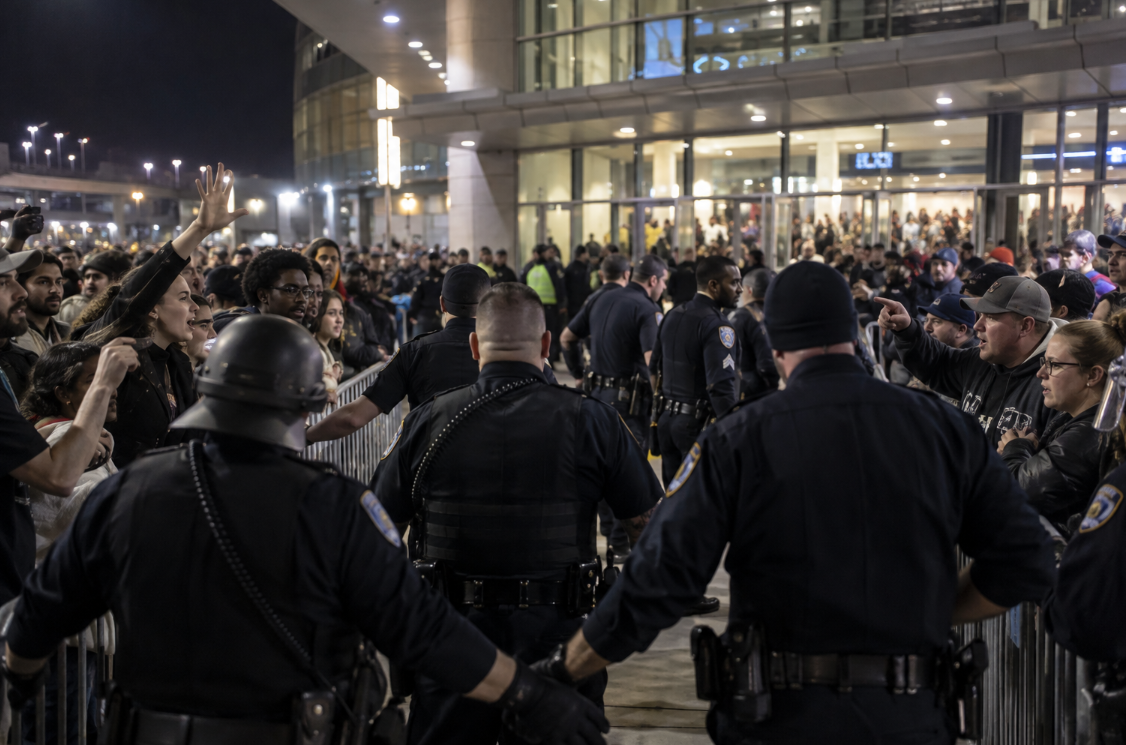
Arguments became shoving matches.
Fights broke out inside and outside the arena.
Police moved between groups attempting to separate them.
Television cameras captured scenes unlike anything Americans normally associated with a presidential primary campaign.
Instead of a candidate delivering a speech, the country watched supporters and protesters confronting one another inside an arena where the speech was supposed to take place.
UIC police later emphasized an important point:
The vast majority of people involved had exercised their rights to free speech and assembly peacefully.
But the confrontations involving a minority of participants dominated the images Americans saw.
Who Was Responsible?
Almost immediately, the political argument turned to responsibility.
Trump blamed organized protesters for deliberately attempting to shut down his event.
There was evidence that activists had indeed organized to disrupt the rally, and protesters inside the arena openly celebrated its cancellation.
Trump's critics, however, pointed toward his own rhetoric.
They remembered:
“Knock the crap out of them.”
They remembered:
“I'd like to punch him in the face.”
They remembered:
“I love the old days.”
And they remembered his promise to pay legal expenses.
Trump rejected accusations that he was responsible for the violence.
He also sometimes explicitly instructed audiences not to hurt protesters, and his rallies included announcements telling attendees not to touch demonstrators.
The competing facts made the controversy more complicated than a simple claim that one person had caused everything happening around the campaign.
Protesters sometimes intentionally disrupted events.
Some confrontations involved aggression from Trump's opponents.
Some involved aggression from his supporters.
But Trump's own words were also part of the record.
A Presidential Campaign Unlike Any Other
Presidential campaigns had dealt with protesters before.
Political demonstrations were hardly new.
But the atmosphere surrounding Trump's rallies had become an important part of the 2016 campaign itself.
The candidate frequently turned protesters into part of the show.
Their removal could generate some of the loudest reactions of the night.
Trump mocked demonstrators from the stage.
Crowds booed them.
Cameras followed them as security escorted them through cheering or jeering audiences.
The boundary between political rally and confrontation was becoming increasingly thin.
Chicago showed what could happen when that tension overwhelmed the event itself.
The Rally That Never Happened
Donald Trump never took the stage at the UIC Pavilion that night.
There was no campaign speech.
There was no policy announcement.
There was no victory celebration.
Instead, the lasting images of March 11, 2016 were police officers, protesters, Trump supporters, shouting matches and physical confrontations.
A campaign built partly around anger had arrived in one of America's largest cities and encountered thousands of people angry enough to try to stop it.
By the end of the evening, the rally itself had disappeared from the story.
The confrontation was the story.
And the 2016 presidential campaign had entered a darker phase.