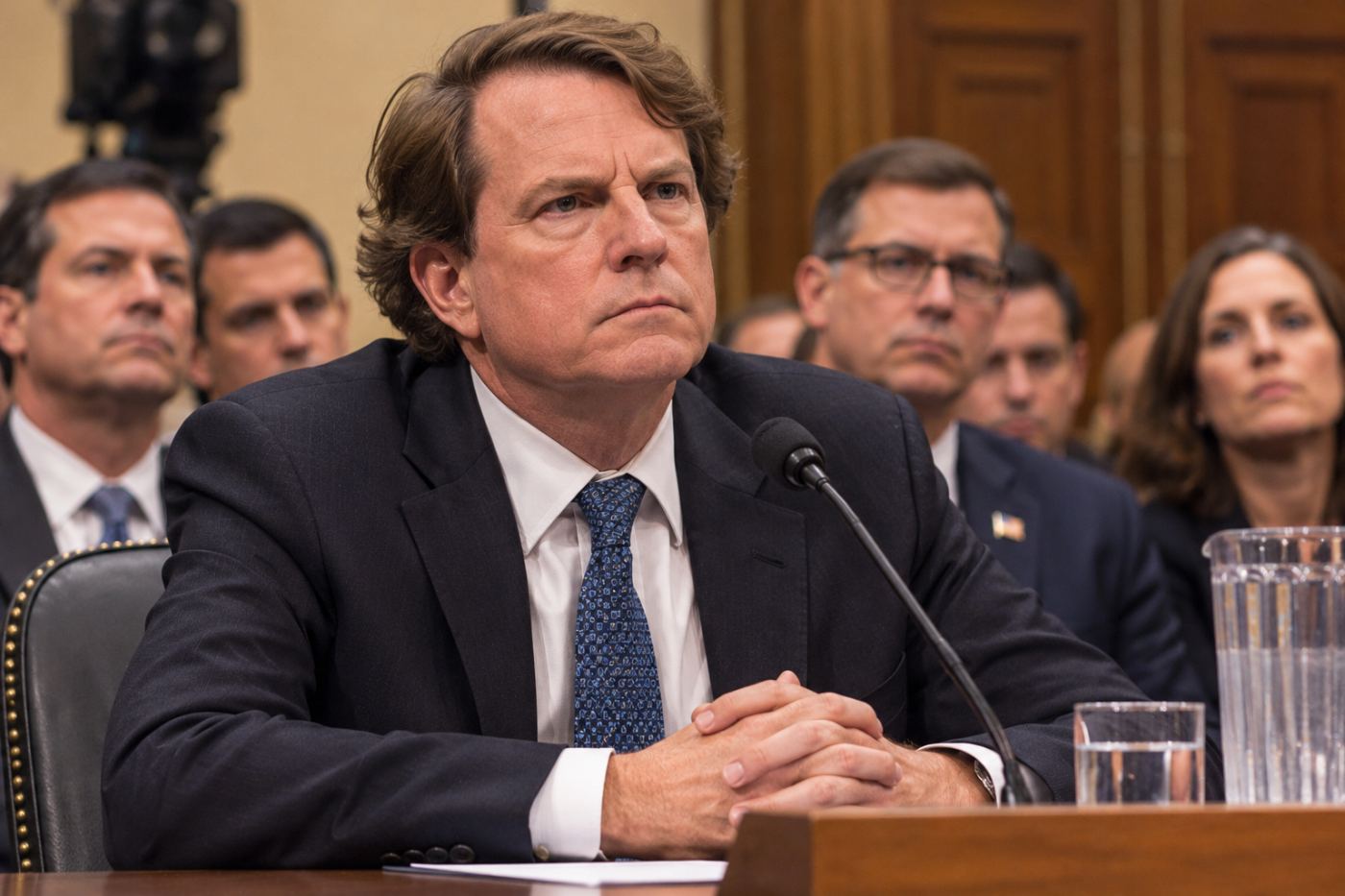
President Donald Trump's administration suffered a significant legal setback on November 25, 2019, when a federal judge rejected its sweeping argument that former White House Counsel Don McGahn was absolutely immune from being compelled to testify before Congress.
U.S. District Judge Ketanji Brown Jackson ruled that McGahn could not simply ignore a congressional subpoena because the president had instructed him not to appear.
The decision challenged a central element of Trump's resistance to congressional investigations: the claim that senior presidential advisers could be placed entirely beyond lawmakers' compulsory testimony powers.
Trump's Former Lawyer Becomes a Key Witness
McGahn served as White House counsel during much of Trump's first two years in office.
He became an important witness in Special Counsel Robert Mueller's investigation into Russian interference in the 2016 presidential election and possible obstruction of justice.
According to Mueller's report, Trump directed McGahn in June 2017 to contact Deputy Attorney General Rod Rosenstein and seek Mueller's removal.
McGahn did not carry out the instruction.
The report also described a later episode in which Trump allegedly pressured McGahn to deny that the president had ordered Mueller's removal.
Trump disputed the characterization of those events.
The House Judiciary Committee wanted to question McGahn about his firsthand knowledge of the episodes and other matters described in Mueller's findings.
The White House Blocks His Testimony
In April 2019, the House Judiciary Committee subpoenaed McGahn to testify and produce documents.
The Trump administration resisted.
The Justice Department's Office of Legal Counsel argued that McGahn, as a former senior presidential adviser, possessed absolute immunity from compelled congressional testimony concerning his official duties.
Under that theory, McGahn could refuse even to appear before the committee.
The administration maintained that forcing close presidential advisers to testify would undermine the separation of powers and interfere with confidential presidential decision-making.
Congressional investigators disagreed.
They argued that the White House was attempting to place important witnesses beyond meaningful legislative oversight.
Judge Jackson Rejects Absolute Immunity
On November 25, Judge Jackson issued a lengthy ruling rejecting the administration's position.
She concluded that former senior presidential advisers were not categorically exempt from congressional subpoenas.
Her decision distinguished between appearing to testify and asserting executive privilege in response to particular questions.
McGahn could potentially raise valid privileges concerning specific information, but the administration could not use a blanket immunity theory to excuse him from appearing altogether.
Jackson emphasized that presidents do not possess unlimited authority to prevent former government officials from responding to lawful congressional demands.
The ruling reaffirmed the judiciary's role in resolving disputes between the executive and legislative branches.
Executive Privilege Is Not Absolute Immunity
The legal distinction was crucial.
Executive privilege can protect certain confidential presidential communications from disclosure.
But the Trump administration had advanced a broader claim.
It argued that McGahn could not be compelled to appear before Congress at all.
Jackson rejected that interpretation.
Her ruling did not require McGahn to answer every possible question regardless of privilege.
Instead, it established that a former White House counsel could not disregard a congressional subpoena solely because the president asserted absolute testimonial immunity.
A Setback for Trump's Oversight Strategy
The decision came during an intense period of congressional investigations into the Trump administration.
House Democrats were examining the findings of Mueller's investigation while separately pursuing impeachment proceedings involving Trump's dealings with Ukraine.
The administration had repeatedly resisted subpoenas and requests for testimony from current and former officials.
Trump's defenders argued that congressional investigators were pursuing politically motivated inquiries and that the presidency required strong protections against legislative intrusion.
Critics countered that sweeping immunity claims threatened Congress's ability to investigate executive misconduct.
Jackson's ruling addressed that dispute by rejecting the categorical protection asserted for McGahn.
The Ruling Did Not End the Fight
Although Jackson ruled against the administration, McGahn did not immediately testify.
The Justice Department appealed, and the litigation continued through subsequent proceedings.
The decision therefore represented an important district court ruling rather than a final resolution of every constitutional issue involved.
McGahn eventually testified privately before the House Judiciary Committee in June 2021 under an agreement reached after Trump had left office.
His testimony addressed matters described in Mueller's report, including Trump's efforts concerning the special counsel.
The lengthy delay illustrated how litigation over congressional subpoenas could postpone oversight even when lawmakers ultimately obtained testimony.
November 25: A Court Challenges Presidential Secrecy
The McGahn ruling raised a fundamental constitutional question: how far can a president go in preventing Congress from questioning people who served in his administration?
Trump's Justice Department argued that close presidential advisers required extraordinary protection from compelled testimony.
Judge Jackson concluded that the Constitution did not support the blanket immunity the administration claimed.
The decision did not eliminate executive privilege or settle every dispute between Congress and the presidency.
But it rejected the argument that a former White House counsel could refuse to appear simply because the president ordered him to stay away.
On November 25, 2019, a federal court ruled that presidential advisers were not automatically beyond the reach of congressional subpoenas.
For Trump's administration, the ruling was a setback in its effort to prevent lawmakers from questioning a witness with firsthand knowledge of events examined in the Mueller investigation.