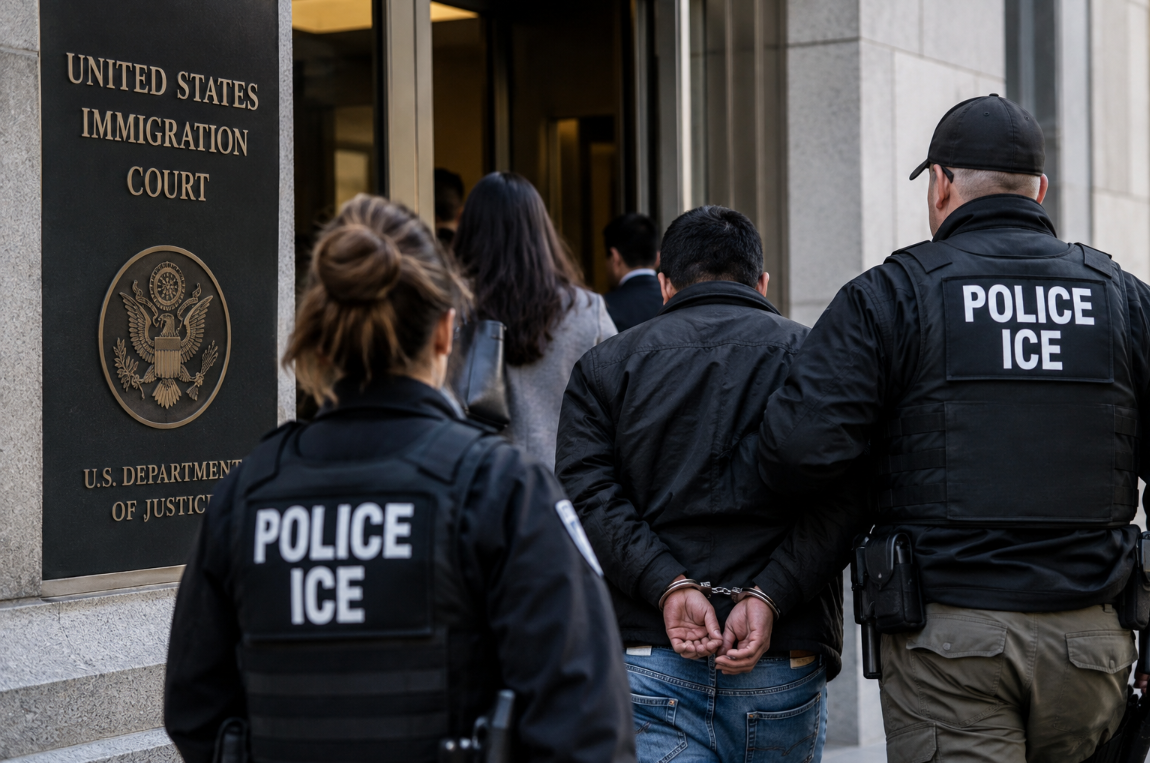
Federal Judge Blocks Trump's Immigration Courthouse Arrest Policy Nationwide
A federal judge delivered a major setback to one of the Trump administration's most controversial immigration-enforcement tactics on June 23, striking down policies that had allowed federal agents to conduct widespread immigration arrests at courthouses across the country.
U.S. District Judge P. Casey Pitts ruled that the administration had failed to adequately justify its decision to abandon previous restrictions on courthouse arrests.
The ruling went beyond earlier regional court orders.
It vacated the Trump administration's courthouse-arrest policies nationwide, effectively restoring earlier restrictions that generally prevented Immigration and Customs Enforcement agents from making civil immigration arrests at or near courthouses except under limited circumstances.
The decision also struck down a separate policy that allowed ICE to keep detainees in short-term holding facilities for as long as 72 hours.
At the center of the case was a basic question:
Should immigrants who appear in court to comply with the immigration system risk being arrested simply because they showed up?
Arrested After Appearing in Immigration Court
The lawsuit grew out of the experience of a Guatemalan asylum seeker who attended a routine immigration hearing in San Francisco.
After leaving court, she was arrested by ICE.
Her case became part of a broader challenge to the Trump administration's renewed use of immigration courthouses as locations for arrests.
Following Trump's return to office in January 2025, ICE abandoned restrictions established during the Biden administration that had sharply limited civil immigration enforcement at courthouses.
Agents subsequently began appearing at immigration courts around the country.
In some cases, government attorneys sought dismissal of immigration proceedings and ICE agents arrested individuals after they left the courtroom.
The administration defended the strategy as an efficient and relatively safe way to locate people already known to immigration authorities.
Immigration attorneys and advocacy organizations argued that it created an obvious problem: people could become afraid to attend the very court hearings the government required them to attend.
The Judge Said the Government Failed to Explain Its Decision
Pitts did not rule that immigration authorities can never arrest someone at a courthouse.
Instead, his decision focused heavily on how the administration changed its policy.
Federal agencies are governed by the Administrative Procedure Act, which generally requires agencies to provide reasoned explanations for significant policy decisions.
Pitts concluded that ICE failed that requirement.
Previous ICE policies had specifically recognized potential consequences of courthouse arrests, including disruption of court proceedings, public-safety concerns and the possibility that immigrants would become afraid to attend hearings.
When the Trump administration removed those restrictions, the judge found that the government failed to adequately address those concerns.
The policy change was therefore deemed “arbitrary and capricious.”
The Court Was Particularly Concerned About a Chilling Effect
One of the most significant issues was whether courthouse arrests discourage people from appearing for immigration proceedings.
That creates an unusual contradiction.
The government requires immigrants involved in removal proceedings to appear in court.
Missing a hearing can result in serious consequences, including a removal order being issued in someone's absence.
But if attending the hearing creates a significant possibility of immediate arrest, people may decide that appearing is too dangerous.
Previous ICE guidance explicitly recognized that concern.
Pitts concluded that the administration had not adequately explained why it was abandoning those earlier considerations.
Earlier Rules Allowed Arrests in Exceptional Circumstances
The policy restored by the court did not make courthouses completely off-limits to ICE.
The earlier rules contained exceptions.
Civil immigration enforcement could still occur at or near a courthouse when authorities were dealing with circumstances such as a national-security threat, an imminent danger of death or violence, hot pursuit of someone presenting a public-safety threat, or an imminent risk that evidence in a criminal case would be destroyed.
Additional arrests involving public-safety threats could also occur under certain circumstances with advance approval.
What the rules prevented was using routine courthouse appearances as a broadly available opportunity for civil immigration arrests.
The Ruling Also Addressed ICE Detention Conditions
The case wasn't limited to courthouse arrests.
Pitts also struck down an ICE policy allowing people to remain in temporary holding facilities for as long as 72 hours.
Those facilities are designed for short-term detention rather than extended stays.
Previous rules generally imposed a 12-hour limit.
The administration had expanded that period as ICE dealt with increased numbers of detainees and limited detention capacity.
The court found that ICE had not adequately considered alternatives and had failed to properly justify the expanded detention policy.
That portion of the ruling therefore represented a second setback for the administration's immigration-enforcement strategy.
New York Had Already Restricted the Practice
The California ruling wasn't the first time the administration encountered resistance over courthouse arrests.
A federal judge in New York had previously restricted ICE arrests at several Manhattan immigration courthouses.
That ruling was geographically limited.
Pitts' June decision was much broader.
By vacating the underlying federal policies rather than merely prohibiting their enforcement against particular plaintiffs, his decision affected the policy nationwide.
The Administration Defends Courthouse Arrests
The Department of Homeland Security has defended courthouse arrests as a legitimate immigration-enforcement tool.
From the government's perspective, courthouses offer several practical advantages.
Authorities know where an individual will be.
People entering courthouses are generally screened for weapons.
And ICE can make arrests without conducting potentially more dangerous operations at homes, workplaces or public locations.
The administration therefore argues that courthouse enforcement can actually reduce risks to officers and the public.
Opponents respond that immigration courts cannot function effectively if people believe complying with a court summons could lead directly to their detention.
The judge ultimately concluded that the government had not sufficiently grappled with that concern when changing the policy.
A Significant Check on Trump's Deportation Strategy
The ruling does not prevent the Trump administration from enforcing immigration law.
It does not prevent ICE from arresting people who are subject to detention or removal.
And it does not create an absolute prohibition against every immigration arrest occurring near a courthouse.
What it does is remove the broad policy the administration had been using to conduct those arrests.
If the federal government wants to change longstanding restrictions on courthouse enforcement, the court concluded, it must follow federal administrative law and provide a reasoned explanation for doing so.
For immigrants appearing for hearings, the practical consequence is significant.
The government can still pursue immigration cases against them.
But under the rules restored by the court, simply walking into an immigration courthouse is no longer supposed to make the courthouse itself a routine location for an ICE arrest.
That makes the June 23 decision one of the most consequential judicial setbacks so far to the administration's courthouse-enforcement strategy.