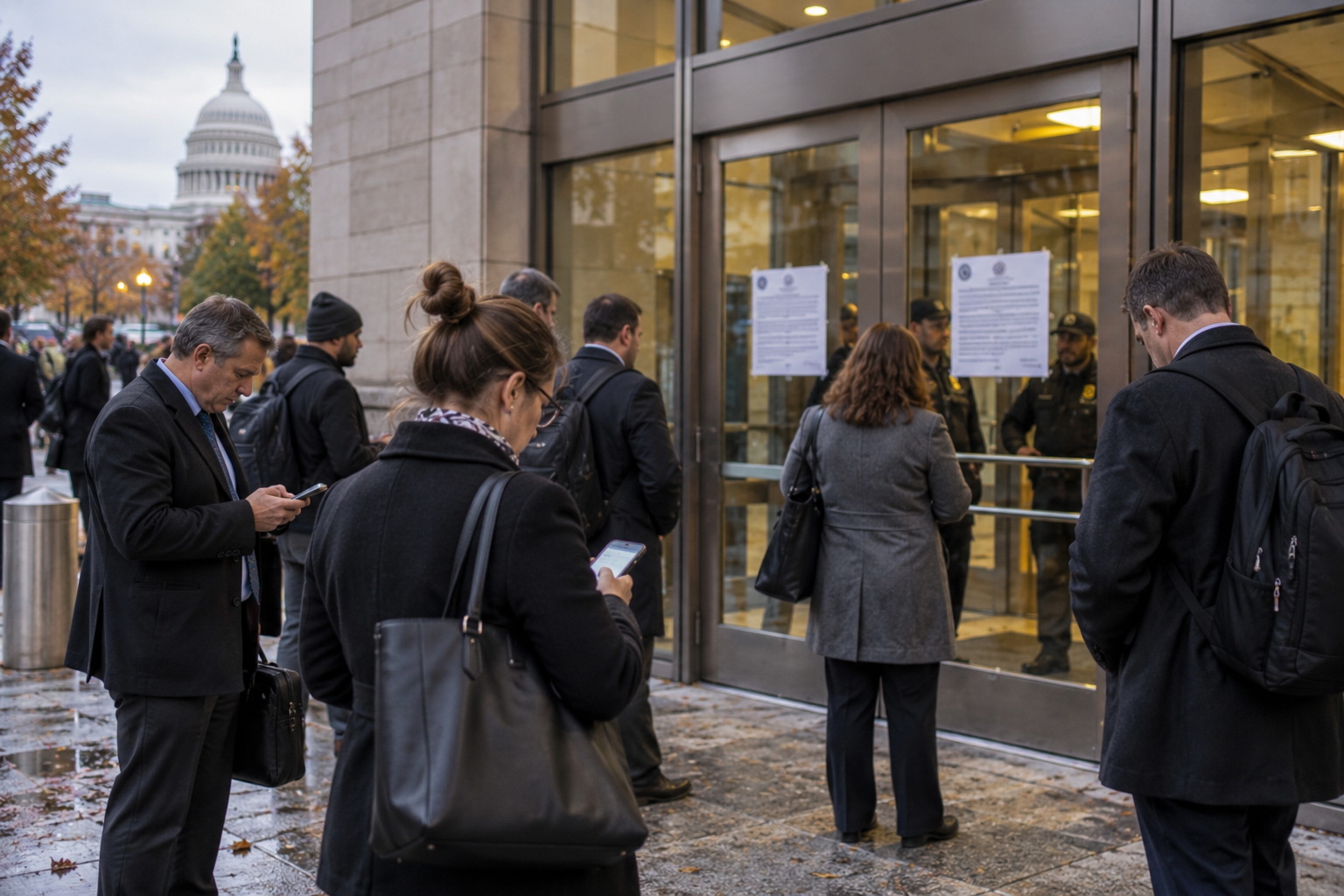
The federal government entered a shutdown as October 1, 2025 began, after Congress failed to reach an agreement to fund federal agencies for the new fiscal year.
The funding lapse marked the first federal shutdown since 2019 and opened another major confrontation between President Donald Trump, congressional Republicans and Democrats over federal spending and health-care policy.
But this shutdown carried an additional threat.
Rather than treating the interruption primarily as a temporary funding dispute, the Trump administration warned that it could use the shutdown to permanently reduce parts of the federal workforce.
Hundreds of thousands of federal employees suddenly faced furloughs, unpaid work or the possibility that their jobs could disappear altogether.
Congress Fails to Reach a Deal
Federal funding expired after lawmakers failed to approve either the regular appropriations bills or a temporary measure to keep the government operating.
Republicans proposed temporarily extending federal spending largely at existing levels.
Democrats sought to attach health-care provisions, most prominently an extension of enhanced Affordable Care Act premium subsidies scheduled to expire at the end of 2025.
Neither side had enough votes in the Senate to advance its preferred approach.
Without legislation reaching Trump's desk before the deadline, the funding lapse began as the new fiscal year opened on October 1.
Health Care Becomes Central to the Fight
Health-care policy quickly emerged as one of the central disagreements.
Democrats argued that Congress needed to address the expiring enhanced Affordable Care Act subsidies as part of the funding negotiations.
The subsidies had reduced insurance costs for millions of people purchasing coverage through ACA marketplaces.
Republicans argued that the immediate priority should be reopening the government and that health-care policy could be negotiated separately.
Both parties blamed the other for the shutdown.
Democrats said Republicans were unwilling to address rising health-insurance costs.
Republicans accused Democrats of blocking a straightforward temporary funding measure in pursuit of unrelated policy demands.
The disagreement left federal agencies without appropriations and large portions of the government unable to operate normally.
Trump Administration Raises the Stakes
The Trump administration added another dimension to the shutdown.
Office of Management and Budget Director Russell Vought had instructed agencies before the deadline to prepare plans that could include reductions in force for employees working in programs the administration did not consider consistent with the president's priorities.
On October 1, Vought told House Republicans that layoffs could begin within days.
Vice President JD Vance similarly warned that federal workers could lose their jobs if the shutdown continued.
That represented a significant departure from the traditional mechanics of a government shutdown.
During previous shutdowns, many affected federal employees had been furloughed temporarily and returned to work once funding resumed.
The Trump administration was openly discussing permanent job reductions.
Federal Workers Caught in the Middle
The immediate consequences spread across the federal workforce.
Employees whose jobs were not legally permitted to continue during the funding lapse were furloughed.
Others whose work was considered essential or otherwise excepted from the shutdown continued reporting to work even though their pay could be delayed until Congress restored funding.
Military personnel, federal law-enforcement officers and other essential workers continued performing their duties.
Other government activities slowed or stopped.
Services involving small-business loans, some national park operations, scientific research, federal training programs and administrative functions were among those potentially affected.
The uncertainty extended far beyond Washington.
Federal employees and contractors across the country faced questions about paychecks, schedules and whether their positions would survive the political fight.
The White House Uses the Shutdown to Push Its Agenda
The administration also began taking actions affecting federal programs and projects while the shutdown was underway.
On October 1, officials announced holds on billions of dollars connected to infrastructure and energy projects, including projects in Democratic-led states.
The White House argued that the shutdown required the government to prioritize limited resources.
Critics accused the administration of using the funding crisis to advance political and policy objectives that extended beyond the immediate budget dispute.
The confrontation therefore became about more than reopening federal agencies.
It became part of a larger struggle over how much authority the executive branch could exercise during a lapse in congressional funding.
The Shutdown Would Become Historic
On October 1, nobody knew exactly how long the confrontation would last.
It would not be resolved quickly.
The funding gap continued through November 11, lasting 42 full days before legislation restoring funding was signed on November 12.
That made it the longest government-wide funding gap in American history.
Federal employees who had been affected by the shutdown ultimately received retroactive pay.
But on its first day, none of that was known.
What Americans saw on October 1, 2025 was the beginning of another major confrontation over government spending — this time accompanied by an administration openly considering whether a temporary shutdown could also become an opportunity to permanently reshape the federal workforce.
The government had run out of money.
The political battle over what happened next had only begun.