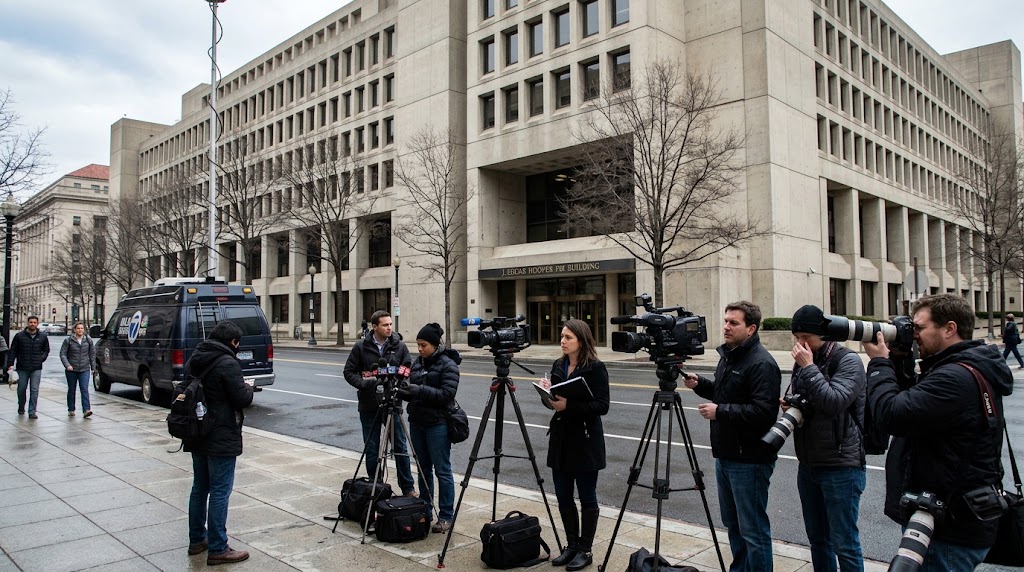
Less than two months into Donald Trump's presidency, FBI Director James Comey walked into a congressional hearing and publicly confirmed something the White House had been confronting through weeks of questions and news reports:
The FBI was investigating Russian interference in the 2016 presidential election — including possible connections between people associated with Trump's campaign and the Russian government.
Comey's announcement did not establish that the Trump campaign had coordinated with Russia.
It established that the possibility was serious enough to be part of an active FBI counterintelligence investigation.
And during the very same hearing, Comey delivered another significant statement.
The FBI had found no information supporting Trump's allegation that Barack Obama had ordered his phones wiretapped at Trump Tower.
Comey Makes the Investigation Public
Comey appeared before the House Permanent Select Committee on Intelligence alongside National Security Agency Director Admiral Michael Rogers.
Normally, the FBI does not publicly acknowledge ongoing investigations.
Comey told lawmakers that this situation was different.
He said the Justice Department had authorized him to confirm the investigation because of the unusual circumstances and the public interest surrounding it.
Comey then publicly disclosed the scope of the inquiry.
The FBI, he said, was investigating the Russian government's efforts to interfere in the 2016 presidential election.
That investigation included examining links between individuals associated with the Trump campaign and the Russian government.
Investigators were also examining whether there had been coordination between people associated with the campaign and Russia's interference efforts.
And, Comey explained, investigators would assess whether any crimes had been committed.
What Comey Did Not Say
Comey's testimony was explosive, but its limitations were equally important.
He did not announce that Trump had committed a crime.
He did not announce that his campaign had conspired with Russia.
He did not identify everyone whose conduct the FBI was examining.
And he did not predict what investigators would ultimately find.
Comey repeatedly emphasized that the investigation was ongoing and classified.
The significance of his announcement was therefore not proof of coordination.
It was official confirmation that the FBI was investigating the question.
Russia Had Interfered in the Election
The investigation unfolded against a broader intelligence finding about Russia's actions during the 2016 campaign.
U.S. intelligence agencies had already concluded that Russia conducted an influence campaign targeting the presidential election.
Russian operations included cyberattacks against political organizations and the release of stolen information.
The FBI's investigation was examining a separate and politically explosive question:
Were there links between people associated with Trump's campaign and the Russian government, and had anyone associated with the campaign coordinated with Russia's efforts?
On March 20, Americans learned officially that the FBI was trying to answer that question.
Then Came Trump's Wiretapping Claim
The hearing also returned to an extraordinary accusation Trump had made just over two weeks earlier.
On March 4, Trump had accused former President Barack Obama of having his phones tapped at Trump Tower before the election.
Trump compared the alleged surveillance to Watergate.
He presented no evidence publicly establishing the accusation.
Now the director of the FBI was sitting before Congress.
Comey addressed it directly.
He told lawmakers that the FBI had no information supporting Trump's tweets.
Comey said the Bureau had examined the allegation carefully.
He also told Congress that the Justice Department had authorized him to say that its answer was the same.
It had no information supporting the allegation either.
Two Stories Collide in One Hearing
That created a striking contrast.
Trump had publicly accused his predecessor of improperly surveilling him during a presidential campaign.
The FBI director said there was no information supporting that accusation.
Meanwhile, Comey confirmed that an entirely different investigation actually did exist:
The FBI was investigating Russian interference in the election and possible links or coordination involving individuals associated with Trump's campaign.
The two issues were not the same.
But on March 20, they collided in the same congressional hearing.
An Investigation That Would Soon Become Even Bigger
Comey's announcement was only the beginning of the public phase of the Russia investigation.
Less than two months later, Trump would fire him.
On May 17, Deputy Attorney General Rod Rosenstein appointed former FBI Director Robert Mueller as special counsel to oversee the investigation into Russian election interference and related matters.
Mueller's investigation would continue for nearly two years.
It would result in criminal charges against numerous individuals and Russian entities and p