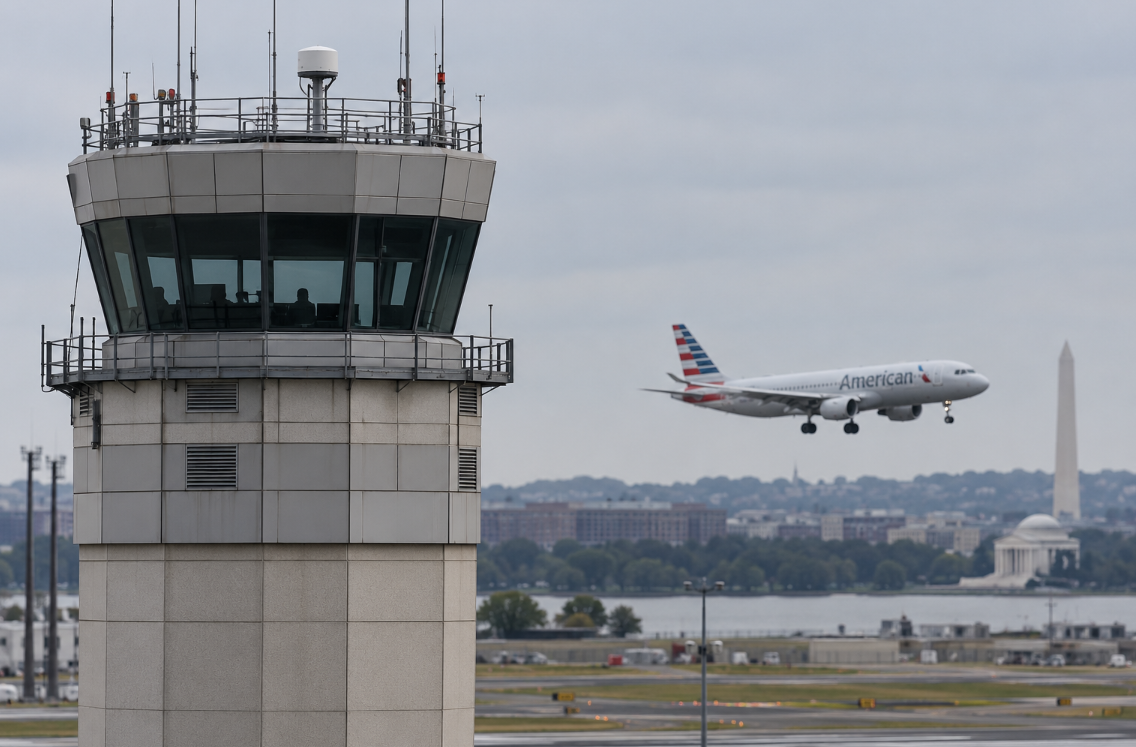
President Donald Trump's ambitious plan to reshape part of the nation's capital has cleared another federal hurdle, with the Federal Aviation Administration determining that his proposed 250-foot triumphal arch near Arlington National Cemetery would not pose a hazard to aircraft — provided the enormous structure meets special visibility requirements.
The proposed monument would rise near one of the busiest and most tightly controlled pieces of airspace in the country, just thousands of feet from Ronald Reagan Washington National Airport.
Its extraordinary size and location have prompted questions about aviation safety, construction impacts and the transformation of one of Washington's most historically significant landscapes.
A 250-Foot Monument Near an Airport
The proposed arch would stand approximately 250 feet tall near the Potomac River, between Washington and Arlington National Cemetery.
Reagan National Airport is only about 3,000 feet away.
Aircraft arriving at and departing from Reagan regularly fly over the surrounding area, making the height of any new structure particularly important.
The FAA conducted an aeronautical review of the proposal and ultimately concluded that the arch itself would not constitute a hazard to air navigation if required conditions are satisfied.
That doesn't mean the structure can simply disappear into the Washington skyline.
The FAA wants it clearly visible to pilots.
An 'Eternal Flame' Could Serve an Aviation Purpose
One of the more unusual elements of the FAA's determination involves the top of the monument.
The proposed arch includes an "eternal flame," and the FAA wants the feature sufficiently conspicuous to help identify the structure to aircraft.
The arch would also be illuminated with floodlights.
The result is an unusual intersection of monumental architecture and aviation safety: a decorative flame envisioned as part of the monument could simultaneously help make the enormous structure visible to pilots operating near Reagan National.
Earlier consideration had included traditional red obstruction lighting, but those requirements were ultimately dropped in favor of other visibility measures.
Construction Could Create an Even Bigger Aviation Issue
The completed arch isn't the only concern.
Building it would require cranes potentially reaching approximately 320 feet into the air.
Construction could continue for as long as three years.
Temporary cranes can present different aviation concerns than permanent structures because their height and location may change throughout a construction project.
The FAA's determination therefore doesn't eliminate every aviation issue associated with building the monument.
Construction equipment would still have to comply with applicable aviation requirements.
The Arch Is Part of Trump's Effort to Transform Washington
The project is part of Trump's broader effort to alter the appearance of Washington as the United States marks its 250th anniversary.
Trump has championed traditional and monumental architecture and has taken a personal interest in several major construction projects around the capital.
The proposed arch would be among the most visually dramatic.
At 250 feet, it would dwarf many traditional triumphal arches around the world and become a major new feature of the Washington landscape.
Its location would also place it near an exceptionally symbolic corridor connecting Washington's monumental core with Arlington National Cemetery.
Critics Question the Location
Opposition to the project extends beyond aviation concerns.
Veterans have filed a lawsuit seeking to block the project, arguing that the structure could interfere with the historic visual relationship between the Lincoln Memorial and Arlington National Cemetery.
Sen. Tammy Duckworth of Illinois, an Iraq War veteran and former Army helicopter pilot, has also raised concerns about the project's potential aviation implications.
The administration, meanwhile, is moving forward with planning while defending the project as part of its effort to commemorate America's 250th anniversary.
FAA Approval Doesn't End the Fight
The FAA's decision removes one potential obstacle, but it does not constitute final approval for every aspect of the project.
The aviation determination can be challenged through a petition for reconsideration, with an October 18 deadline.
The project is also facing litigation.
A federal judge has ordered the administration to provide advance notice before taking certain actions at the proposed construction site, with limited exceptions for preliminary work.
That means Trump's arch may have cleared the FAA, but its future is far from settled.
A Monument Unlike Anything Else in Washington
Washington is already a city defined by monumental architecture.
The Washington Monument, Lincoln Memorial, Jefferson Memorial and U.S. Capitol have become internationally recognized symbols of the United States.
Trump's proposed arch would add something dramatically different to that landscape.
Its scale alone would guarantee that.
But its proximity to Arlington National Cemetery and Reagan National Airport means the debate isn't simply about architectural taste.
It involves historic views, federal land, aviation safety, construction logistics and the question of how dramatically a sitting president should be able to reshape the physical landscape of the nation's capital.
The FAA has now answered one piece of that question.
From an aviation standpoint, the agency says Trump's massive arch can be built without creating a hazard — provided it remains visible to the aircraft flying nearby.
Whether the monument ultimately rises over Washington remains a much larger question.