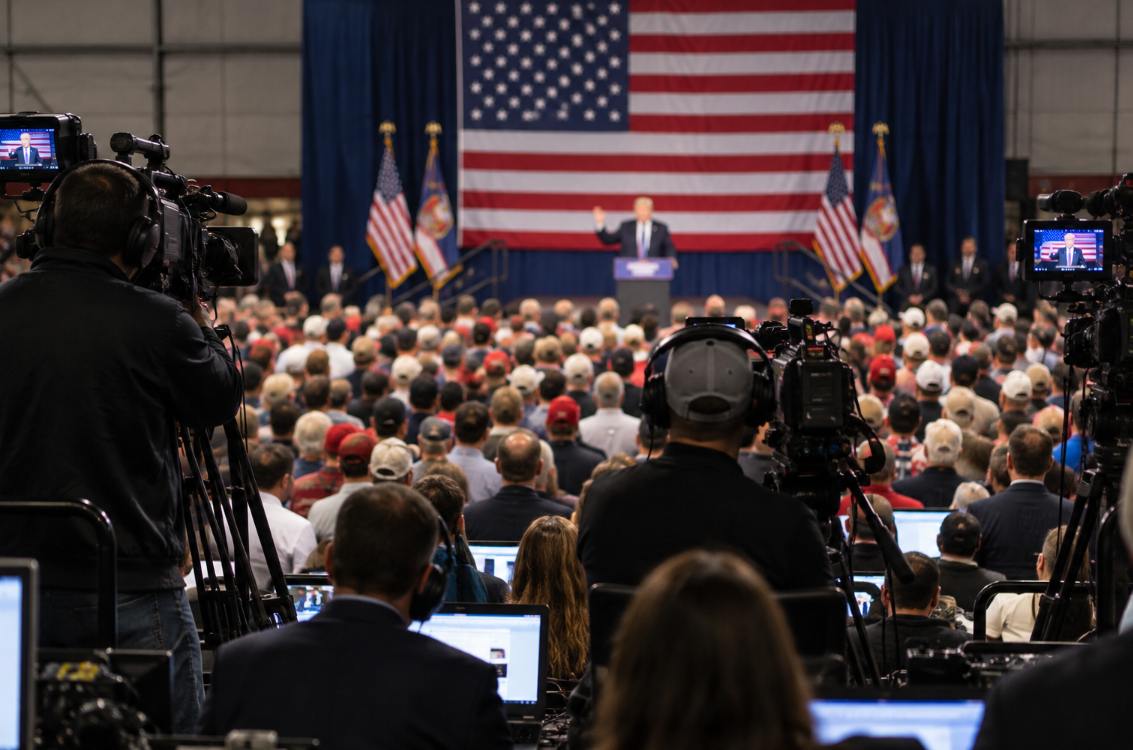
When Donald Trump descended the escalator at Trump Tower on June 16, 2015, and announced that he was running for president, much of the political world did not react as though it had just witnessed the arrival of the eventual Republican nominee.
Trump was a billionaire real-estate developer and reality television personality who had flirted with presidential campaigns before.
Many political observers regarded his latest campaign with skepticism.
The numbers seemed to support them.
Around the time Trump entered the race, his support among Republican voters was near the bottom of a crowded field. One national poll conducted shortly after his announcement had Trump at just 1 percent.
There appeared to be little reason to believe that was about to change.
It changed remarkably quickly.
The Candidate Everyone Was Talking About
Whatever people thought about Donald Trump, they were talking about him.
His June 16 announcement generated an extraordinary amount of attention.
Millions of Americans interacted with material about Trump's campaign on Facebook on the day of his announcement, dramatically exceeding the online attention generated by several other Republican campaign launches.
Then came the controversy surrounding his comments about Mexican immigrants.
Trump was condemned by Latino organizations, politicians, journalists and businesses. Univision severed its relationship with the Miss Universe Organization. NBCUniversal followed. Macy's discontinued its Trump-branded merchandise.
For a conventional political candidate, the succession of controversies might have been expected to damage a campaign.
Trump's support among Republican voters was moving in the opposite direction.
From the Bottom of the Field to the Top
The transformation happened in weeks.
In June, a Monmouth University poll had Trump receiving just 2 percent support among Republican voters.
By July, Monmouth had him at 13 percent.
His standing among Republicans changed just as dramatically.
In late May, 65 percent of Republicans surveyed in a Washington Post-ABC News poll viewed Trump unfavorably.
By mid-July, that had reversed: 57 percent viewed him favorably.
Then came a result that was much harder for the political world to dismiss.
A Washington Post-ABC News poll conducted July 16–19 found Trump supported by 24 percent of Republicans and Republican-leaning independents.
Scott Walker was second at 13 percent.
Jeb Bush was at 12 percent.
Donald Trump wasn't merely generating headlines anymore.
He was leading the Republican presidential field.
Trump Dominates the Conversation
Trump's rise coincided with an extraordinary level of media attention.
During the month following his announcement, researchers examining the presidential campaign conversation found that Trump generated more than 7 million mentions.
Among Republican candidates, he accounted for nearly half of the conversation.
Candidates who had spent months assembling campaign organizations, hiring political professionals, courting donors and developing policy platforms suddenly found themselves competing for attention with a candidate who seemed capable of creating another national story almost every time he spoke.
Trump understood television.
He understood controversy.
And he understood that a presidential candidate did not necessarily have to control what people were saying about him if he could ensure that they were talking about him.
Then He Attacked John McCain
If Trump's comments about Mexican immigrants were supposed to end his campaign, they didn't.
Then came another moment that political observers thought might finally damage him.
On July 18, Trump attacked Senator John McCain's reputation as a war hero.
“He's not a war hero,” Trump said.
Trump then added:
“He's a war hero because he was captured. I like people that weren't captured.”
McCain had spent more than five years as a prisoner of war in North Vietnam after his aircraft was shot down in 1967.
Republican politicians quickly condemned Trump's comments.
Once again, there were questions about whether Trump had finally gone too far.
Once again, his campaign continued.
The Rules Were Changing
Something unusual was happening.
Political controversies that traditionally might have forced a candidate to apologize, retreat or leave the race were not producing the expected result.
Trump frequently did the opposite.
He fought back.
He attacked his critics.
He accused the news media of treating him unfairly.
And he continued appearing on television.
The constant controversies produced constant coverage, and the constant coverage kept Trump at the center of the Republican presidential campaign.
Researchers studying media coverage during this period found that Trump consistently received an unusually large share of attention after entering the race.
That attention alone does not explain why Republican voters supported him. His positions on immigration and dissatisfaction with the Republican political establishment also resonated with a portion of the party's electorate.
But it ensured that virtually everyone knew what Donald Trump was saying.
The Joke Was Becoming a Serious Campaign
The political establishment had reasons for initially doubting Trump.
Presidential campaigns normally required enormous fundraising networks, experienced political organizations and years of relationships within a political party.
Trump had never held elected office.
He had never served in government.
He was competing against governors, senators and experienced national politicians.
Yet only weeks after entering the race, he was beating them.
The transition happened so rapidly that the conventional understanding of Trump's campaign struggled to keep up with the polling.
First, he was the celebrity candidate.
Then he was the controversial candidate.
Then he was the candidate generating enormous television ratings and media coverage.
And by July 2015, Donald Trump was something else entirely:
The Republican front-runner.
The campaign that many people initially treated as political entertainment was becoming a genuine fight for control of the Republican Party.
And it was happening much faster than almost anyone expected.