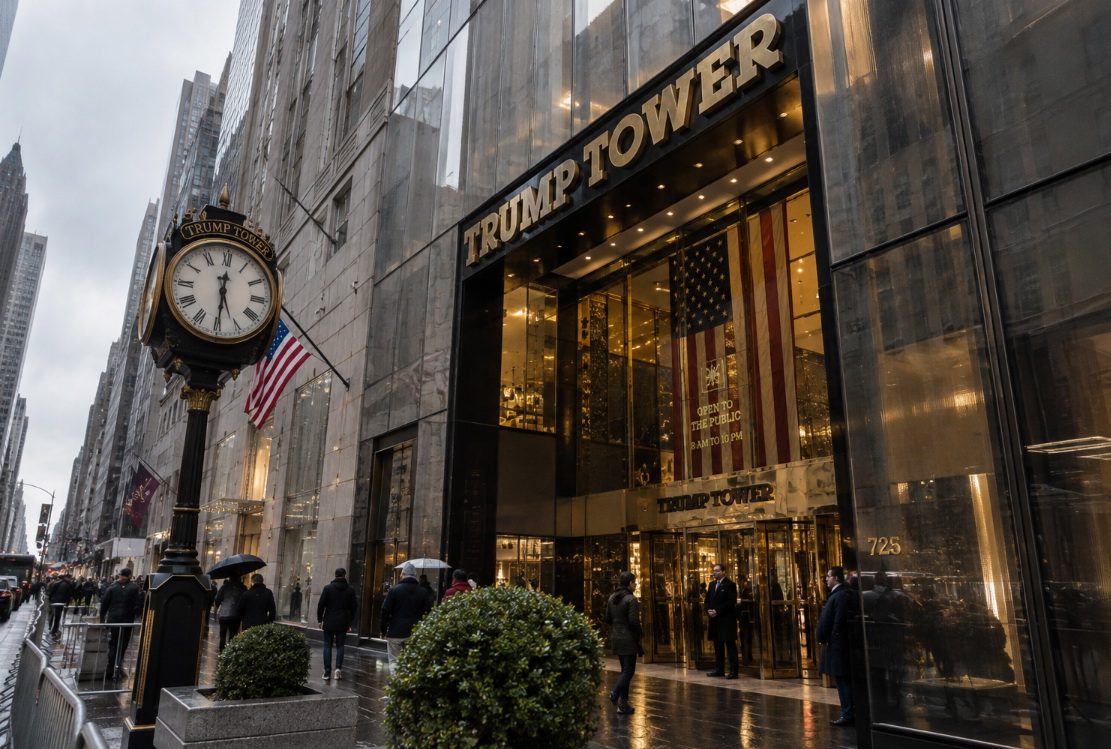
For more than a year, questions had followed Donald Trump's campaign about its contacts with Russians.
Then, in July 2017, the public learned about a meeting that brought those questions directly inside Trump Tower.
Donald Trump Jr., Jared Kushner and campaign chairman Paul Manafort had attended a June 2016 meeting with a Russian lawyer and others after Trump Jr. was explicitly offered damaging information about Hillary Clinton.
The emails arranging the meeting were even more consequential than the fact that the meeting occurred.
Trump Jr. had been told that the information was coming from Russia.
He had been told it was part of the Russian government's support for his father's presidential campaign.
And when offered the information, Donald Trump Jr. responded:
“If it's what you say I love it especially later in the summer.”
Those words would become one of the most memorable quotations of the investigation into Russia and the 2016 election.
The Story Begins to Unravel
The meeting itself had occurred more than a year earlier, on June 9, 2016, at Trump Tower in New York.
But the public did not learn about it until July 2017.
The initial disclosure revealed that Donald Trump Jr., Jared Kushner and Paul Manafort had met with Russian attorney Natalia Veselnitskaya.
Trump Jr.'s initial explanation portrayed the encounter largely as a discussion about Russian adoption policy.
That explanation quickly became incomplete as additional details emerged.
The meeting had not simply appeared on Trump Jr.'s calendar.
There had been an email exchange explaining why he was being invited.
And those emails were explicit.
“Official Documents and Information”
The approach came through Rob Goldstone, a British music publicist who represented Russian pop singer Emin Agalarov.
Trump had previous connections with the Agalarov family through the 2013 Miss Universe pageant in Moscow.
On June 3, 2016, Goldstone emailed Donald Trump Jr.
Goldstone wrote that Emin's father, Russian businessman Aras Agalarov, had met with what Goldstone described as the “Crown prosecutor of Russia.”
According to the email, the prosecutor had offered to provide the Trump campaign with “official documents and information” that would incriminate Hillary Clinton and could be useful to Donald Trump.
Then came the sentence that would make the email particularly significant.
Goldstone described the proposed information as:
“part of Russia and its government's support for Mr. Trump.”
Trump Jr. did not reject the offer.
He did not contact the FBI.
Instead, he replied within minutes:
“If it's what you say I love it especially later in the summer.”
The meeting was arranged.
Manafort and Kushner Are Brought In
Trump Jr. subsequently forwarded the email chain to two of the most senior figures in the Trump campaign.
Paul Manafort was Trump's campaign chairman.
Jared Kushner was Trump's son-in-law and a senior campaign adviser.
Both attended the meeting.
On June 9, Trump Jr., Manafort and Kushner gathered at Trump Tower expecting a discussion connected to damaging information about Hillary Clinton.
Later evidence reviewed by Special Counsel Robert Mueller's investigation concluded that the communications arranging the meeting and the participation of senior campaign officials supported an inference that the campaign anticipated receiving derogatory material from official Russian sources that could help Trump's electoral prospects.
What actually happened inside the meeting was less explosive than the promise that had brought everyone there.
The Meeting Doesn't Deliver What Was Promised
Veselnitskaya discussed allegations involving money connected to Clinton and Democratic interests.
The conversation then moved toward the Magnitsky Act, a U.S. sanctions law targeting Russian officials accused of human-rights abuses.
Russia had retaliated against the law by prohibiting Americans from adopting Russian children.
That is why discussions of “Russian adoptions” became intertwined with the sanctions issue.
Participants later described the meeting as disappointing and said the promised damaging information about Clinton never materialized in the form they had expected.
But politically and investigatively, that did not erase the significance of why the meeting had been arranged.
The central issue was no longer simply what information had actually been delivered.
It was that senior members of an American presidential campaign had agreed to attend a meeting after being offered damaging information about their opponent that was explicitly described to them as Russian government support for their candidate.
Then the Emails Become Public
As reporting about the meeting accelerated, Trump Jr. took an extraordinary step on July 11.
He released the email chain himself.
The emails removed much of the ambiguity surrounding how the meeting had originated.
Americans could now read the exchange directly.
There was Goldstone describing information that could “incriminate Hillary.”
There was the explicit reference to “Russia and its government's support for Mr. Trump.”
And there was Trump Jr.'s response:
“I love it.”
The release transformed the story.
Until then, much of the Russia controversy had revolved around investigations, anonymous sources, intelligence assessments and competing political claims.
This time there was a written record.
Trump Jr. Defends Himself
Trump Jr. argued that he had approached the meeting as routine political opposition research.
He said that before the meeting he did not know the identity of the person he would meet and that the promised information ultimately went nowhere.
He characterized the encounter as a short meeting that produced no meaningful information.
His defenders emphasized that political campaigns routinely seek damaging information about opponents.
Critics focused on a different question:
What should an American campaign do when the offered information is explicitly presented as assistance from a foreign government?
That question would follow Trump Jr. long after the emails became public.
What Did Donald Trump Know?
The disclosure also raised an obvious question about Donald Trump himself.
Did he know about the meeting before it happened?
Trump Jr. later said he had not told his father about it.
Trump also denied knowing about the meeting in advance.
The Mueller investigation examined conflicting evidence surrounding that question.
Former Trump attorney Michael Cohen recalled being present when Trump Jr. told his father that a meeting involving adverse information about Clinton was going forward, although Cohen did not recall Trump Jr. saying the meeting involved Russia.
Trump Jr. denied informing his father.
Investigators ultimately did not establish that Donald Trump knew beforehand about the Trump Tower meeting based on the evidence available to them.
The uncertainty surrounding that question became another component of the broader Russia investigation.
The Legal Question
The meeting also prompted investigators to examine whether federal campaign-finance laws had been violated.
Federal law prohibits foreign nationals from making certain contributions or donations in connection with American elections and prohibits people from knowingly soliciting, accepting or receiving prohibited foreign contributions.
Mueller's investigators considered whether the promised information could constitute a prohibited “thing of value” and whether Trump Jr.'s response could amount to solicitation.
The Special Counsel's Office ultimately did not bring charges against Trump Jr. or the other campaign participants over the meeting.
Among the issues prosecutors considered were whether they could establish the necessary willfulness and whether the promised opposition research could be assigned a value sufficient to satisfy applicable criminal thresholds.
That legal conclusion, however, was separate from the factual record of how the meeting had been arranged.
The emails themselves were not disputed.
A Different Kind of Russia Story
The Trump Tower meeting became one of the defining episodes of the Russia investigation because it was unusually concrete.
There was an offer.
There was an email.
There was a response.
There was a meeting.
The message presented to Donald Trump Jr. said damaging information about Hillary Clinton was being offered as part of Russian government support for Donald Trump.
Trump Jr.'s response was preserved in writing.
“If it's what you say I love it.”
He then brought Jared Kushner and Paul Manafort into the meeting.
The promised material apparently did not live up to expectations, and the Mueller investigation later declined to prosecute the participants for campaign-finance offenses arising from the meeting.
But those later developments did not change what Americans learned in July 2017.
Senior members of Donald Trump's campaign had been presented with what was described to them as an opportunity to obtain damaging information about Hillary Clinton from a source claiming Russian government backing.
Rather than rejecting the approach, Donald Trump Jr. accepted the meeting.
For months, the country had debated whether people around Trump's campaign had been receptive to help from Russia.
Then Americans saw an email in which the president's son had been offered exactly that.
His answer was three words that would follow the Trump presidency for years:
“I love it.”