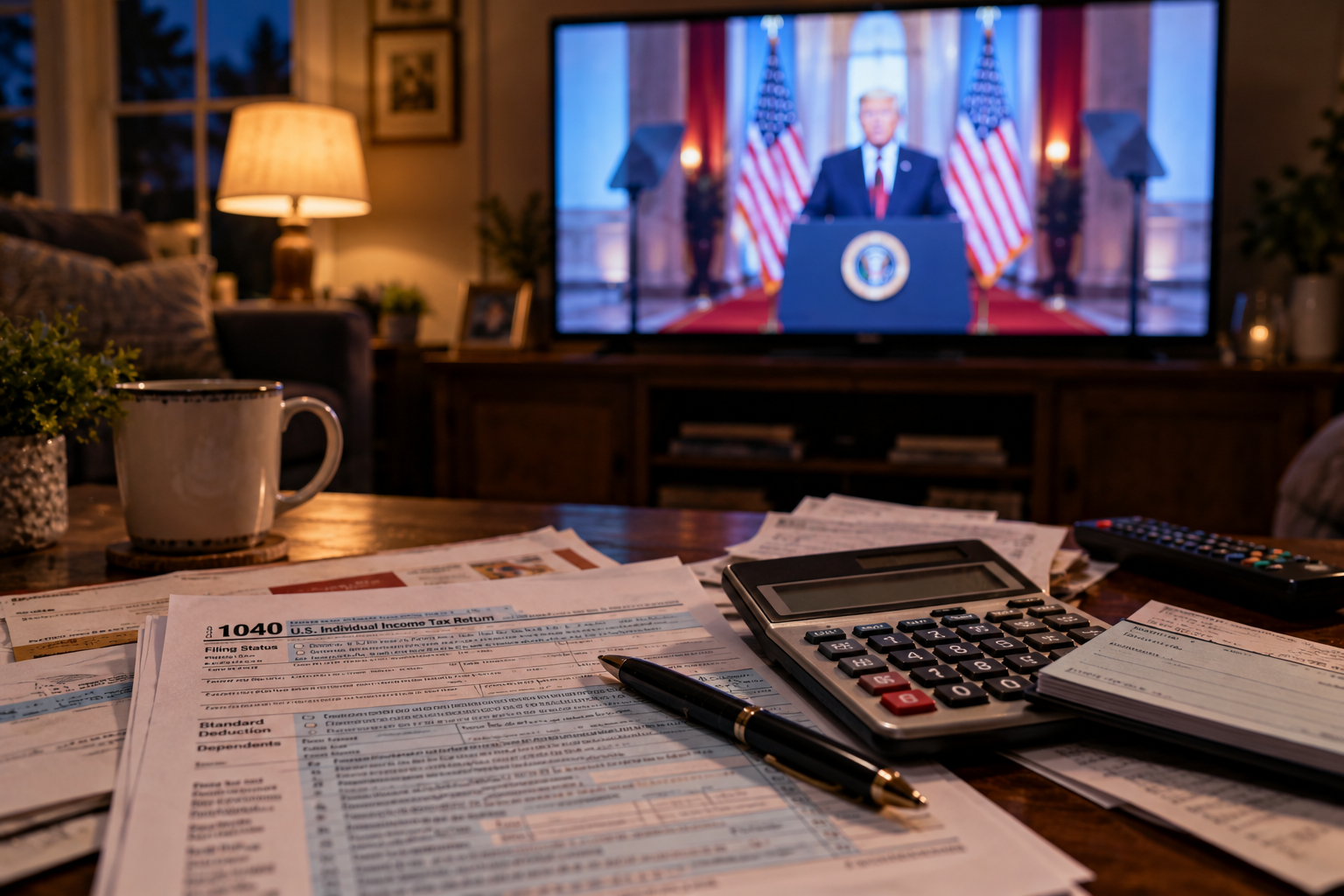
Turn on the television and you might see something that looks remarkably like a Donald Trump campaign commercial.
Donald Trump appears on screen.
Trump talks about America's supposed "golden age."
Trump boasts about his accomplishments.
Trump attacks the "deep state," "globalists" and the "sick political class."
One commercial even uses language remarkably similar to Trump's previous campaign advertising.
But then something unusual appears at the bottom of the screen.
"Paid for by the U.S. Government."
That means you.
American taxpayers are paying to put Donald Trump on television just weeks before the 2026 midterm elections.
And the federal government has already spent at least $1.7 million doing it.
These Aren't Trump Campaign Ads
That's the important distinction.
Political campaigns routinely spend millions of dollars producing television advertisements.
Trump's political organizations can legally raise money from supporters and spend it promoting Trump and Republican candidates.
But these commercials aren't being paid for by Trump's campaign.
They are being paid for by the federal government.
According to advertising-tracking firm AdImpact, the government has spent at least $1.7 million airing three Trump-focused television advertisements.
At least some of the money reportedly originated with funding intended for Customs and Border Protection.
That immediately raises an obvious question:
Why are taxpayer dollars intended for the federal government being used to purchase television airtime promoting Donald Trump?
Watch the Ads and Decide What They Look Like
The White House insists these aren't political advertisements.
It calls them "public service announcements."
But consider what's actually in them.
One advertisement features Trump talking about defeating communism while touting his administration's accomplishments.
Another features Trump declaring that America has entered a "golden age."
A third is even more remarkable.
Trump slowly walks down a hallway while describing what he calls a "final battle" against the "deep state," "globalists" and the "sick political class that hates our country."
The advertisement concludes with Trump promising:
"We will rout the fake news media, and we will liberate America from these villains once and for all."
Then comes the disclosure:
Paid for by the U.S. Government.
The advertisement reportedly bears a striking resemblance to material used by Trump's own 2024 presidential campaign.
Yet taxpayers are footing the bill.
There Is Actually a Law About This
This isn't simply a question of whether taxpayers should be annoyed.
There is a longstanding federal restriction on using appropriated government money for unauthorized "publicity or propaganda."
The restriction dates back to the 1950s and has repeatedly appeared in congressional appropriations legislation.
The Government Accountability Office has developed standards for determining when government communications cross the line.
Federal agencies are allowed to explain their programs.
They're allowed to educate the public.
They're allowed to tell Americans about government services.
Presidential administrations from both political parties have used government-funded public-service advertising.
That's not particularly unusual.
What agencies cannot do is use taxpayer money for purely partisan political propaganda.
The GAO has specifically said appropriated funds may never be used in a general propaganda effort designed to help a political party or political candidates.
And that's where Trump's commercials become considerably more controversial.
The White House Says It's Perfectly Fine
The Trump administration rejects accusations that the commercials amount to taxpayer-funded political advertising.
The White House says the advertisements are educational public-service announcements.
Officials argue that Trump isn't on the ballot in November and that the advertisements contain no explicit instruction telling viewers to vote Republican.
The administration has also pointed out that previous presidents have appeared in government-funded public-service announcements.
That's true.
Previous administrations have used taxpayer-funded advertising to explain Medicare benefits, health-care enrollment and other government programs.
The question isn't whether a president can ever appear in a government advertisement.
The question is what the advertisement is actually doing.
Is it informing Americans about a government program?
Or is it promoting the president and his political message?
That distinction is now at the center of the controversy.
Even Republicans Are Asking Questions
Concern about the advertisements hasn't been limited entirely to Democrats.
Lawmakers from both parties have questioned whether the government should be paying for commercials that look remarkably similar to political advertising immediately before a national election.
Government watchdogs are going further.
Citizens for Responsibility and Ethics in Washington filed a complaint with the Department of Homeland Security's inspector general arguing that the advertisements may violate federal appropriations law.
The organization wants investigators to determine exactly where the money came from and whether Congress authorized it to be spent this way.
Meanwhile, the Federal Communications Commission has become involved in the controversy.
Trump-appointed FCC Chairman Brendan Carr says he sees no reason for his agency to investigate the advertisements.
Democratic FCC Commissioner Anna Gomez strongly disagrees, arguing that taxpayer money is being used to influence voters.
That leaves the legality unresolved.
But the ethical question is much easier for taxpayers to understand.
Imagine the Reaction If Biden Had Done This
Strip Donald Trump's name out of the story for a moment.
Imagine Joe Biden's administration had taken federal money shortly before the 2022 midterms and purchased television advertisements featuring Biden boasting about Democratic accomplishments.
Imagine one showed Biden attacking MAGA Republicans.
Imagine another praised the beginning of a new Democratic era.
Imagine the commercials aired during football games and Sunday political programs.
And imagine every commercial ended with:
"Paid for by the U.S. Government."
Would Republicans have called those harmless public-service announcements?
Would Fox News?
Would Donald Trump?
The answer isn't difficult to imagine.
Your Tax Dollars at Work
Americans pay taxes because governments cost money.
Taxes fund the military.
They fund Border Patrol agents.
They fund air-traffic controllers.
They fund highways, disaster relief, veterans' programs, Social Security administration and thousands of other public functions.
Americans can argue endlessly about how much government should spend and what government should spend it on.
But taxpayer money belongs to the public.
It isn't supposed to become a political advertising account for whichever president happens to occupy the White House.
Donald Trump already has political organizations capable of raising enormous amounts of money.
Republicans have campaign committees.
Super PACs have millions more.
Trump has wealthy donors willing to finance his political movement.
If they want to purchase commercials telling Americans that Donald Trump has ushered in a "golden age," they're free to do so.
What they shouldn't need is your wallet.
Yet that's exactly what makes these advertisements so remarkable.
You don't have to donate to Donald Trump.
You don't have to buy a MAGA hat.
You don't have to attend one of his rallies.
You don't even have to vote for him.
But when the president appears on television praising himself and attacking his political enemies, there's now a chance you've already contributed to the advertising budget.
Check the bottom of the screen.
"Paid for by the U.S. Government."
Translation:
Paid for by you.