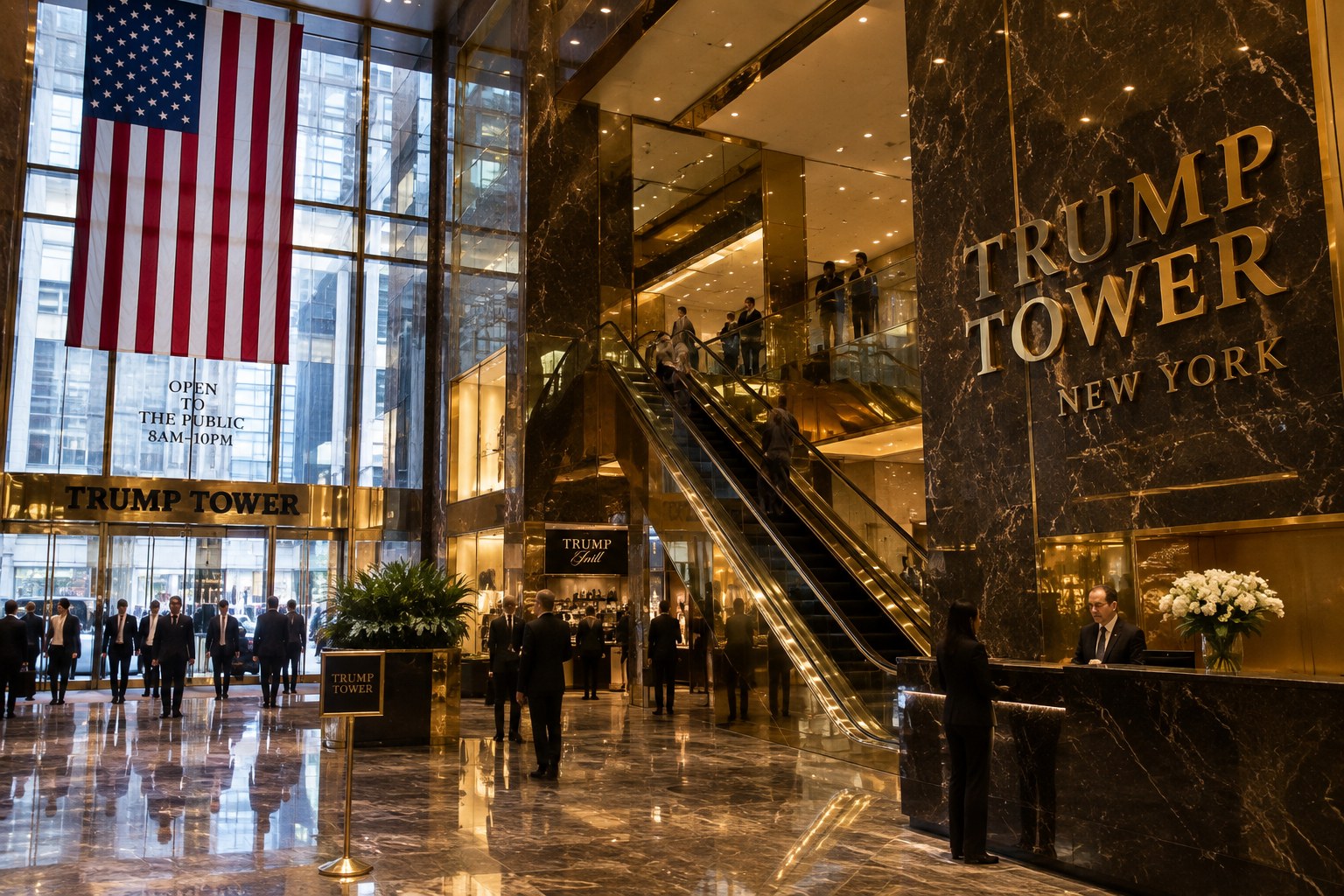
On June 16, 2015, Donald Trump stepped onto an escalator inside Trump Tower in New York City and descended toward a crowd of supporters waiting below.
When he reached the stage, the businessman and television personality made it official: he was running for president of the United States.
Few political announcements would prove as consequential.
Trump entered a crowded Republican primary field as a candidate unlike the traditional politicians surrounding him. He had never held elected office. He was best known nationally as a real-estate developer, celebrity businessman and host of The Apprentice. Yet from his first campaign speech, Trump presented himself as someone who could succeed precisely because he was not part of the political establishment.
“I am officially running for president of the United States,” Trump announced, “and we are going to make our country great again.”
A Campaign Built Around Decline
Trump's announcement speech established many of the themes that would define his political career.
America, he argued, was losing.
The country's leaders were being outmaneuvered by foreign governments. Trade agreements were hurting American workers. The southern border was inadequately controlled. Washington politicians were beholden to donors and special interests.
Trump offered his business experience as the solution.
He repeatedly emphasized his wealth and negotiating ability, portraying himself as financially independent enough to resist the influence of political donors.
His campaign's central message was equally direct: Make America Great Again.
Trump's campaign declared that the “American Dream is dead,” while promising that a Trump presidency would bring it back “bigger and better and stronger than ever before.”
The Wall
Immigration immediately emerged as one of the defining issues of Trump's campaign.
During the announcement, Trump promised to construct a massive wall along the southern border.
He also made another promise that would become one of the most recognizable lines of the 2016 campaign: Mexico would pay for it.
“I will build a great, great wall on our southern border,” Trump said, “and I will have Mexico pay for that wall.”
The wall would become a centerpiece of Trump rallies, eventually producing the familiar call-and-response between Trump and his supporters:
“Who is going to pay for the wall?”
“Mexico!”
The Mexican government repeatedly rejected the idea that it would pay for the project.
A Different Kind of Presidential Campaign
Trump's political style was apparent almost immediately.
His announcement speech was unusually long, frequently improvised and filled with attacks against political opponents and American institutions.
Rather than presenting himself as another Republican politician, Trump positioned himself against the political system itself.
He criticized President Barack Obama, Hillary Clinton and Republican leaders. He attacked existing trade policies and questioned America's relationships with allies and adversaries alike.
It was a style that would soon dominate television coverage and Republican primary debates.
Trump understood something particularly important about modern politics: controversy generated attention.
And attention generated coverage.
What Initially Looked Like a Long Shot
Trump's candidacy was initially treated with skepticism by many political observers.
The Republican field included governors, senators and nationally established politicians. Trump had never served in government.
But his campaign quickly demonstrated that traditional political experience was not necessarily an advantage in the environment of 2015.
Trump attracted enormous media coverage and increasingly large crowds.
His confrontational style connected with Republican voters who believed Washington's political establishment had failed them.
Within months, what had initially appeared to some observers as an unconventional campaign had become a serious political movement.
Trump would eventually defeat the Republican establishment candidates one after another.
He secured the Republican nomination.
Then, on November 8, 2016, Donald Trump defeated Hillary Clinton in the Electoral College and became president-elect of the United States, while Clinton won the national popular vote.
The Beginning of the Trump Era
Looking back, June 16, 2015 was more than another presidential campaign announcement.
Many of the defining characteristics of Trump's political movement were already visible.
The distrust of established institutions.
The attacks on political elites.
The focus on immigration and the southern border.
The promise of sweeping trade changes.
The emphasis on nationalism.
The constant confrontation with opponents.
And the slogan that would become inseparable from his political movement:
Make America Great Again.
Whatever Americans thought of Donald Trump that morning, American politics would not be the same afterward.
The escalator ride lasted only moments.
The political movement that began at the bottom of it would reshape the Republican Party, produce two Trump presidencies, and transform American political life for more than a decade.