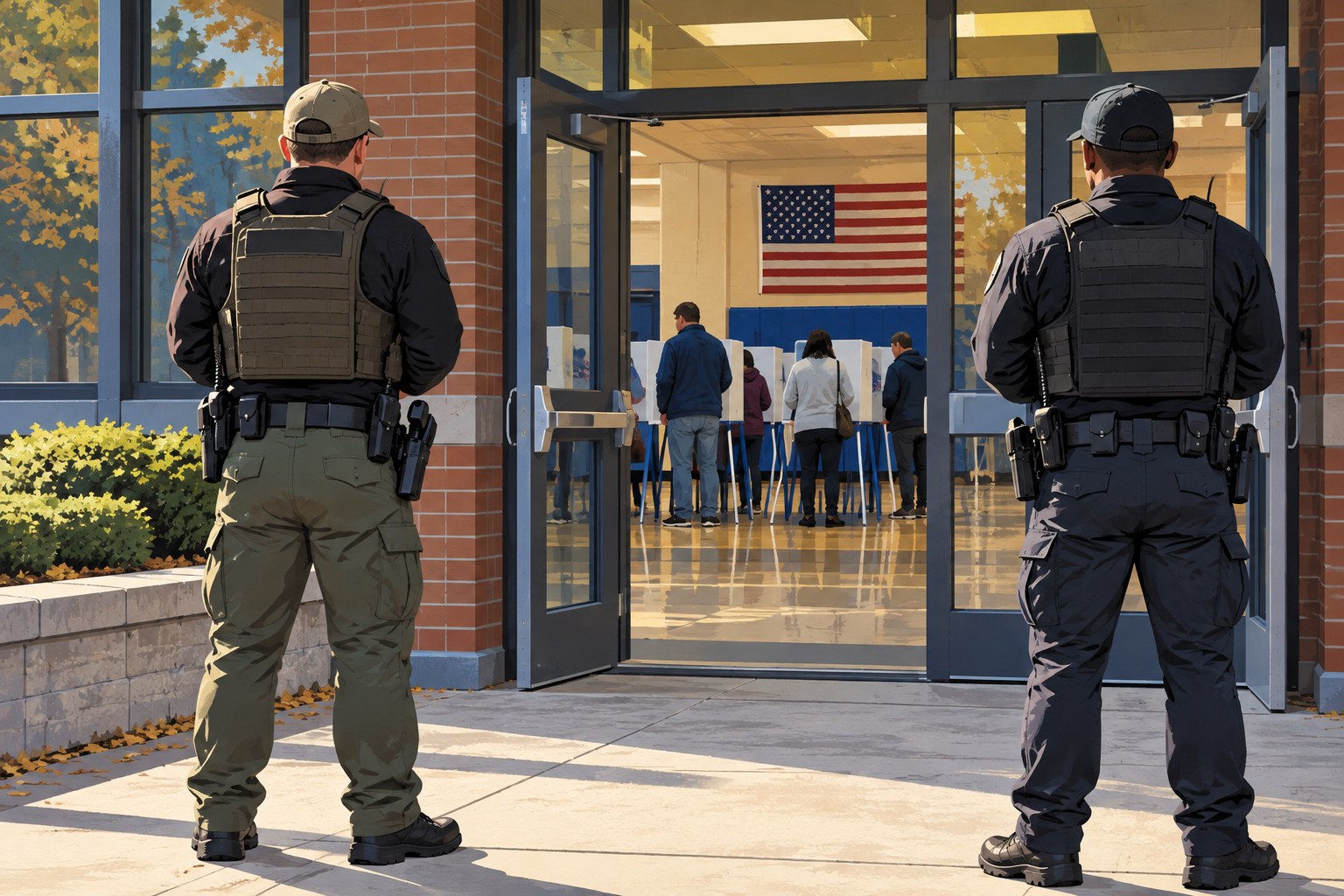
Democratic leaders are asking a federal judge to prevent the Trump administration from deploying armed ICE and FBI agents to voting locations during the 2026 midterms, arguing that the presence—or threat—of federal officers could intimidate voters. The administration says there is no plan to patrol polling places.**
With Americans already beginning to cast ballots in the 2026 midterm elections, a new legal fight is developing over something rarely associated with American polling places:
Armed federal agents.
Democratic congressional leaders and national campaign organizations have sued the Trump administration, asking a federal court to prohibit armed Immigration and Customs Enforcement and FBI agents from being deployed at locations where Americans vote or where their ballots are processed.
The lawsuit was filed in federal court in Washington, D.C., by Senate Democratic Leader Chuck Schumer, House Democratic Leader Hakeem Jeffries, the Democratic Senatorial Campaign Committee, Democratic Congressional Campaign Committee and Democratic Governors Association.
Their argument is straightforward.
Federal law generally prohibits armed federal officers from being stationed at places where elections are being held, and federal law separately prohibits intimidation, threats or coercion against voters.
The Democrats say recent statements from senior Trump administration officials have created enough uncertainty about whether federal agents could appear at polling locations that a judge should intervene before Election Day.
The Trump administration disputes that characterization.
And that distinction matters.
There has been no announcement that ICE or FBI agents will routinely patrol polling places during the November election.
The legal battle is about whether administration officials have nevertheless asserted authority that could allow armed agents to enter voting locations—and whether that threat itself can unlawfully discourage people from voting.
What Trump Administration Officials Have Said
The concern didn't materialize from nowhere.
Homeland Security Secretary Markwayne Mullin recently said ICE would not go to polling places simply to patrol them.
But he left open circumstances in which immigration agents could enter.
“The only reason why we would be at polling places is if there is a threat to that polling place or we're serving a warrant on someone that we have been actively tracking down,” Mullin told reporters.
“If we're serving a warrant we will be where we need to be.”
FBI Director Kash Patel has offered a similarly qualified answer.
Asked whether FBI agents could be deployed to polling places, Patel said agents could respond if there had been a violation of law, while also acknowledging internal FBI guidance restricting Election Day investigations inside voting locations.
President Trump himself declined earlier this year to categorically rule out using ICE or the National Guard around elections.
Those statements have alarmed voting-rights organizations and Democratic officials.
The administration says that alarm is misplaced.
The Justice Department has said it has never announced that federal law-enforcement officers would be sent to polling locations.
DHS has similarly said ICE does not plan operations targeting polling sites.
The Law Has Something to Say About Armed Agents at Elections
The dispute involves an unusually old federal statute.
Federal law generally prohibits officers of the United States military or civil service from bringing “troops or armed men” to places where federal elections are being held unless their presence is necessary to repel armed enemies.
The restriction dates to the Civil War era.
There is also the Voting Rights Act.
Section 11(b) prohibits intimidating, threatening or coercing someone for voting, attempting to vote or helping another person vote.
The Democrats' lawsuit argues that armed federal law enforcement appearing at voting locations—or credible threats that they might appear—could violate those protections.
The administration has not conceded that interpretation.
That leaves the courts to determine how these laws apply to the circumstances being described by administration officials.
This Isn't the First Lawsuit
Democratic Party organizations aren't alone.
Civil-rights organizations have filed separate lawsuits seeking similar restrictions.
The NAACP and several labor and civil-rights organizations filed their own federal case on September 18.
Another coalition that includes Latino civil-rights organizations and the city of Denver previously sued to prevent armed immigration officers from being deployed at polling locations.
Those organizations argue that the possibility of encountering federal immigration officers could particularly discourage naturalized citizens, immigrants living in mixed-status families and other eligible voters from appearing at polling places.
The government disputes accusations that its immigration-enforcement activities are designed to intimidate voters.
ICE Has Appeared Near Voting Locations Before
The dispute isn't entirely hypothetical.
Plaintiffs have pointed to incidents during elections earlier in 2026 when immigration officers appeared in or around polling locations in several states.
That does not establish that the administration has developed a nationwide program to deploy ICE officers during the November midterms.
But plaintiffs argue that the previous incidents demonstrate that federal law-enforcement activity around voting locations is possible.
And that possibility is precisely what they want the court to address before Election Day.
What Democrats Want the Judge to Do
The lawsuit isn't asking the court merely to declare that voter intimidation is illegal.
It seeks specific restrictions.
The plaintiffs want armed federal officers kept away from polling places, ballot drop boxes, curbside voting locations and places where ballots are collected, counted or certified.
That protection would extend beyond Election Day itself.
It would cover early voting and portions of the post-election process as well.
The practical objective is to establish the rules before voters arrive.
Because once armed federal officers appear at a polling location, plaintiffs argue, the potential intimidation cannot simply be undone afterward.
The Administration Says There Is No Plan to Patrol Polls
There is another side to this dispute that shouldn't be ignored.
The Trump administration has repeatedly denied having a general plan to station ICE officers at polling places.
DHS says its immigration enforcement is targeted and intelligence-driven.
Administration officials maintain that federal agents could have legitimate reasons to respond to a polling location—for example, an immediate public-safety threat.
Mullin has explicitly said ICE would not be present simply to patrol voting locations.
The Justice Department has accused critics of exaggerating the threat.
Those distinctions will matter in court because the plaintiffs are asking a judge to restrict conduct before the government has announced that such a deployment will occur.
The Democrats argue that waiting until armed agents actually appear would defeat the purpose of protecting voters from intimidation.
The Question Before Election Day
This case ultimately presents a basic question about the relationship between federal law enforcement and American elections.
There are legitimate reasons police might have to respond to an emergency at a polling location.
A violent attack doesn't become immune from law enforcement simply because it happens at a voting site.
But routine federal law-enforcement operations around polling places raise very different constitutional and statutory concerns.
American elections have traditionally been administered primarily by state and local governments, with polling locations intentionally separated from intimidating displays of government power.
Now a federal judge is being asked to establish where that boundary lies before November.
The Trump administration says it isn't planning to patrol America's polling places with ICE agents.
Democrats and civil-rights organizations want that assurance turned into something considerably stronger:
A court order ensuring armed federal agents stay away from voters.