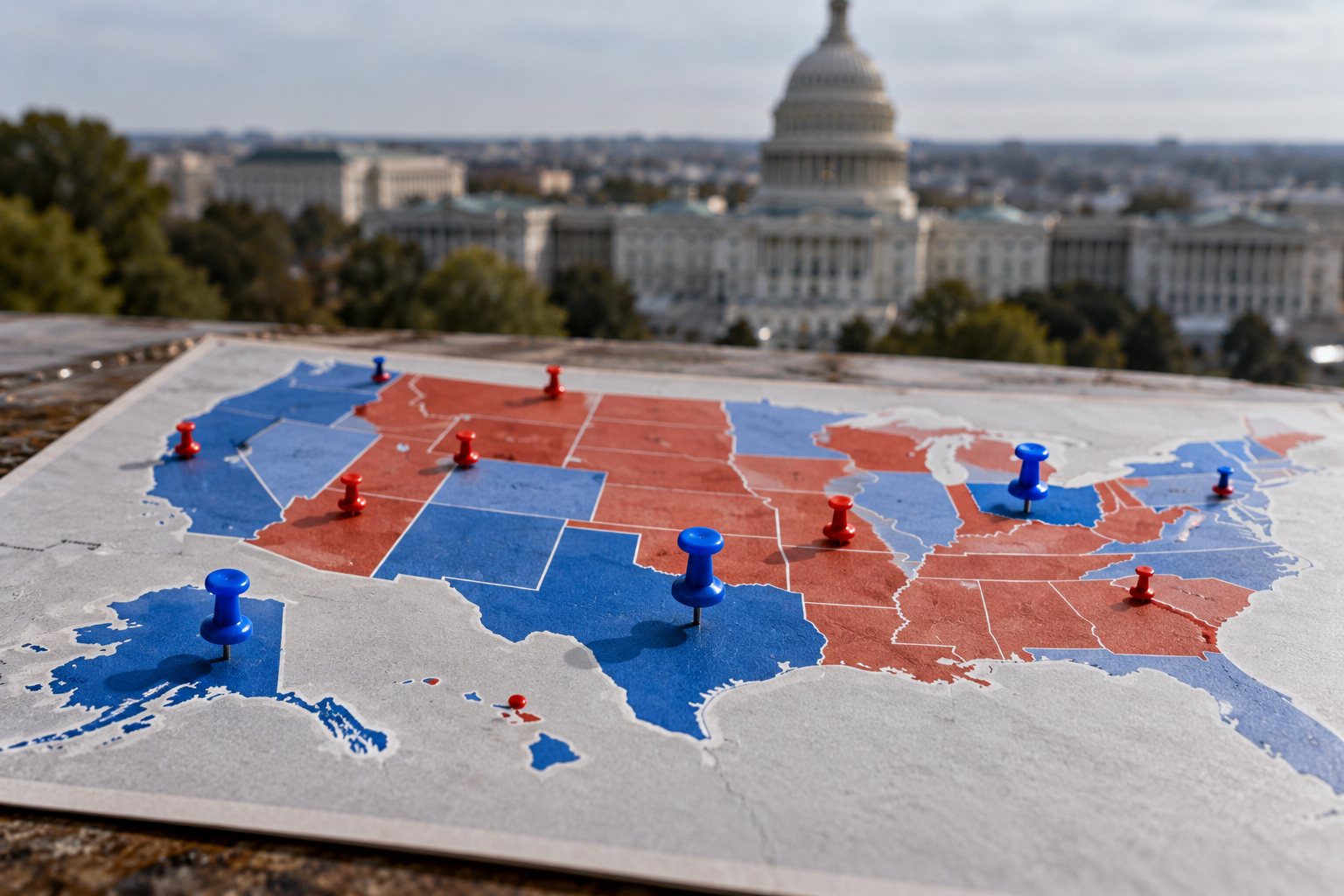
A new round of polling has produced one of the clearest signs yet that the 2026 midterm battlefield has expanded far beyond the states Democrats originally expected to contest.
Democratic Senate candidates are leading Republicans in three GOP-held seats — Alaska, Texas and Ohio — according to New York Times/Siena polling released October 3.
All three states voted for Donald Trump in 2024.
And not by narrow margins.
Trump won Ohio by roughly 11 percentage points, Alaska by about 13 and Texas by approximately 14.
Less than two years later, Democrats are competitive in Senate races across all three.
The latest Siena results show:
Alaska: Democrat Mary Peltola 50% — Republican Sen. Dan Sullivan 43%
Texas: Democrat James Talarico 51% — Republican Ken Paxton 45%
Ohio: Democrat Sherrod Brown 49% — Republican Sen. Jon Husted 46%
The polls are snapshots rather than election predictions, and Election Day remains nearly a month away.
But the geography alone makes the results significant.
These aren't traditionally Democratic states where Republicans are struggling to hang on.
They are states Donald Trump won comfortably.
Alaska: Peltola Leads an Incumbent Republican
Perhaps the biggest surprise comes from Alaska.
Former Democratic Rep. Mary Peltola leads incumbent Republican Sen. Dan Sullivan 50% to 43% in the Siena survey.
Peltola is already familiar to Alaska voters.
She won a special election for Alaska's House seat in 2022 and subsequently won a full term before losing the seat in 2024.
Now she is trying to unseat Sullivan, a two-term Republican senator.
The race has become important enough that Vice President JD Vance traveled to Alaska to campaign for Sullivan.
Vance described Alaska as a Republican “firewall” in the battle for control of Congress.
That alone illustrates how dramatically the Senate map has expanded.
Republicans are spending precious campaign time defending a Senate seat in a state Trump won by approximately 13 points just two years ago.
Polling Alaska is notoriously difficult because of its small, geographically dispersed population, and another recent survey showed Peltola and Sullivan tied.
Still, the Siena result makes clear that Republicans cannot simply take the seat for granted.
Texas: A Republican Stronghold Suddenly Has a Senate Race
Then there is Texas.
Democrat James Talarico leads Republican Ken Paxton 51% to 45% in the Siena poll.
And Siena isn't alone.
Several recent polls have shown Talarico ahead.
Fox News measured the race at 51% for Talarico and 49% for Paxton.
Texas Public Opinion Research showed Talarico leading 49% to 44%.
Marist found Talarico ahead 50% to 44%.
Other polls have shown narrower margins.
Texas remains a Republican state by virtually every traditional measure.
A Democrat hasn't won statewide office there in more than three decades.
Trump won it comfortably in 2024.
But Republicans are now spending enormous amounts of money defending the Senate seat, while Trump himself has campaigned in the state and urged Republican voters to turn out as though he were personally on the ballot.
Whether the Texas race reflects a permanent political realignment, dissatisfaction with Paxton specifically or the broader national environment won't be clear until voters actually cast their ballots.
But Texas being seriously contested at all represents a significant change from recent election cycles.
Ohio: Sherrod Brown Attempts a Comeback
Ohio presents a different situation.
Unlike Texas and Alaska, Democrats have won statewide there relatively recently.
Sherrod Brown represented Ohio in the Senate from 2007 until 2025, when Republican Bernie Moreno defeated him.
Brown is now attempting a political comeback against Republican Sen. Jon Husted in a special election.
The Siena poll has Brown ahead 49% to 46%.
Other recent surveys have also shown Brown leading.
A Marist poll put Brown at 51% and Husted at 43%.
A Suffolk University poll showed Brown leading 47% to 44%.
The polling average currently gives Brown an advantage of roughly three percentage points.
Again, that doesn't guarantee an election result.
But Ohio's movement is notable because the state had appeared to be moving steadily toward Republicans.
Trump carried Ohio in 2016, 2020 and 2024.
Now Republicans are defending a Senate seat there in a genuinely competitive race.
Democrats Need Four Seats
The stakes extend far beyond these individual contests.
Republicans currently hold a 53-47 Senate majority, counting the two independents who caucus with Democrats on the Democratic side.
That means Democrats need a net gain of four seats to reach 51.
And Alaska, Texas and Ohio aren't the only Republican-held seats receiving attention.
North Carolina and Maine are major battlegrounds.
Iowa has become surprisingly close.
The Siena poll there showed Republican Ashley Hinson leading Democrat Josh Turek by just one percentage point, 48% to 47%.
Kansas was even closer.
Democrat Adam Hamilton and Republican Sen. Roger Marshall were tied at 45%.
Those numbers don't mean Democrats will win all — or even most — of these races.
But they force Republicans to defend a much larger map.
Every dollar spent protecting Alaska, Texas, Iowa or Kansas is a dollar that can't be spent somewhere else.
Every campaign appearance in a normally Republican state consumes time that could have been spent trying to capture a Democratic seat.
That is why an expanding map matters even when the challenging party ultimately loses some of those races.
Trump Is Campaigning in States He Won Easily
Another indication of Republican concern can be seen simply by looking at where Donald Trump and JD Vance are campaigning.
Trump has been traveling through states he won comfortably in 2024, urging Republican voters to participate in the midterms even though his own name isn't on the ballot.
Vance has traveled to Alaska to campaign for Sullivan.
Trump has campaigned for Republicans in Texas and Nebraska.
These aren't the kinds of places a Republican president would normally need to spend substantial political capital defending.
Trump himself has repeatedly acknowledged one of the Republican Party's biggest challenges in midterm elections: some of his supporters turn out when he is personally running but are less reliable when he isn't on the ballot.
At a recent rally, Trump told supporters to essentially pretend that he was.
That plea could become crucial.
This Is Still Polling — Not an Election Result
There is an important warning attached to all of these numbers.
Polls can be wrong.
Individual state polls can be especially difficult, and Alaska presents unusual polling challenges because of its geography and population.
Turnout models can change.
Undecided voters can break heavily toward one candidate.
And a month is an eternity in politics.
Republicans could ultimately retain all three seats.
Democrats could win some of them.
Nobody knows yet.
But polling doesn't have to predict the final result perfectly to tell us something important about the political environment.
Republicans entered this election cycle with a Senate map that appeared to give them substantial structural advantages.
Now they are defending competitive races in states Donald Trump won by double digits less than two years ago.
Alaska.
Texas.
Ohio.
And behind them are competitive contests in Iowa, Kansas, North Carolina and Maine.
A Senate map that once appeared relatively narrow has become much larger.
The votes haven't been counted.
The seats haven't flipped.
But Republicans are being forced to defend political territory that, until very recently, they had little reason to believe would be seriously contested.
With Election Day approaching, that may be one of the most consequential developments of the 2026 midterms.