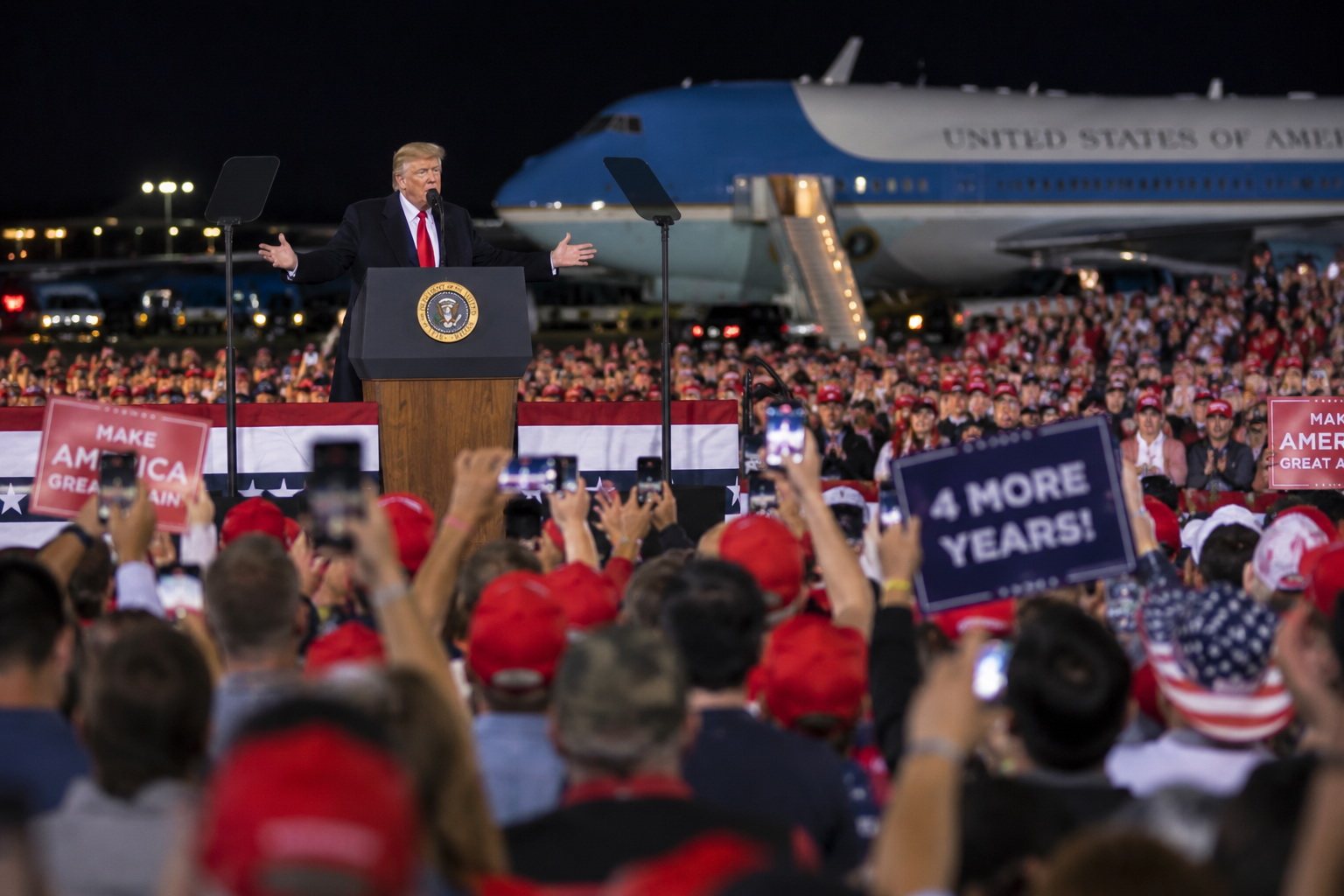
Just one week after leaving Walter Reed National Military Medical Center following treatment for COVID-19, President Donald Trump returned to the campaign trail in Florida, addressing a packed crowd where many supporters were not wearing masks as the American death toll from the pandemic surpassed 214,000.**
Donald Trump wanted America to see that he was back.
On the night of October 12, Air Force One arrived at Orlando Sanford International Airport in Florida, where thousands of supporters had gathered for Trump's first campaign rally since his COVID-19 diagnosis and hospitalization.
The president walked onto the stage without a mask.
Many people in the tightly packed crowd weren't wearing them either.
It had been only ten days since Trump announced that he and first lady Melania Trump had tested positive for the coronavirus.
It had been only nine days since Trump was flown by helicopter to Walter Reed National Military Medical Center for treatment.
And only seven days since he had returned to the White House.
Now Trump was back in front of a crowd.
“I Feel So Powerful”
Trump didn't return to the campaign trail chastened by his experience with a disease that had already killed more than 214,000 Americans.
Instead, he portrayed his recovery almost as a personal victory over the virus.
“I went through it. Now they say I'm immune,” Trump told supporters.
Then he added:
> “I feel so powerful.”
Trump joked that he wanted to walk into the audience and kiss his supporters.
“I'll kiss everyone in that audience,” he said, adding that he would kiss both the men and the “beautiful women.”
It was an extraordinary scene during an extraordinary moment in American history.
The president of the United States had just been hospitalized with a potentially deadly infectious disease.
He was standing before thousands of people during a pandemic.
And he was joking about kissing them.
More Than 214,000 Americans Were Already Dead
Trump's return came while COVID-19 continued spreading throughout the United States.
CDC data updated October 12 listed 7,740,934 confirmed U.S. cases and 214,108 deaths.
Hundreds more Americans were dying every day.
Families were grieving.
Businesses had closed.
Schools had been disrupted.
Hospitals across the country had spent months treating COVID patients.
And there was still no vaccine available to the public.
Yet Trump's message in Sanford remained largely consistent with the approach he had taken throughout much of 2020: Americans needed to get back out and reopen the country.
“The cure cannot be worse than the problem itself,” Trump told the crowd.
A President Who Had Access to Extraordinary Medical Care
Trump's own experience with COVID was also far removed from what most Americans could expect.
When his condition worsened, the president was transported by helicopter to one of the nation's premier military hospitals.
At Walter Reed, he received intensive medical monitoring and treatments including the antiviral drug remdesivir, the steroid dexamethasone and an experimental antibody treatment from Regeneron.
He had a dedicated team of physicians.
He had immediate access to testing.
He had around-the-clock medical care.
And when he left the hospital, he returned to a White House equipped with its own medical unit.
Most Americans infected with COVID had nothing remotely comparable.
Trump nevertheless presented his own recovery as evidence that people should not allow the virus to dominate their lives.
The White House Said Trump Was No Longer Infectious
There was an important development shortly before the Florida rally.
Trump's physician, Dr. Sean Conley, announced that the president had tested negative on consecutive days and said the medical team had concluded that Trump was no longer infectious.
Conley did not disclose which days those negative tests occurred.
That meant the concern surrounding the rally wasn't simply whether Trump himself would transmit the virus.
It was also about gathering thousands of people together during an ongoing pandemic.
Many supporters stood shoulder-to-shoulder.
Many were unmasked.
Public-health officials had spent months warning Americans that large gatherings—particularly those involving close contact, shouting and limited distancing—could increase the opportunity for the virus to spread.
Trump returned to precisely that kind of event.
COVID Had Already Reached the White House
Trump's diagnosis had not occurred in isolation.
The coronavirus had already spread through his political circle and the White House.
First lady Melania Trump tested positive.
Former White House counselor Kellyanne Conway tested positive.
Trump campaign manager Bill Stepien tested positive.
White House press secretary Kayleigh McEnany tested positive.
Several Republican senators also contracted the virus around the same period.
The outbreak demonstrated that even one of the most heavily protected workplaces in the world was vulnerable.
Yet Trump's return to campaigning looked remarkably similar to his rallies before his hospitalization.
Back on the Road
The Sanford rally wasn't intended to be a cautious test of Trump's recovery.
It was the beginning of an aggressive return to campaigning with only three weeks remaining before the November election.
More rallies were scheduled immediately afterward.
Trump wanted voters to see energy, strength and normalcy.
But the backdrop was anything but normal.
More than 214,000 Americans were dead.
Millions had been infected.
The president himself had just spent three nights in the hospital with the disease.
And before a packed Florida crowd where many supporters stood without masks, Trump declared that he felt powerful, claimed he was immune and joked about kissing everyone in attendance.
For a country still deep in a public-health emergency, Trump's first major campaign event after surviving COVID did not signal a new approach to the pandemic.
It looked remarkably like the old one.