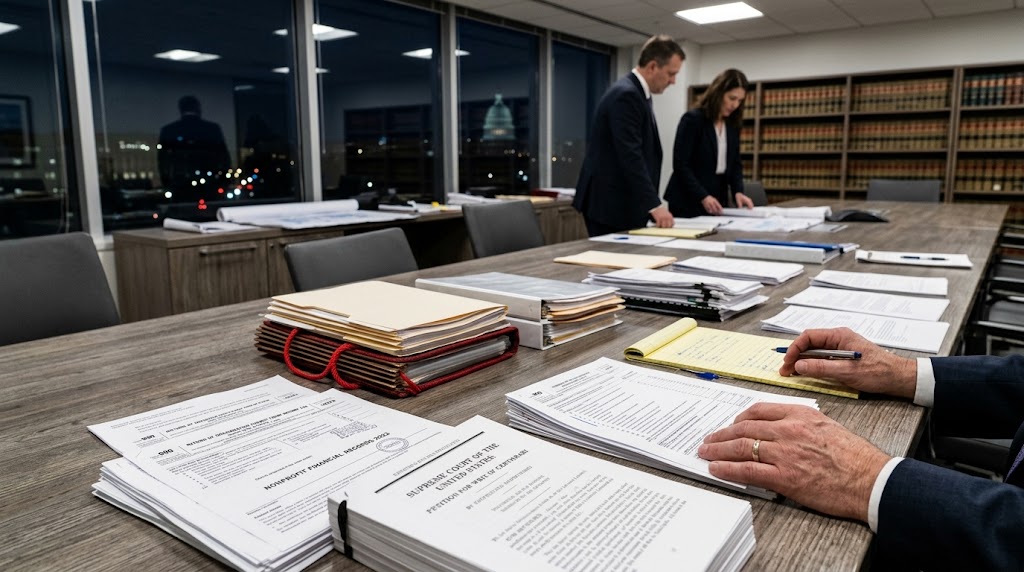
Behind some of the most consequential conservative legal battles to reach the Supreme Court sits a network of nonprofit organizations, anonymous donors and a relatively small law firm with unusually deep connections to Justice Clarence Thomas.
The money involved is enormous.
Consovoy McCarthy, a conservative litigation firm that has represented Donald Trump and argued major cases before the Supreme Court, received more than $33.5 million from nonprofit organizations associated with conservative legal causes, according to an analysis of tax filings by the progressive research organization True North Research.
More than $29 million reportedly came from nonprofits associated with conservative legal activist Leonard Leo.
And Consovoy McCarthy has another notable connection to the Supreme Court:
Six of the firm's 11 partners reportedly clerked for Clarence Thomas.
The arrangement does not establish that Thomas received money, coordinated with the organizations or altered his decisions because of those relationships.
There is no evidence establishing any of those things.
But the extraordinary flow of largely opaque money into organizations financing Supreme Court litigation raises a different question:
Who is paying for the legal campaigns that are reshaping American law?
$33.5 Million Into One Law Firm
Consovoy McCarthy isn't an ordinary small law firm.
Founded in 2014, it became an important player in conservative constitutional litigation and has appeared in some of the country's most politically significant court battles.
According to the tax-filing analysis reported by Raw Story, nonprofit organizations connected to conservative legal causes have paid the firm more than $33.5 million.
Among them was the 85 Fund, an organization associated with Leonard Leo's conservative legal network.
Public tax documents independently confirm at least some of those payments.
The 85 Fund's 2021 federal tax return, for example, lists $900,000 paid to Consovoy McCarthy for legal services.
The broader analysis found that the 85 Fund paid the firm approximately $5.65 million between 2016 and 2023.
And it wasn't alone.
Students for Fair Admissions reportedly paid Consovoy McCarthy nearly $8.8 million.
Speech First reportedly paid more than $7.3 million between 2018 and 2024.
Defending Education reportedly paid approximately $4 million since 2021.
Other conservative organizations paid hundreds of thousands or millions more.
The Donors Behind the Money Can Be Difficult to Identify
This is where the term “dark money” becomes important.
The nonprofit organizations themselves aren't necessarily secret.
Their tax filings are public.
Their expenditures can often be examined.
What frequently isn't publicly disclosed is the identity of the original donors supplying the money.
Nonprofit organizations organized under certain sections of the tax code can receive substantial contributions without publicly identifying individual donors.
Money can also move through donor-advised funds and multiple organizations before eventually financing litigation.
The result is an unusual situation.
Americans can watch attorneys stand before the Supreme Court arguing cases capable of transforming national policy without necessarily knowing who ultimately financed the legal campaign that brought the case there.
That doesn't make the litigation improper.
It does make the financial structure considerably less transparent.
Then There Is Clarence Thomas
Consovoy McCarthy's relationship with Thomas is particularly noteworthy.
According to the firm's biographies and the new analysis, six of its 11 partners previously served as law clerks to Thomas.
The firm's late co-founder William Consovoy was himself a former Thomas clerk.
Former Supreme Court clerks routinely enter elite legal practice, and there's nothing inherently improper about former clerks arguing cases before the Court.
The significance here is the concentration.
A majority of the partners at one firm involved in major conservative Supreme Court litigation reportedly previously worked inside Thomas' chambers.
Former clerks can possess something extremely valuable to appellate lawyers: firsthand knowledge of how a justice approaches legal questions, evaluates arguments and thinks about constitutional doctrine.
That experience can make former Supreme Court clerks extraordinarily valuable attorneys.
And Consovoy McCarthy has assembled an unusually large collection of them from one justice's chambers.
The Firm Helped End Affirmative Action
Perhaps the clearest example of the firm's influence came in Students for Fair Admissions v. Harvard.
Students for Fair Admissions challenged the use of race in university admissions.
Consovoy McCarthy represented the organization.
The Supreme Court ultimately ruled against Harvard and the University of North Carolina in 2023, effectively ending race-conscious admissions programs of the type challenged in the cases.
Justice Thomas joined the majority and wrote a separate concurring opinion.
Again, none of that establishes misconduct.
Thomas' opposition to affirmative action was publicly established long before this case reached the Court.
But the financial ecosystem behind the litigation deserves attention.
Students for Fair Admissions received funding from conservative organizations, including the Leo-associated 85 Fund.
Students for Fair Admissions, in turn, paid millions of dollars to Consovoy McCarthy.
Consovoy McCarthy then represented the organization in litigation that eventually reached the Supreme Court.
And the firm itself was filled with attorneys who had previously worked for one of the justices deciding the case.
That is not evidence that the decision was purchased.
It is evidence of how interconnected America's conservative legal infrastructure has become.
Leonard Leo's Network
Leonard Leo has spent decades building influence within the conservative legal movement.
His network of nonprofit organizations and affiliated groups has raised and distributed enormous amounts of money supporting conservative legal causes, judicial advocacy and litigation.
ProPublica previously documented how organizations connected to Leo funded groups involved in Supreme Court litigation concerning elections and affirmative action.
In the affirmative-action fight alone, tax records showed the 85 Fund giving Students for Fair Admissions $250,000 in 2020.
The organization also gave $700,000 to Speech First in 2020 and 2021. Speech First subsequently filed briefs supporting Students for Fair Admissions in the affirmative-action litigation.
The organizations were operating legally within a system that permits nonprofit advocacy groups to participate extensively in public-policy litigation.
But the structure makes following the money difficult.
Consovoy McCarthy Also Represented Trump
The firm's influence extends beyond conservative nonprofit litigation.
Consovoy McCarthy represented Donald Trump in his long-running legal effort to prevent congressional investigators and prosecutors from obtaining his financial records and tax information.
That placed the same relatively small law firm at the center of another enormous constitutional battle.
The connection illustrates how a specialized network of attorneys, advocacy organizations and donors can repeatedly appear in litigation involving some of the country's most politically consequential disputes.
What We Know — And What We Don't
The facts here require an important distinction.
There is evidence that conservative nonprofits paid Consovoy McCarthy millions of dollars.
There is evidence that some organizations financing conservative litigation receive money from donors whose identities aren't publicly disclosed.
There is evidence that Consovoy McCarthy has an extraordinary number of former Clarence Thomas clerks among its attorneys.
There is evidence that the firm argued major cases before a Supreme Court on which Thomas sits.
What there is not evidence of is equally important.
There is no evidence that Clarence Thomas received these legal fees.
There is no evidence that the nonprofits paid Consovoy McCarthy specifically to influence Thomas.
There is no evidence that Thomas coordinated his decisions with the firm.
And there is no evidence that Thomas changed a Supreme Court vote because former clerks were involved in a case.
Those distinctions matter.
The Transparency Question Remains
The larger issue isn't whether someone can prove that a particular Supreme Court decision was bought.
The issue is how much money can flow through America's legal advocacy system without the public knowing who originally supplied it.
Supreme Court decisions can determine abortion policy, voting rules, environmental regulation, presidential authority, gun laws, affirmative action and the limits of federal government power.
Those decisions can affect hundreds of millions of Americans for generations.
Yet organizations capable of spending millions financing the litigation that produces those decisions can receive substantial funding without publicly identifying the people providing it.
The Consovoy McCarthy story provides a remarkable window into that system.
Tens of millions of dollars.
Powerful nonprofit networks.
Anonymous or difficult-to-trace donors.
Former Supreme Court clerks.
And cases capable of changing American law.
None of that, standing alone, proves corruption.
But when so much money is being spent trying to determine what reaches the Supreme Court and what arguments the justices hear when it gets there, Americans have legitimate reason to ask a simple question:
Who is paying for it?