The coronavirus outbreak surrounding President Donald Trump spread deeper into the White House Monday as Press Secretary Kayleigh McEnany announced that she had tested positive for COVID-19, adding another senior administration official to a growing list of infections reaching into the highest levels of the federal government.
McEnany said she tested positive Monday morning after repeatedly testing negative during the previous several days.
She said she was experiencing no symptoms and would begin quarantining while continuing to work remotely.
Her diagnosis comes just days after Trump himself tested positive and was hospitalized at Walter Reed National Military Medical Center.
But the growing number of infections surrounding the president is raising broader questions about precautions inside the White House, contact tracing and whether administration officials continued interacting with others after they may have been exposed to the virus.
McEnany Continued Speaking With Reporters
McEnany's diagnosis is particularly concerning for members of the White House press corps because she continued interacting with journalists in the days preceding her positive test.
She spoke with reporters outside the White House Sunday evening without wearing a mask.
McEnany said Monday that the White House Medical Unit had not identified any reporters, producers or members of the press as close contacts.
She also said she had not known that senior Trump adviser Hope Hicks had tested positive before McEnany conducted a White House briefing Thursday.
But her positive test illustrates one of the fundamental difficulties of containing the coronavirus.
A negative test does not necessarily mean someone has not been infected. There can be a period following exposure when an infected person continues testing negative before the virus becomes detectable.
McEnany said she had tested negative consistently since Thursday before receiving Monday's positive result.
The Outbreak Keeps Growing
McEnany is far from the only person in Trump's orbit to contract the virus.
Hope Hicks tested positive last week.
Trump and First Lady Melania Trump subsequently announced that they had also tested positive.
Former White House counselor Kellyanne Conway has tested positive.
Republican Sens. Mike Lee of Utah and Thom Tillis of North Carolina have tested positive.
Former New Jersey Gov. Chris Christie also tested positive and has been hospitalized.
Trump's personal assistant Nick Luna has reportedly tested positive as well.
Two members of the White House press operation have also tested positive.
The expanding list has transformed what initially appeared to be several isolated infections into a significant outbreak among people who work with or regularly interact with the president.
Attention Turns to Rose Garden Ceremony
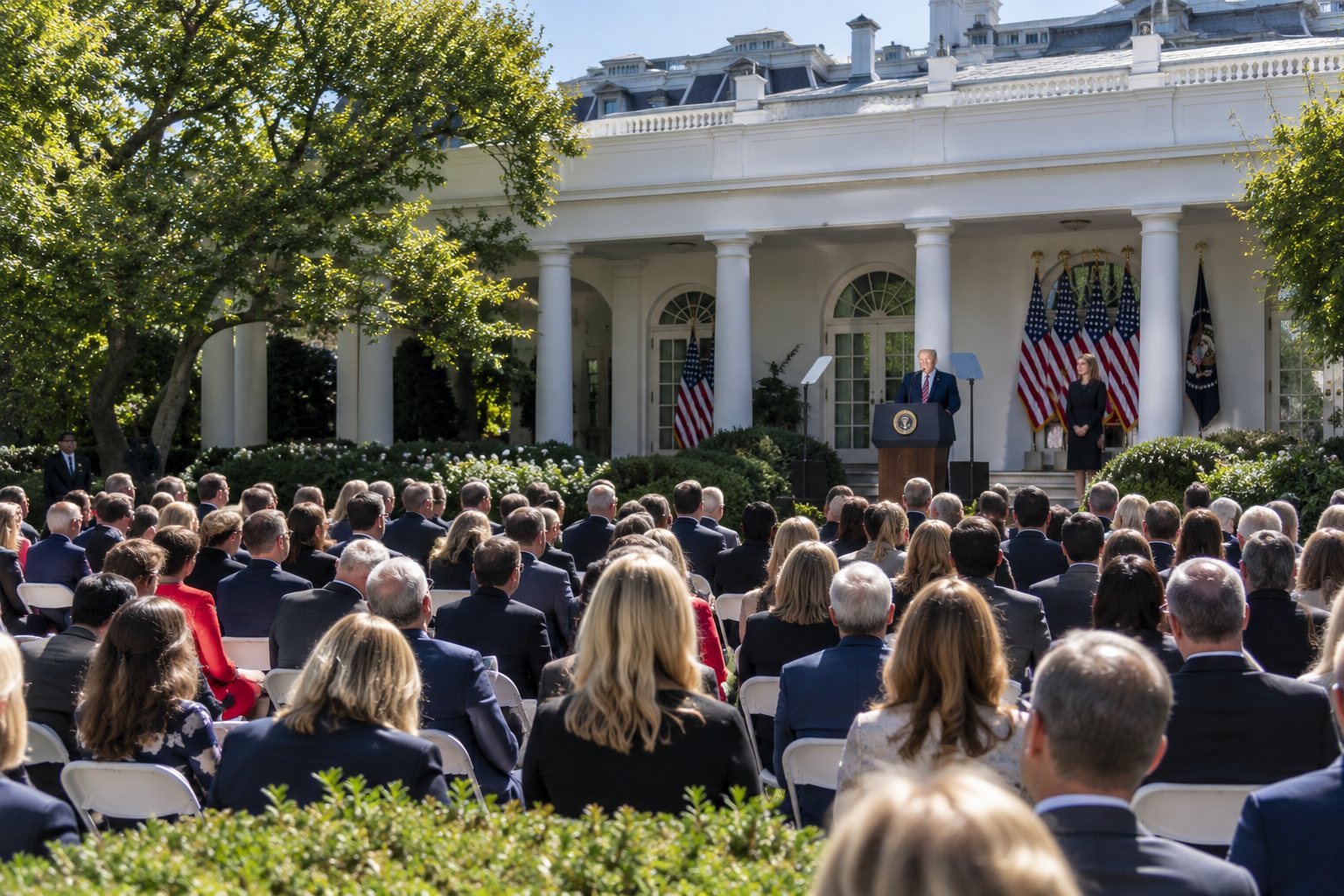
Increasing scrutiny is being placed on a September 26 White House ceremony announcing Trump's nomination of Judge Amy Coney Barrett to the Supreme Court.
Approximately 150 to 200 people attended the Rose Garden event.
Photographs and television footage showed many guests sitting closely together without masks. Attendees also gathered indoors as part of the day's events.
Several people who attended the ceremony have since tested positive.
They include Trump, Conway, Lee, Tillis, University of Notre Dame President John Jenkins and Christie.
It has not been established that those individuals contracted the virus at the ceremony, and investigators have not publicly identified a single source responsible for the White House outbreak.
But the concentration of infections among people connected to the event has made it an obvious focus of concern.
White House Mask Practices Under Scrutiny
The outbreak is also renewing questions about the administration's approach to masks and social distancing.
Trump has frequently appeared publicly without a mask and has repeatedly emphasized testing as a primary method of protecting people around him.
Many White House officials have followed his example.
Throughout the pandemic, administration officials have often appeared at events and press gatherings without face coverings even when standing close to other people.
The White House's extensive testing program has allowed officials to argue that they operate in a uniquely controlled environment.
The events of the past several days are challenging that assumption.
Testing can identify infections, but it cannot necessarily identify them immediately after exposure.
That means someone who tests negative can potentially become infectious before a later test detects the virus.
McEnany's sequence of negative tests followed by Monday's positive result demonstrates precisely that problem.
Questions About Contact Tracing
The growing outbreak is also placing pressure on the White House to determine who may have been exposed and when.
Effective contact tracing requires identifying infected individuals, determining when they may have been contagious and notifying people who spent significant time near them.
That becomes considerably more complicated when infected individuals have participated in presidential events, campaign activities, meetings and press gatherings involving large numbers of people.
The president himself maintained an active schedule during the period before his positive diagnosis became public.
Other administration officials continued working and appearing publicly while the extent of the outbreak remained unclear.
For White House employees, Secret Service personnel, journalists and others who regularly work around administration officials, determining possible exposure has therefore become an urgent concern.
The President Remains Hospitalized
Trump remains at Walter Reed after being admitted Friday following his COVID-19 diagnosis.
His doctors have said his condition has improved, and the president has said he hopes to return to the White House Monday.
Trump has received several treatments, including the antiviral medication remdesivir and the steroid dexamethasone.
The president's illness has created an extraordinary situation barely four weeks before Election Day.
The person responsible for leading the federal government's response to the pandemic is now himself a COVID-19 patient, while infections continue appearing among people surrounding him.
A Crisis Inside the White House
More than seven months after the coronavirus began dramatically disrupting American life, the pandemic has now reached directly into the center of the presidency.
The White House has access to regular testing, medical personnel and security procedures unavailable to most Americans.
Yet those resources have not prevented the virus from spreading among people working at or closely connected to the administration.
McEnany's positive test Monday underscores how difficult the virus can be to contain once transmission begins.
She tested negative repeatedly.
She continued working.
She continued speaking with reporters.
Then Monday morning, the test came back positive.
The White House is now dealing not simply with a sick president, but with an outbreak whose full extent remains unknown.
Source: White House statements, Associated Press and contemporary reporting on the White House COVID-19 outbreak.