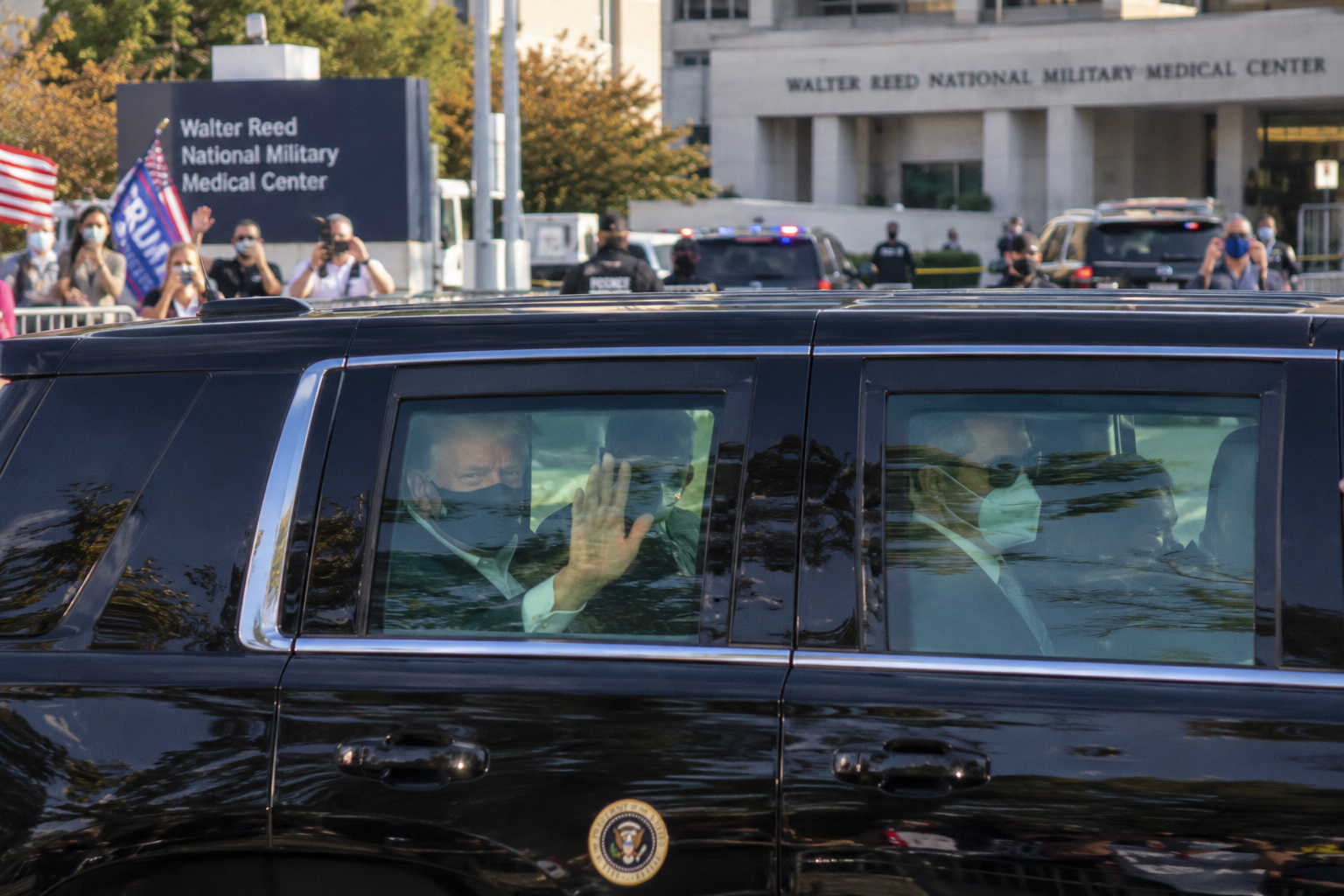
President Donald Trump stunned observers on October 4, 2020, when he briefly left Walter Reed National Military Medical Center—where he was hospitalized with COVID-19—and rode past supporters in a presidential SUV.
Trump, wearing a mask, could be seen through the closed window of the black vehicle waving at people gathered outside the hospital.
Inside the SUV with the infectious president were members of the United States Secret Service.
The short trip immediately became controversial.
Medical professionals questioned why a hospitalized COVID-19 patient had been placed inside an enclosed vehicle with other people for a non-medical outing. Current and former Secret Service personnel also expressed concern about the agents assigned to accompany him.
The White House defended the decision, saying appropriate precautions had been taken and Trump's medical team had cleared the trip.
Trump Hospitalized With COVID-19
Only two days earlier, Trump had announced that he and First Lady Melania Trump had tested positive for COVID-19.
The president was transported to Walter Reed on October 2.
His illness came during a particularly consequential moment in the pandemic and just one month before the 2020 presidential election.
Trump's doctors later acknowledged that he had experienced episodes in which his blood oxygen level dropped and that he had received supplemental oxygen.
He was being treated with several medications, including the antiviral drug remdesivir and the steroid dexamethasone.
Yet on Sunday afternoon, October 4, Trump announced that he was about to leave his hospital room briefly.
"A Little Surprise"
Shortly before the motorcade appeared, Trump released a video from Walter Reed.
He thanked supporters who had gathered outside and said:
"I also think we're going to pay a little surprise to some of the great patriots that we have out on the street."
Minutes later, the presidential motorcade emerged from Walter Reed.
Trump sat in the rear of an armored SUV.
Wearing a mask, he waved through the closed window at supporters lining the roadway.
The motorcade made a brief circuit outside the medical center before returning Trump to the hospital.
Government records later described it simply as a "brief motorcade ride outside the hospital to wave to supporters."
Secret Service Agents Ride With an Infectious President
The presence of Secret Service agents inside the vehicle quickly became the most controversial aspect of the trip.
Protecting the president requires agents to remain close to him, even when doing so carries risks.
But critics questioned whether those agents should have been exposed to an infectious president for an outing that was not medically necessary.
The presidential SUV was designed as a highly protected vehicle. Its enclosed environment intensified concerns among physicians about possible airborne transmission.
Dr. James Phillips, an attending physician at Walter Reed and a professor at George Washington University, sharply criticized the decision.
Phillips called the outing unnecessary and warned that the people inside the vehicle had potentially been exposed to COVID-19.
Other physicians raised similar concerns.
Secret Service Personnel Express Anger
The criticism wasn't limited to doctors.
The Washington Post reported that current and former Secret Service personnel reacted angrily to the outing.
Some agents had already been concerned about COVID-19 exposure while protecting the president during the pandemic.
One unnamed agent told the newspaper:
"He's not even pretending to care now."
A former Secret Service member asked:
"Where are the adults?"
Their comments reflected frustration over the unusual position in which presidential protection personnel found themselves.
Secret Service agents could not simply decline to protect the president because he was infected.
If Trump traveled, they had to protect him.
White House Says Precautions Were Taken
The White House rejected the suggestion that the motorcade had been conducted without concern for those involved.
White House spokesman Judd Deere said appropriate precautions had been taken to protect Trump and everyone supporting the movement.
Those precautions included personal protective equipment.
Deere also said:
"The movement was cleared by the medical team as safe to do."
Photographs and video showed agents inside the SUV wearing protective equipment.
The White House therefore maintained that the risks had been considered and mitigated before the president left Walter Reed.
Critics remained unconvinced, arguing that the fundamental question was why an infectious patient needed to make the trip at all.
An Extraordinary Moment in the Pandemic
The images were unlike almost anything previously seen involving an American president.
Trump was simultaneously the president of the United States, a candidate seeking reelection and a hospitalized COVID-19 patient.
Yet there he was, riding past supporters and waving through the window of the presidential SUV.
The episode also highlighted the unusual challenges created when the person infected with a contagious disease was someone Secret Service agents were legally obligated to protect.
For Trump, the drive allowed him to appear publicly after days dominated by questions about his health.
For his critics, it represented an unnecessary exposure of the people assigned to protect him.
The motorcade lasted only a few minutes.
The controversy lasted considerably longer.
One day later, on October 5, Trump was discharged from Walter Reed and returned to the White House.
But the extraordinary scene from October 4 remained one of the defining images of his COVID-19 hospitalization:
A sitting president, infected with COVID-19 and still hospitalized, waving to supporters from inside an armored SUV while Secret Service agents rode alongside him.