Donald Trump had just spent three nights hospitalized with COVID-19.
The White House was dealing with an outbreak that had infected multiple officials and political allies.
Trump's own campaign manager had tested positive.
And the president was less than a month away from an election in which Joe Biden had opened a substantial polling advantage.
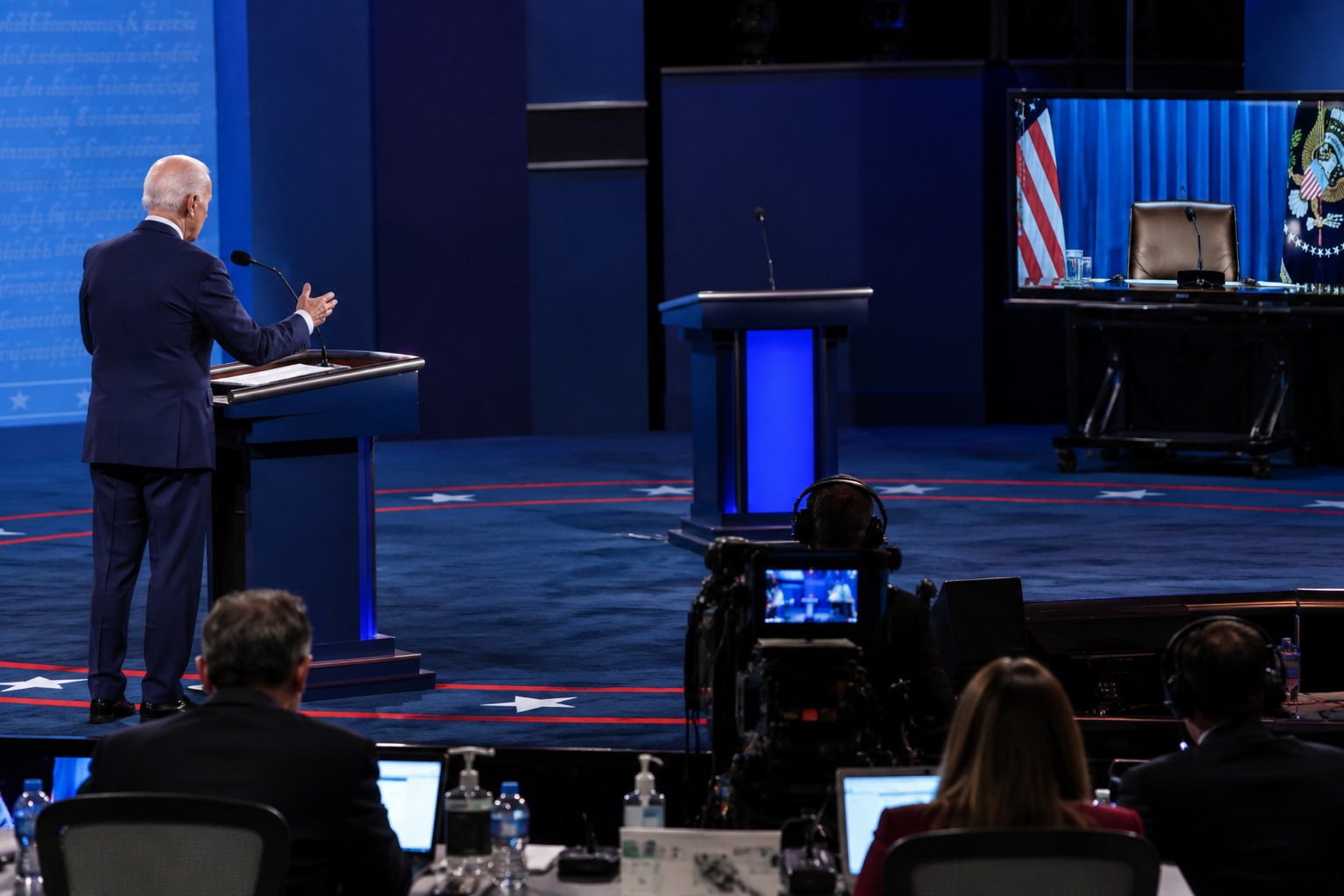
Faced with those circumstances, the Commission on Presidential Debates announced on October 8, 2020, that Trump's upcoming debate with Biden would be conducted virtually to protect everyone involved.
Trump's response was immediate.
He refused to participate.
“No, I'm not going to waste my time on a virtual debate,” Trump said during a Fox Business interview that morning.
Instead, his campaign said Trump would hold a rally.
Trump Had Just Left the Hospital
The timing made the dispute remarkable.
Trump announced that he had tested positive for COVID-19 early on October 2.
Later that day, he was taken to Walter Reed National Military Medical Center.
His illness was serious enough that doctors treated him with an experimental antibody therapy, the antiviral drug remdesivir and the steroid dexamethasone, which at the time was generally used for patients requiring supplemental oxygen or experiencing significant disease.
Trump returned to the White House on October 5.
Only three days later, the debate dispute erupted.
The second presidential debate was scheduled for October 15 in Miami.
Because Trump had recently contracted COVID-19, the Commission on Presidential Debates announced that Trump and Biden would participate remotely from separate locations while the moderator and voters participating in the town-hall event remained in Miami.
The commission said the change was being made “in order to protect the health and safety of all involved.”
Trump wasn't interested.
“I'm Not Going to Waste My Time”
Trump learned of the decision shortly before calling into Fox Business host Maria Bartiromo's program.
He rejected it almost immediately.
“I'm not going to do a virtual debate,” Trump said.
Then he went further:
“I'm not going to waste my time on a virtual debate. That's not what debating is all about.”
Trump complained that sitting behind a computer would allow organizers to cut him off whenever they wanted.
He also accused the debate commission of trying to protect Biden.
Trump insisted that he had defeated Biden in their first debate and predicted he would defeat him again if another face-to-face debate occurred.
That assessment was Trump's.
The political situation surrounding him suggested something very different.
Trump Needed a Political Reset
The first presidential debate on September 29 had been chaotic.
Trump repeatedly interrupted Biden and moderator Chris Wallace, while the candidates talked over one another throughout much of the night.
The spectacle became so unruly that the debate commission subsequently announced it would consider changes to ensure a more orderly discussion.
More importantly for Trump, the political aftermath wasn't moving in his direction.
Biden's polling advantage had grown.
The Los Angeles Times reported on October 8 that Biden had surged in polling following Trump's performance in the first debate.
That meant the second debate represented something Trump badly needed:
Another nationally televised opportunity to change the trajectory of the race.
Instead, Trump threatened to walk away from it because he didn't like the format.
The Reason for the Virtual Debate Was Trump Himself
There was another unusual aspect to the controversy.
The debate wasn't being moved online because of a hurricane.
It wasn't because of a scheduling problem.
It wasn't because Biden refused to appear with Trump.
The format was changed because the president of the United States had contracted a potentially deadly infectious disease.
Trump nevertheless claimed during his October 8 interview that he didn't believe he was contagious.
“I don't think I'm contagious at all,” he said.
But Trump wasn't in a position to simply declare himself virus-free.
His doctors had not publicly established at that point that he was no longer contagious.
The debate commission therefore faced an obvious problem: putting Trump, Biden, the moderator, audience members, staff and Secret Service personnel together in the same room only days after the president had been hospitalized with COVID-19.
Its solution was straightforward.
Keep the debate.
Keep the town-hall format.
Keep the voters asking questions.
Just put Trump and Biden in separate locations.
Trump refused.
His Own Campaign Manager Had COVID Too
The outbreak wasn't limited to Trump.
Numerous people connected to the White House and Republican politics had recently tested positive, including First Lady Melania Trump, White House press secretary Kayleigh McEnany, senior Trump adviser Hope Hicks and former New Jersey Gov. Chris Christie.
Trump campaign manager Bill Stepien had also tested positive.
Yet it was Stepien who issued the campaign's defiant response to the debate commission.
The campaign would, he said, “pass on this sad excuse to bail out Joe Biden and do a rally instead.”
The irony was difficult to miss.
The campaign manager criticizing the safety precautions was himself working remotely because he had COVID-19.
Even Mitch McConnell Was Avoiding Trump's White House
The concerns weren't confined to Democrats or debate organizers.
That same day, Senate Majority Leader Mitch McConnell revealed that he had been avoiding the White House for approximately two months because he was uncomfortable with its coronavirus precautions.
McConnell said he had not visited since August 6.
His reason was remarkably direct.
He said the White House wasn't approaching protection from the illness the way he believed was appropriate for the Senate, particularly regarding masks and social distancing.
In other words, one of the most powerful Republicans in Washington had already decided that visiting Trump's White House wasn't worth the health risk.
Now the presidential debate commission was making essentially the same calculation.
Biden Was Willing to Participate Virtually
Biden's campaign initially accepted the virtual arrangement.
After Trump announced he wouldn't participate, Biden's campaign said it would instead find another venue where Biden could take questions directly from voters.
The dispute ultimately destroyed the planned October 15 debate.
Instead of Trump and Biden appearing together, the two candidates ended up participating in competing televised town halls on separate networks.
Trump appeared on NBC.
Biden appeared on ABC.
The candidates would eventually meet again for the final presidential debate on October 22.
But Trump's refusal eliminated what had been scheduled as the second of three presidential debates.
COVID Had Already Reshaped Trump's Campaign
The episode captured the extraordinary position Trump found himself in during the final month of the 2020 campaign.
For months, Trump had minimized the danger posed by COVID-19.
He frequently resisted wearing a mask publicly.
He continued holding large political rallies.
He repeatedly pushed for the country to return to normal.
Then the virus entered his own White House.
Trump became infected.
His wife became infected.
His advisers became infected.
His campaign manager became infected.
He was hospitalized.
And less than a week later, the disease was disrupting the presidential debates themselves.
Yet rather than accept a temporary accommodation allowing the debate to continue safely, Trump rejected it.
A Debate Trump Could Ill Afford to Lose
Presidential debates don't always change elections.
But Trump was running out of opportunities.
Election Day was November 3.
October 8 left fewer than four weeks.
Biden was ahead nationally and leading in several critical battleground states.
Trump had just endured a disastrous news cycle surrounding his hospitalization.
His campaign schedule had been interrupted.
The White House outbreak had once again placed the administration's handling of the pandemic at the center of the presidential race.
A second debate offered Trump a massive national audience and an opportunity to challenge Biden directly.
Instead, the president announced that participating remotely would be a waste of his time.
The debate commission had changed the format because Donald Trump had COVID-19.
Joe Biden was willing to participate.
Donald Trump wasn't.
And with the election rapidly approaching and his campaign needing every opportunity it could get to change the race, the president chose to walk away.