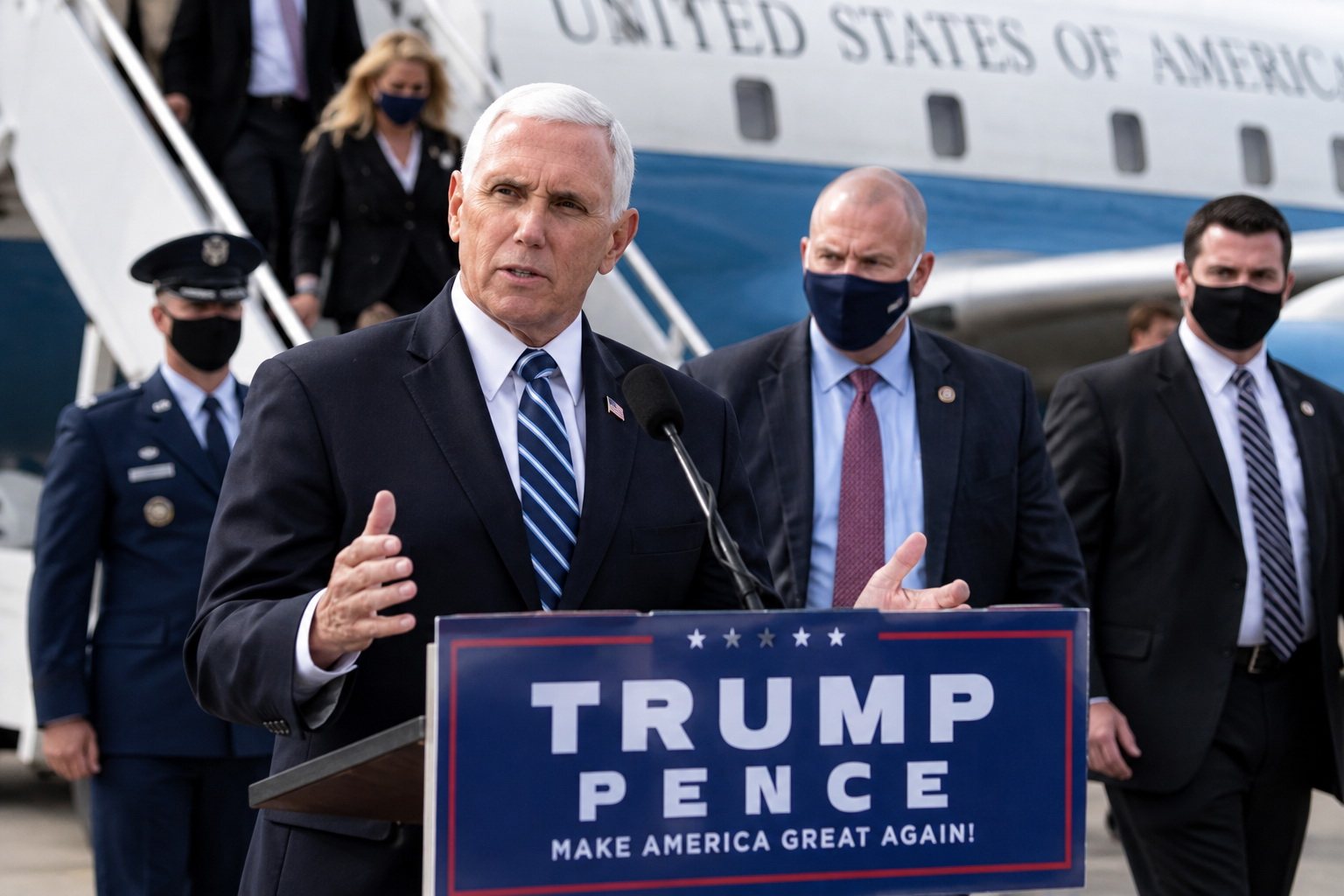
Another coronavirus outbreak has reached the highest levels of the Trump administration, with Vice President Mike Pence's chief of staff testing positive for COVID-19 as the White House announces that Pence will continue his campaign schedule despite close contact with the infected official.
Marc Short, one of Pence's closest advisers and a senior figure involved in the administration's coronavirus response, tested positive Saturday and has begun quarantining.
The announcement comes just one day after the United States recorded more than 83,000 new coronavirus infections in a single day, setting a national record.
It also comes barely three weeks after President Donald Trump himself was hospitalized with COVID-19 following an outbreak that infected numerous White House officials and Republican political figures.
With Election Day just ten days away, the virus continues to spread across the country — and through the administration responsible for coordinating the federal response.
Pence Exposed to Infected Chief of Staff
The vice president's office confirmed Saturday evening that Short had tested positive for the coronavirus.
Pence's press secretary, Devin O'Malley, said Short was quarantining and cooperating with contact-tracing efforts.
The White House acknowledged that Pence had been in close contact with Short, making the vice president potentially exposed to the virus.
Pence and his wife, Karen, both tested negative Saturday and were described as being in good health.
However, a negative coronavirus test does not necessarily rule out infection following a recent exposure, particularly during the period before symptoms develop.
Public health authorities generally recommend that people who have been in close contact with an infected individual quarantine to reduce the risk of spreading the virus.
Despite those recommendations, Pence has no plans to suspend his campaign activities.
White House Says Pence Will Keep Traveling
The vice president's office announced that Pence would maintain his scheduled appearances after consulting with the White House Medical Unit.
Officials cited Centers for Disease Control and Prevention guidance permitting certain essential workers to continue performing necessary duties after exposure to an infected person, provided they follow additional precautions.
But the decision raises an obvious question: Is campaigning for reelection an essential government function?
Pence is scheduled to campaign in North Carolina on Sunday after spending Saturday at campaign events in Florida.
The White House has not explained how political rallies qualify as essential work under public health guidelines.
Infectious disease specialists have questioned the decision.
George Mason University infectious disease expert Saskia Popescu criticized the plan, arguing that Pence should remain home for the recommended quarantine period rather than attend political events.
More Infections in Pence's Political Circle
Short is not the only person associated with Pence to test positive.
Marty Obst, a longtime political adviser who has worked closely with the vice president, has also contracted the coronavirus.
Obst recently traveled aboard Air Force Two and has been involved in Pence's political activities.
The infections raise concerns about whether the virus is spreading among individuals who regularly work and travel together.
Short's diagnosis is especially significant because of his senior position and frequent contact with the vice president.
He also participates in the administration's coronavirus response efforts.
The White House has not provided a complete public accounting of possible exposures associated with the latest infections.
The Man Leading the Coronavirus Task Force
Pence is not simply another administration official exposed to COVID-19.
He chairs the White House Coronavirus Task Force, the group responsible for coordinating the federal government's response to the pandemic.
Since February, Pence has appeared alongside public health officials to discuss testing, hospital capacity, protective equipment, and efforts to slow transmission.
His position places him at the center of the administration's public health strategy.
Yet the decision to continue campaign travel after close contact with an infected aide has renewed questions about whether the administration is following the precautions it asks Americans to observe.
Pence has encouraged mask-wearing and social distancing in public statements, but he has also participated in political gatherings where many attendees have not worn face coverings.
Another White House Outbreak
The latest infections come just weeks after a major coronavirus outbreak involving the president and numerous people associated with the White House.
Trump announced his positive test on October 2 and was subsequently hospitalized at Walter Reed National Military Medical Center.
First Lady Melania Trump also tested positive.
Other infected individuals included White House staff members, political advisers, and Republican officials.
The outbreak prompted questions about testing procedures, mask usage, and distancing practices at White House events.
Now the virus has reached Pence's immediate circle.
The recurrence raises fresh concerns about the effectiveness of infection-control measures within the administration.
A Record-Breaking National Surge
The latest White House infections are occurring as the pandemic accelerates nationwide.
On Friday, the United States reported more than 83,000 new coronavirus cases, surpassing the previous daily record established during the summer.
More than 220,000 Americans have died from COVID-19 since the pandemic began.
Hospitalizations are increasing in numerous states, and public health officials warn that colder weather could contribute to further transmission.
The latest figures directly contradict Trump's repeated assurances that the country is approaching the end of the pandemic.
During Thursday night's presidential debate, Trump insisted that the United States was rounding the corner and that the virus was going away.
Friday's record-breaking infection count and Saturday's announcement from Pence's office present a dramatically different picture.
Campaigning Takes Priority
The Trump campaign is entering the final stretch of a closely contested presidential election.
Trump and Pence are traveling extensively through battleground states, holding events intended to energize supporters and encourage turnout.
The president has argued that the country must reopen its economy and move beyond restrictions imposed during the pandemic.
Democratic presidential nominee Joe Biden has criticized the administration's response, arguing that it has failed to control the virus or provide consistent national leadership.
The campaigns have also adopted different approaches to public events.
Biden's campaign has emphasized smaller gatherings and distancing precautions, while Trump and Pence have continued holding larger rallies.
Earlier this month, Democratic vice presidential nominee Kamala Harris temporarily suspended in-person campaigning after two people associated with her campaign tested positive.
Pence's decision to continue traveling after his chief of staff's diagnosis presents another contrast between the campaigns' approaches.
Questions About Public Health Leadership
The White House maintains that Pence is following medical advice and that his negative test results allow him to continue his duties.
Officials argue that his responsibilities as vice president qualify him for special provisions available to essential personnel.
However, public health experts have warned that negative test results immediately following exposure cannot guarantee that someone is free of infection.
The CDC's essential-worker provisions are intended to maintain critical services while reducing the risk of workplace transmission.
Whether those provisions should extend to political campaign appearances is now being questioned.
The concern is not limited to Pence's personal health.
His travel schedule involves campaign staff, security personnel, transportation crews, local officials, and members of the public.
A Pandemic That Refuses to Disappear
The latest outbreak presents another difficult moment for an administration that has repeatedly portrayed the coronavirus as a crisis nearing its conclusion.
On Thursday, Trump told the nation the virus was going away.
On Friday, the United States recorded its highest number of daily infections since the pandemic began.
On Saturday, the vice president's own chief of staff tested positive, and the White House confirmed that Pence had been exposed.
The sequence highlights the continuing gap between the administration's optimistic public statements and the measurable spread of the virus.
Pence remains negative for COVID-19, according to his office, and officials say he is healthy.
But his decision to continue campaigning despite close contact with an infected aide has intensified scrutiny of the administration's pandemic precautions.
With more than 220,000 Americans dead and infections rising rapidly, the country continues to confront a public health emergency.
And now, once again, that emergency has reached the White House itself.