President Donald Trump’s ambitious plan to dramatically reshape the White House hit a major legal obstacle on August 7, when a federal appeals court ruled that his administration cannot continue above-ground construction of a massive new ballroom without authorization from Congress.
In a 2-1 decision, the U.S. Court of Appeals for the District of Columbia Circuit upheld a preliminary injunction blocking construction of the proposed ballroom.
The ruling does not permanently prohibit Trump from building it.
Instead, the court concluded that the president cannot unilaterally make such a substantial alteration to federal property without Congress approving the project.
The distinction goes directly to one of the central questions surrounding Trump's second term: how far can a president go when Congress has not specifically authorized what he wants to do?
A 90,000-Square-Foot Transformation
Trump's proposed ballroom is no minor renovation.
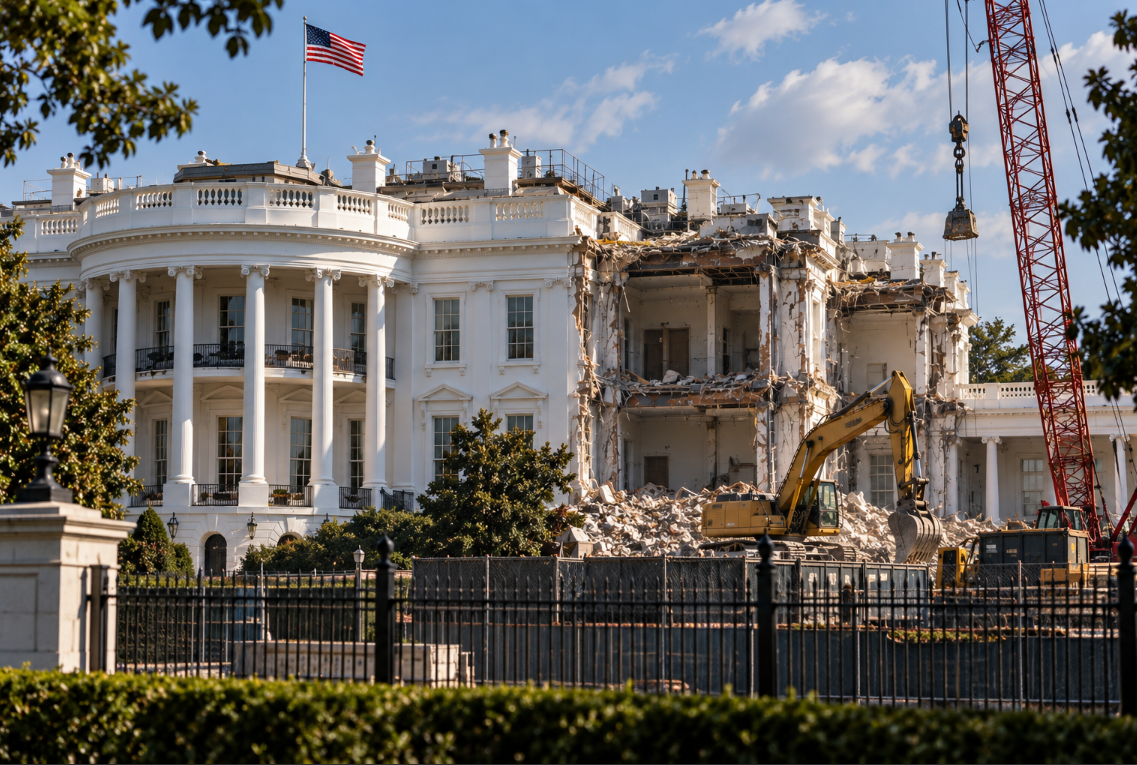
The project calls for a roughly 90,000-square-foot ballroom on the former site of the White House East Wing, which was demolished in 2025 as preparations for the project moved forward.
The estimated price has risen to approximately $400 million.
Trump has said private donations will pay for the project rather than taxpayers, and his administration has argued that the larger redevelopment also includes important security improvements and underground facilities.
But private financing did not resolve the legal question at the center of the lawsuit.
The White House belongs to the federal government.
And according to the appeals court, constitutional authority over federal property rests with Congress.
“Each President Is a Temporary Tenant”
The majority opinion delivered an unusually direct description of the president's relationship with the White House.
The judges wrote that each president is a temporary tenant rather than the owner of the White House and Executive Residence.
That distinction became central to the court's reasoning.
Presidents obviously have considerable authority over the operation of the White House. Renovations, maintenance and security improvements have occurred under administrations of both parties.
But the court concluded that demolishing a substantial portion of the complex and replacing it with an enormous new structure goes considerably further.
The administration had not demonstrated that Congress gave either the president or the National Park Service authority to undertake such a transformation without congressional approval.
The court summarized its position plainly: whether a massive ballroom should be constructed is a decision for Congress.
The East Wing Was Already Demolished
The legal battle is particularly significant because construction did not begin with an untouched White House.
The East Wing had already been demolished.
Trump's administration moved ahead with demolition in October 2025 as part of plans for the new ballroom and associated facilities.
The National Trust for Historic Preservation subsequently challenged the project, arguing that the administration had bypassed legal requirements governing major alterations to one of America's most historically significant federal properties.
The government's own environmental review acknowledged that the project would permanently alter the historic appearance of the White House grounds.
The proposed ballroom would also be dramatically larger than the structure it replaces.
Those changes helped convince the courts that allowing construction to continue while the lawsuit proceeded could result in irreversible alterations before the underlying legal dispute was resolved.
Security Work Can Continue
The ruling does not bring every construction activity at the site to a halt.
The injunction specifically allows below-ground construction associated with national-security facilities to continue.
Work necessary to protect those facilities, maintain structural integrity and ensure the safety of the president, White House staff and surrounding property can also proceed.
What cannot proceed under the injunction is construction of the above-ground ballroom itself.
That distinction is important because the Trump administration has argued that the project should be viewed as an integrated security complex rather than simply an extravagant event space.
Officials have cited underground bunkers and other security infrastructure as reasons construction should continue.
The majority acknowledged those concerns but concluded that national-security arguments do not give the executive branch unlimited authority to redesign federal property without congressional authorization.
One Judge Strongly Disagreed
The decision was not unanimous.
Judge Neomi Rao dissented.
Rao argued that the National Trust lacked standing to bring the lawsuit and that the courts were improperly interfering with decisions involving White House security.
She also gave greater weight to the government's argument that the ballroom is part of a broader project intended to improve presidential security and provide a permanent space for large official events.
In her view, the potential security consequences of interrupting construction outweighed the preservation concerns raised by the plaintiffs.
The majority disagreed.
The two judges concluded that Congress's constitutional authority over federal property could not simply be bypassed because the executive branch considered the project desirable or connected it to security improvements.
Private Money Doesn't Make the White House Private Property
Trump has repeatedly emphasized that private donors are financing the ballroom.
That may address the question of who pays for construction, but according to the court, it does not answer the question of who has the legal authority to approve it.
The White House remains federal property regardless of where construction money originates.
That is an important distinction.
If private financing alone allowed a president to substantially alter federal property without congressional authorization, a president could potentially circumvent Congress simply by finding private donors willing to finance a desired project.
The appeals court rejected that interpretation of presidential authority.
Trump Plans to Take the Fight to the Supreme Court
Trump responded to the August 7 ruling by announcing that his administration would appeal to the Supreme Court.
The appeals court anticipated that possibility and stayed its decision for 14 days, giving the administration time to seek Supreme Court review.
That means the legal battle over the ballroom is far from finished.
The Supreme Court could ultimately determine whether construction may proceed while the underlying lawsuit continues and, eventually, how much authority a president possesses to make major structural changes to the White House without Congress.
The appeals court was also careful to make clear that its ruling was not a judgment about whether America should have a new White House ballroom.
Congress could authorize one.
The dispute is about who gets to make that decision.
A Ballroom Becomes a Separation-of-Powers Fight
What began as an architectural project has turned into something considerably larger.
The case now involves the Constitution's division of power between Congress and the presidency, the government's control of federal property, historic preservation, presidential security and the limits of privately financed projects involving public buildings.
Trump wants a permanent ballroom capable of hosting large state functions and official events.
His administration argues that the project also provides significant security benefits.
The National Trust argues that the administration cannot fundamentally alter one of America's most historically important public buildings without following the law.
For now, two federal appellate judges have agreed.
Trump may occupy the White House.
But according to their August 7 ruling, occupying the White House does not give a president the authority to fundamentally rebuild it on his own.