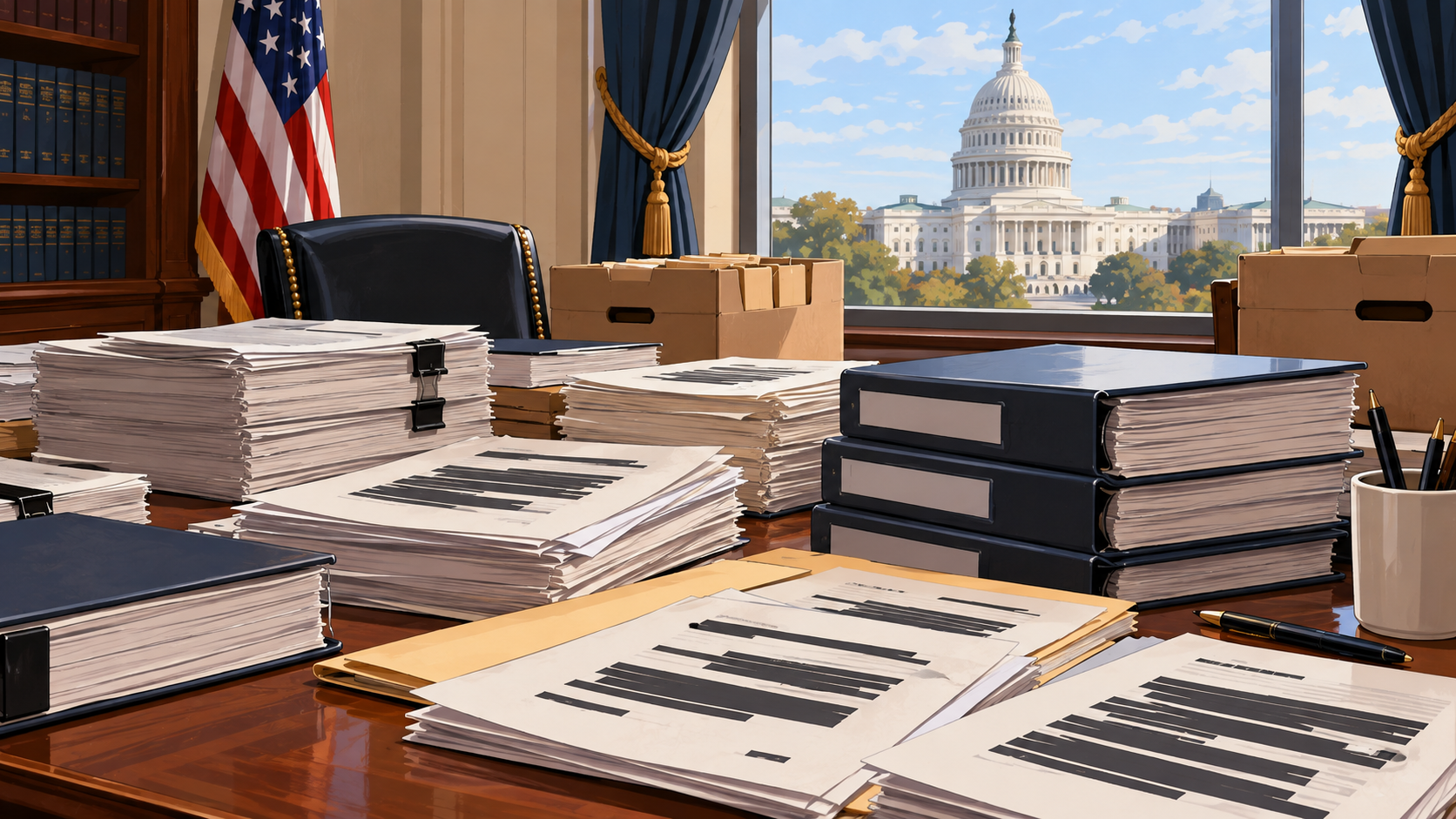
Ten months after Donald Trump signed legislation requiring the government to release its Jeffrey Epstein records, lawmakers say the job still isn't finished. Now a bipartisan pair in Congress is trying to force another disclosure vote.
Congress already passed a law to release the Epstein files.
Donald Trump signed it.
The Justice Department subsequently published millions of pages.
And now Congress may have to do it all over again.
Republican Rep. Thomas Massie of Kentucky and Democratic Rep. Ro Khanna of California are pushing a second Epstein transparency bill designed to force the federal government to disclose information they believe remains improperly hidden from the public.
The effort comes less than a year after the first Epstein Files Transparency Act became law.
Massie and Khanna have now secured enough support—including the Republican signatures necessary—to force another House vote.
There is just one problem.
That vote isn't expected until after the November midterm elections.
Congress Already Ordered the Files Released
The first Epstein Files Transparency Act was supposed to settle this.
Congress ordered the Justice Department to release records connected to convicted sex offender Jeffrey Epstein and his associates while protecting victims' identities and other information that legally must remain confidential.
Trump signed the legislation in November 2025.
The Justice Department eventually released an enormous archive.
Its public Epstein Library now contains 12 separate datasets, court records, Freedom of Information Act material and previous DOJ disclosures.
The department has said it published millions of pages responsive to the law.
But Massie and Khanna say significant questions remain about what wasn't released.
That is why they're back.
Epstein Files Transparency Act II
The new legislation is effectively an attempt to close what its sponsors consider loopholes in the first law.
The proposal would give additional parties—including state attorneys general, survivors and Congress itself—greater ability to demand access to remaining Epstein-related information.
It would also create additional mechanisms for challenging redactions and withheld material.
That distinction matters.
Not every blacked-out name in an Epstein document represents an improper government concealment.
Some information must legitimately remain secret.
Victims deserve privacy.
Grand jury information is protected by federal law.
Personal identifying information can require redaction.
Courts can also order records sealed.
The dispute isn't over whether those protections should exist.
The question is whether the Justice Department has gone beyond those protections and withheld information Congress intended the public to see.
Massie and Khanna believe it has.
Millions of Pages—and Still Questions
The sheer size of the Epstein archive makes determining what remains missing extraordinarily difficult.
The Justice Department says it has released millions of responsive pages.
That sounds definitive.
It isn't necessarily.
An enormous document dump can simultaneously contain a tremendous amount of information while leaving important material undisclosed.
And the Epstein releases have already generated controversy in both directions.
Some records have been criticized for excessive redactions.
Others were released without sufficient redactions.
Victims' names and sensitive personal information were accidentally exposed in some of the government's disclosures, creating exactly the kind of privacy violations the redaction process was supposed to prevent.
That history complicates the current fight.
The government has a legitimate obligation to protect Epstein's victims.
It also has a legal obligation to comply with the transparency law Congress passed.
Those responsibilities are not mutually exclusive.
Massie Hasn't Let This Go
Thomas Massie has become one of the most persistent Republican lawmakers demanding additional Epstein disclosures.
That has repeatedly placed him at odds with Trump and Republican leadership.
Massie joined Khanna in the original bipartisan campaign to force the Epstein records into public view.
Now the two lawmakers are working together again.
Their second effort demonstrates how unusual the Epstein controversy has become politically.
This isn't simply Democrats demanding information from a Republican administration.
A Republican congressman is helping lead the effort.
And he has persuaded enough fellow Republicans to join him that House leadership can no longer simply prevent the measure from reaching the floor indefinitely.
Why Another Law?
That may be the most important question.
If the first law required the government to disclose the records, why does Congress need another one?
The answer is that lawmakers behind the new legislation believe the original statute didn't give them enough power to challenge the government's decisions about what could remain concealed.
The second bill attempts to strengthen that enforcement mechanism.
In other words:
The first law told the government to release the files.
The second would give people more tools to challenge the government when they believe it hasn't.
Whether those challenges ultimately uncover significant additional information remains unknown.
But Congress wouldn't be considering another transparency law if the first release had resolved every dispute.
The Vote Will Have to Wait
There is another remarkable element to this story.
Timing.
The lawmakers have gathered the support necessary to force the issue.
But the House isn't expected to take the matter up until after the November midterm elections.
That means voters could go to the polls before members of Congress are required to publicly vote on the next round of Epstein transparency.
After years of political promises surrounding the Epstein files, another election may come and go before Congress finishes deciding what Americans are entitled to see.
The Epstein Files Still Aren't Finished
Jeffrey Epstein died in 2019.
His crimes had been investigated for years before that.
Ghislaine Maxwell was convicted in 2021.
Congress passed an Epstein transparency law in 2025.
The Justice Department released millions of pages.
And in September 2026, Congress is preparing for another fight over what remains hidden.
That doesn't prove every redaction conceals something scandalous.
It doesn't prove every withheld document contains the name of someone powerful.
And appearing anywhere in Epstein-related records does not itself establish criminal wrongdoing.
Those distinctions are essential.
But another fact is becoming increasingly difficult to ignore:
After years of investigations, promises, legislation and millions of pages of disclosures, the federal government and members of Congress still cannot agree that the public has received everything it was legally supposed to receive.
So Congress is preparing to ask again.