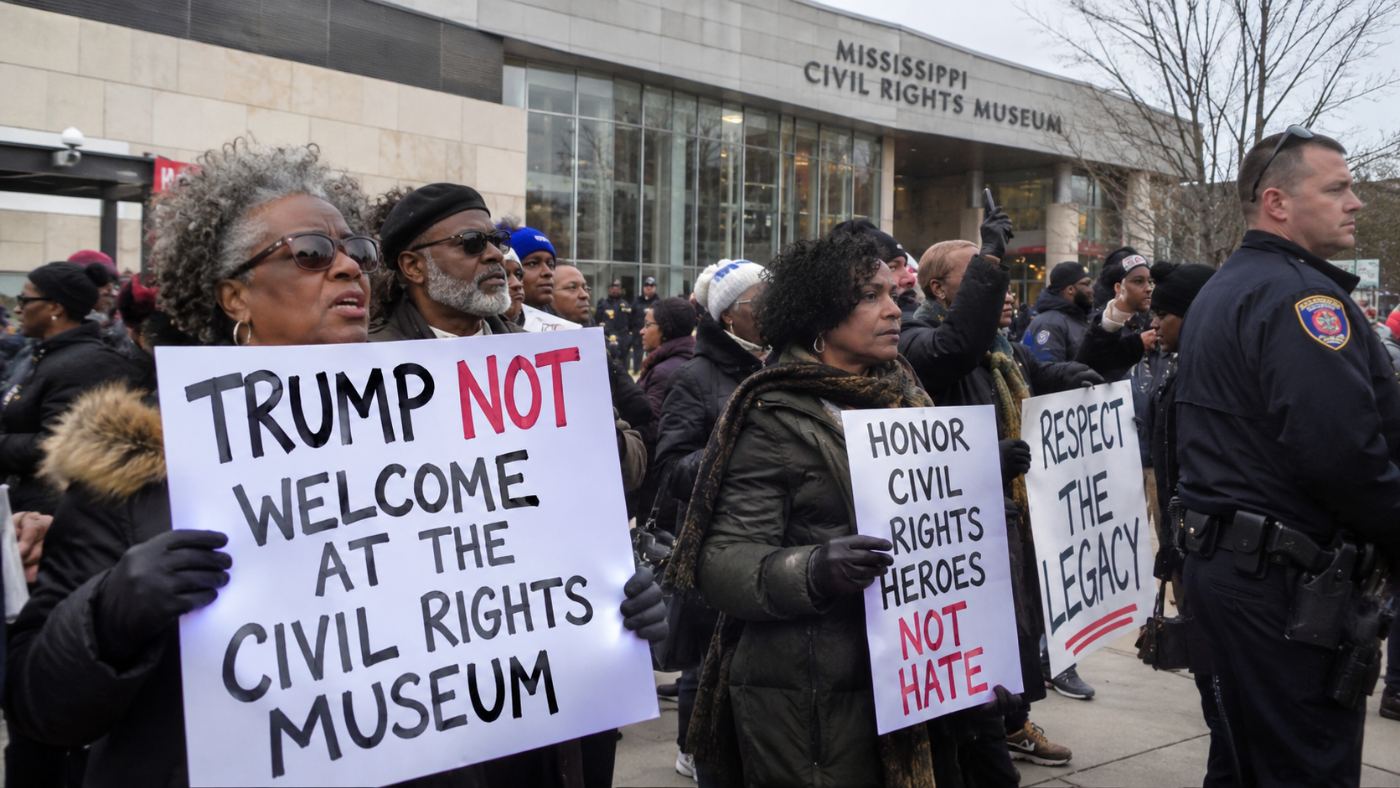
President Donald Trump's appearance at the opening of the Mississippi Civil Rights Museum on December 9, 2017, sparked protests and a boycott by prominent civil rights leaders who argued that his rhetoric and policies contradicted the principles the museum was created to honor.
The controversy unfolded in Jackson, Mississippi, where the new museum commemorated generations of African Americans who fought segregation, racial violence, and discrimination.
For many activists, Trump's participation raised a fundamental question: Should a president whose conduct they considered divisive be given a prominent role in celebrating the struggle for racial equality?
John Lewis Refuses to Attend
Congressman John Lewis, a central figure in the civil rights movement, announced that he would boycott the ceremony.
Lewis had marched alongside Martin Luther King Jr. and suffered a fractured skull when Alabama state troopers attacked voting rights demonstrators on Bloody Sunday in 1965.
Mississippi Congressman Bennie Thompson joined Lewis in refusing to participate.
Both lawmakers argued that Trump's attendance dishonored the legacy of those memorialized inside the museum.
Their objections reflected longstanding criticism of Trump's statements about race, his response to the 2017 white supremacist rally in Charlottesville, and his administration's civil rights policies.
Lewis had originally been scheduled to speak at the museum's opening.
Instead, he stayed away.
NAACP Organizes Separate Event
NAACP President Derrick Johnson, a Mississippi native, also refused to attend Trump's appearance.
Johnson accused the administration of pursuing divisive policies and retreating from civil rights enforcement.
Rather than participate in the presidential ceremony, Johnson joined Jackson Mayor Chokwe Antar Lumumba and other community leaders at a separate gathering at the Smith Robertson Museum.
The alternative event honored the people who had struggled against segregation and racial injustice in Mississippi.
Civil rights advocates emphasized that their objections were directed at Trump's participation, not the museum itself.
They encouraged Americans to visit the new institution and learn its history.
Protesters Gather Outside
Approximately 200 demonstrators gathered near the museum as Trump's visit proceeded.
Protesters carried signs criticizing the president and questioned his commitment to racial equality.
The demonstrations highlighted the contrast between the museum's mission and the political divisions surrounding Trump's presidency.
The Mississippi Civil Rights Museum documents some of the darkest chapters in American history, including lynchings, segregation, voter suppression, and the assassination of civil rights leader Medgar Evers.
For critics, honoring that history required more than ceremonial remarks.
Trump Delivers a Private Speech
Trump toured the museum and delivered a roughly nine-minute address at a private, invitation-only gathering rather than speaking at the main public opening ceremony.
He praised Martin Luther King Jr., James Meredith, Medgar Evers, and other civil rights figures.
Trump described the museum as a tribute to Americans who fought injustice and emphasized the importance of equality and freedom.
Mississippi Governor Phil Bryant, who had invited Trump, defended the president's participation.
Supporters argued that the opening was an appropriate occasion for a sitting president to recognize the achievements of the civil rights movement.
Trump departed before the main public ceremony.
A Celebration Overshadowed by Political Division
The museum's opening was intended to commemorate the sacrifices of Americans who challenged institutional racism and helped transform the nation.
Instead, Trump's participation became a national controversy.
The boycotts by Lewis, Thompson, and NAACP leaders demonstrated the depth of disagreement over the president's civil rights record.
The ceremony also illustrated how Trump's public statements about equality could be received very differently by those who questioned his administration's actions.
On December 9, 2017, Trump praised America's civil rights heroes inside a Mississippi museum while prominent veterans and advocates of that movement refused to share the occasion with him. Their boycott turned a historic dedication into a public confrontation over the meaning of civil rights and presidential leadership.