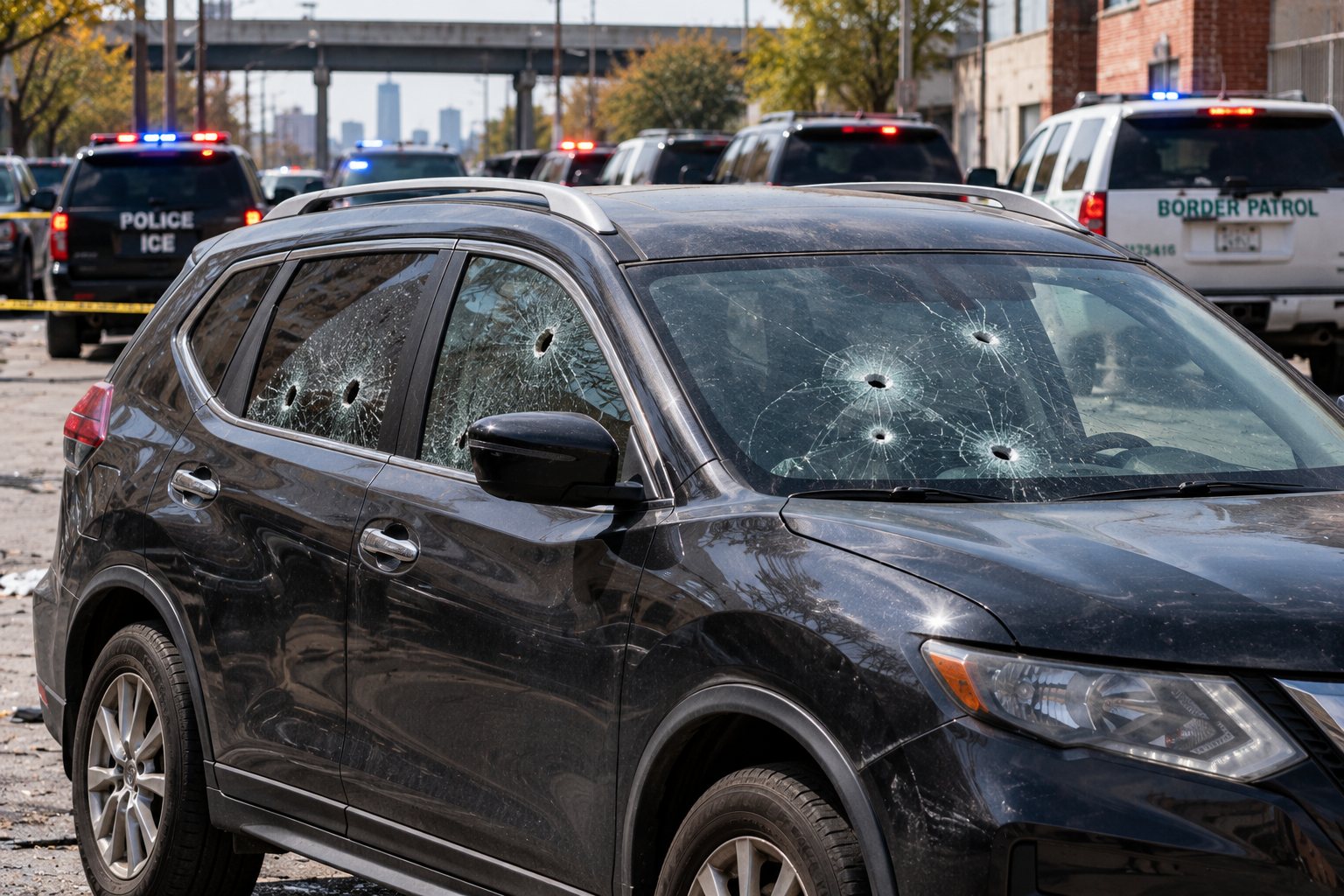
A Chicago woman who was shot five times by a U.S. Customs and Border Protection agent during the Trump administration's immigration crackdown is now suing the federal government, alleging the agent fired into her vehicle without justification and then gave investigators a false account of what happened. The government initially portrayed Marimar Martinez as part of an “ambush” on federal agents and criminally charged her. But prosecutors later abandoned the case, a judge dismissed the charges with prejudice, and publicly released video evidence raised significant questions about the government's original description of the encounter.**
A year ago, Marimar Martinez was the defendant.
Now she is the plaintiff.
Martinez, a U.S. citizen and Montessori school teacher's aide, has filed a federal lawsuit seeking damages over an October 4, 2025 encounter with immigration agents in Chicago that left her with multiple gunshot wounds.
Her lawsuit alleges false arrest and imprisonment, malicious prosecution, negligence and other wrongdoing.
But the case is about considerably more than the shooting itself.
It is also about what the federal government said happened afterward—and whether those claims matched the evidence.
Operation Midway Blitz
The confrontation occurred during Operation Midway Blitz, the Trump administration's large-scale immigration enforcement campaign in the Chicago area.
Martinez had spotted federal immigration agents operating in her neighborhood.
She began following an unmarked government vehicle in her Nissan Rogue, honking her horn and warning people that immigration agents were nearby.
The pursuit continued for roughly 20 minutes.
Then the vehicles collided.
What happened immediately before and after that collision became the foundation of a federal criminal case against Martinez.
And the two versions of events were dramatically different.
The Government Said Agents Were “Ambushed”
Federal officials initially described the encounter in stark terms.
The Department of Homeland Security said Border Patrol agents had been “ambushed” by vehicles that boxed them in and rammed their government vehicle.
DHS Secretary Kristi Noem said agents had opened fire in self-defense.
Martinez was accused of using her vehicle as a weapon.
The government charged Martinez and another person, Anthony Ruiz, with assaulting, resisting or impeding federal officers.
The allegations were serious.
But then evidence from the encounter became public.
And the government's story began encountering problems.
The Video Told a Different Story
Body-camera footage and surveillance video released following the shooting did not show Martinez ramming the agents' vehicle as DHS had originally described.
ABC News conducted a visual analysis of the footage.
Its conclusion was striking:
At no point in the available footage was a driver seen ramming the agents' vehicle.
Instead, video appeared to show the government vehicle driven by Supervisory Border Patrol Agent Charles Exum steering toward Martinez's vehicle before the collision.
The footage also undermined another part of the government's description.
Agents had reported being “boxed in.”
But video showed only two vehicles following them shortly before the shooting—not the larger convoy initially described—and the agents' vehicle was not blocked from the front.
None of that automatically establishes everything Martinez alleges in her lawsuit.
But it raised substantial questions about the government's original public description of the encounter.
Five Shots
Exum exited his vehicle and opened fire.
He fired five rounds in less than a second.
Martinez was struck five times, leaving seven entrance and exit wounds.
Her attorneys say their forensic reconstruction shows three bullets entered through the passenger side of the windshield.
A fourth went through the front passenger-side window.
And according to the reconstruction, the fifth shot entered from behind the vehicle.
That final bullet is particularly important to Martinez's lawsuit.
Her attorneys contend the trajectory demonstrates that Exum was no longer in front of her vehicle—and therefore could not have been protecting himself from being run over—when he fired the final round.
Attorney Christopher Parente put the issue bluntly:
“In what world can a U.S. law enforcement officer stand behind a car and fire his Glock service weapon through the rear passenger window at a young woman who's crouched over the steering wheel?”
That is the position of Martinez's attorneys and their forensic expert. It has not yet been established as a finding in her civil lawsuit.
What Exum Allegedly Told the FBI
Martinez's attorneys say Exum gave investigators a very different account.
According to Parente, Exum told the FBI that Martinez was driving directly toward him.
He allegedly said he fired through the windshield.
And he allegedly said he stopped shooting once he was no longer in the path of her vehicle.
Martinez's lawyers contend the physical evidence contradicts all three claims.
Parente has characterized them as lies.
Whether a court ultimately agrees will be one of the central questions surrounding the litigation.
Exum has not been personally named as a defendant because Martinez filed her lawsuit against the United States under the Federal Tort Claims Act.
Customs and Border Protection says Exum has been placed on administrative leave.
“It's Time to Get Aggressive”
There is another piece of evidence likely to receive significant attention.
Body-camera footage from another agent inside the government vehicle captured agents talking shortly before the shooting.
According to the lawsuit, one can be heard saying:
“It's time to get aggressive.”
Other profanity-laced remarks followed.
Moments later, the vehicles collided and Exum opened fire.
Those statements don't independently determine whether the shooting was legally justified.
But Martinez's attorneys argue they provide important context about the agents' mindset immediately before the encounter.
Shot—and Then Arrested
Martinez survived the shooting.
She was taken to a hospital.
Then federal authorities arrested her.
According to her lawsuit, FBI agents removed her from the hospital while she was confined to a wheelchair and her wounds were still bleeding through her bandages.
Instead of the Border Patrol agent who shot her being charged, Martinez became the criminal defendant.
A federal judge ordered her released two days later.
The prosecution continued.
Until suddenly it didn't.
The Justice Department Drops the Case
On November 20, 2025, the Justice Department asked a federal judge to dismiss the charges against Martinez and Ruiz.
The government did not merely lose the case at trial.
It abandoned the prosecution itself.
U.S. District Judge Georgia Alexakis dismissed the charges with prejudice.
That distinction matters.
A dismissal with prejudice means the government cannot simply refile the same case later.
The criminal prosecution of Martinez was over.
But by then, federal officials had already publicly accused her of attacking immigration agents.
Martinez's attorneys began fighting to release the evidence from the case so the public could see what happened.
In February 2026, Judge Alexakis authorized the release of body-camera footage, photographs, FBI reports and other evidence.
The government's original narrative could now be compared with the actual footage.
Then Came the Text Messages
The released evidence also included messages Exum allegedly exchanged with fellow agents after the shooting.
One attracted particular attention.
Referring to the shooting, Exum wrote:
“I fired 5 rounds and she had 7 holes.”
He followed it with:
“Put that in your book, boys.”
In another message the following day, Exum wrote that he was ready for another round of “f--- around and find out.”
When questioned about the messages, Exum testified that he had been using humor as a way of relieving stress.
Other messages released by Martinez's attorneys showed fellow agents congratulating Exum after the shooting and referring to him as a “legend.”
Former Border Patrol official Gregory Bovino also praised Exum's service in Chicago.
From “Domestic Terrorist” to Plaintiff
Martinez argues the consequences extended well beyond her physical injuries.
She says government officials publicly portrayed her as a dangerous extremist before the facts had been fully established.
Her attorneys say federal officials falsely branded her a domestic terrorist and attempted to justify the shooting publicly while she was simultaneously being prosecuted.
Then the criminal case disappeared.
Now Martinez wants the federal government held accountable for what happened before, during and after the shooting.
Her lawsuit seeks monetary damages.
But Martinez says that isn't the only reason she filed it.
She pointed to other shootings involving federal immigration agents and said she believes someone has to challenge what is happening.
“What's happening is not normal,” Martinez said.
“We shouldn't sit here and normalize what's happening, and I'm not going to sit here.”
The Agent Has Not Been Criminally Charged
Despite the collapse of the case against Martinez, Exum has not been criminally charged over the shooting.
CBP says use-of-force incidents are thoroughly investigated, reviewed and presented to an independent board.
Martinez and her attorneys argue that federal authorities have failed to adequately investigate Exum.
Chicago police have since opened their own investigation.
The department's Investigative Response Team—the unit that handles police shootings and other major incidents—is examining the case.
Any decision to pursue state felony charges would ultimately rest with Cook County prosecutors.
Martinez's attorneys say they have provided local investigators with evidence they believe supports criminal charges against Exum.
That remains their allegation; no prosecutor has announced such charges.
A Very Different Story One Year Later
Consider how the case was originally presented.
Federal agents were supposedly ambushed.
Their vehicle was supposedly rammed.
Martinez was supposedly using her SUV as a weapon.
The agent supposedly opened fire to protect himself.
Martinez was arrested.
Martinez was prosecuted.
Federal officials publicly condemned her.
Now compare that with where the case stands one year later.
The Justice Department dropped the charges against Martinez.
A federal judge dismissed them permanently.
Released video did not show Martinez ramming the government vehicle as DHS initially claimed.
Video appeared to show the government vehicle steering toward hers.
A forensic reconstruction commissioned by Martinez's attorneys concludes that the final shot was fired from behind her vehicle.
Messages showed Exum discussing the shooting afterward with fellow agents.
Exum is on administrative leave.
Chicago police are investigating.
And Martinez is now suing the United States government.
Those facts don't automatically determine the outcome of her civil case.
A court will still have to evaluate the evidence, the government's defenses and whether Exum's use of force was legally justified.
But the transformation of the case is extraordinary.
The Woman the Government Prosecuted Is Now Asking the Government to Answer for What It Did
Marimar Martinez was shot five times.
Then she was arrested.
Then she was accused of assaulting federal officers.
Then federal officials publicly portrayed her as a dangerous threat.
Then the government's prosecution collapsed.
Now the evidence that emerged from that failed prosecution is being used for an entirely different purpose.
This time, Marimar Martinez isn't the person the government is prosecuting.
She's the person asking the government to explain itself.