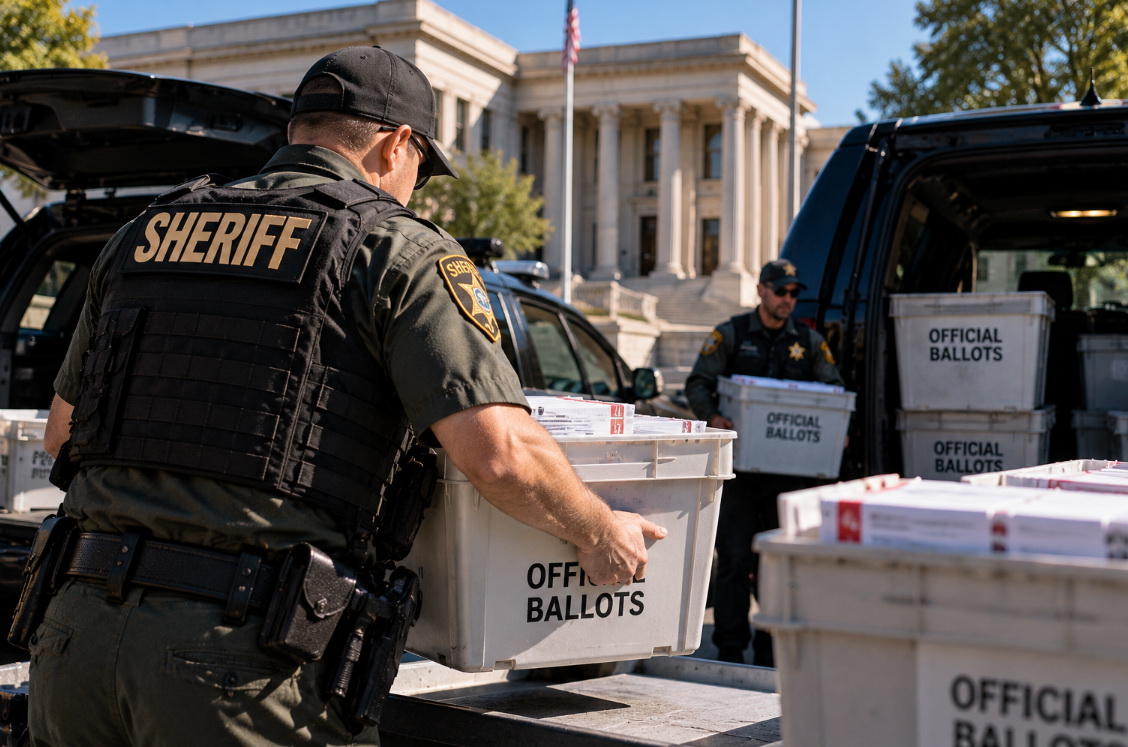
More than 650,000 ballots.
Roughly 1,000 boxes.
Armed deputies.
A sheriff convinced something was wrong with an election.
And a state attorney general ordering him to stop.
On Thursday, the California Supreme Court delivered its answer to what had become one of the most consequential election-law confrontations in the state:
The sheriff broke the law.
Not once.
Twice.
In two unanimous rulings, California's highest court concluded that Riverside County Sheriff Chad Bianco acted unlawfully when his department seized more than 650,000 ballots from the county registrar following the November 2025 special election.
The court also ruled that Bianco acted unlawfully when he refused to follow California Attorney General Rob Bonta's order to stop.
The ballots must be returned.
The investigation must stop, pending review by the attorney general.
And perhaps most importantly, California's Supreme Court has now established something that should never have required this much litigation:
A local sheriff does not get to take control of an election because he doesn't trust the result.
It Started With Claims of a Missing 46,000 Votes
The controversy grew out of California's November 2025 special election on Proposition 50, which redrew congressional districts.
Riverside County voters approved the measure by roughly 80,000 votes.
But a citizen-led hand tally conducted as part of a county pilot program came up roughly 46,000 votes short of the official count.
That discrepancy immediately fueled suspicions of election fraud.
There was a problem.
Election officials explained why the numbers didn't match.
The unofficial hand tally wasn't a complete count.
According to election officials, activists had misunderstood preliminary election data and treated the discrepancy as evidence of something sinister.
Nevertheless, Bianco pursued an investigation.
And eventually his department obtained warrants.
Then armed deputies went into the Riverside County elections office and removed approximately 1,000 boxes containing more than 650,000 voted ballots.
California's Attorney General Told Him to Stop
When Attorney General Rob Bonta learned what was happening, he ordered Bianco to stand down.
Bianco didn't.
Instead, according to reporting on the case, the sheriff accelerated the operation.
Deputies from specialized investigative and tactical units participated in taking possession of the election materials.
Later, Bianco directed personnel to begin counting ballots by hand.
Bonta again ordered him to stop.
Bianco's response was essentially that California's attorney general didn't have the authority to tell an elected county sheriff what to do.
That argument has now been rejected by the California Supreme Court.
Unanimously.
Sheriffs Don't Run Elections
This is the most important part of the ruling.
California already has detailed laws governing what happens to ballots after an election.
Those laws exist for a reason.
Ballots remain under the control of election officials.
There are procedures for recounts.
There are procedures for audits.
There are procedures for investigating election crimes.
There are rules governing who may handle ballots.
There are chain-of-custody requirements designed to ensure that nobody can alter, destroy, substitute or improperly examine votes.
Law enforcement isn't prohibited from investigating election crimes.
But police officers don't get to invent their own election procedures.
That's essentially what California's Supreme Court concluded.
Chief Justice Patricia Guerrero wrote that California law plainly requires voted ballots to remain in the custody of election officials.
The court also pointed out the remarkable irony in Bianco's argument.
The sheriff claimed he needed control of the ballots to protect election integrity.
But allowing law enforcement officers to remove ballots and secretly handle or count them outside established election procedures would itself create a risk to election integrity.
Exactly.
Imagine If Every Sheriff Could Do This
Forget Chad Bianco for a moment.
Imagine the precedent.
There are 58 counties in California.
Imagine that after an election, a sheriff doesn't like the result.
Someone sends the sheriff a spreadsheet.
Someone discovers a numerical discrepancy.
Someone posts a theory online.
Someone insists thousands of ballots are suspicious.
The sheriff obtains a warrant.
Armed deputies arrive at the elections office.
They load hundreds of thousands of ballots into vehicles.
Then deputies begin conducting their own recount.
Now imagine another sheriff doing it.
And another.
Perhaps the sheriff is Republican.
Perhaps the sheriff is Democratic.
It shouldn't matter.
Law enforcement officers cannot become independent election authorities whenever they decide an election deserves another look.
If that became normal, the chain of custody protecting American ballots would become meaningless.
This Is Bigger Than Riverside County
The timing of Thursday's decision matters enormously.
California's November midterm election is approaching.
And Riverside County isn't the only place where law enforcement has recently become involved with old ballots.
Federal agents have seized 2020 election records in Fulton County, Georgia, and Maricopa County, Arizona.
The FBI has also recently visited Shasta County, California, where outgoing Registrar of Voters Clint Curtis has alleged that some ballots from the June primary looked, felt and even smelled suspicious.
Curtis lost that election himself.
No evidence of widespread election fraud has emerged from these investigations.
Yet the pattern is becoming difficult to ignore.
Six years after Donald Trump refused to accept his 2020 election defeat, election-fraud allegations continue generating investigations long after elections have been certified.
The danger isn't merely another conspiracy theory appearing online.
The danger comes when people carrying badges, warrants and guns begin acting on those theories.
California Just Changed the Law Too
State lawmakers weren't waiting for the Supreme Court.
After Bianco's ballot seizure, California passed additional protections governing election materials.
Gov. Gavin Newsom signed legislation strengthening restrictions against unauthorized removal of ballots, election records and voting equipment.
One new law makes certain unauthorized seizures of election materials a felony.
Those laws will apply going forward.
Thursday's Supreme Court ruling answers the equally important question of whether Bianco's actions were already prohibited under the law existing when he seized the ballots.
They were.
Then There Was the AI
As if the case weren't unusual enough already, the California Supreme Court included another remarkable detail in its decision.
During preliminary litigation, Bianco's attorneys challenged whether the people suing him even had legal standing.
Their argument relied upon purported language from an earlier California Supreme Court case.
There was a problem.
The quotations weren't accurate.
Neither was the description of what the earlier case actually held.
The court said artificial-intelligence tools apparently contributed to the errors.
The justices used a footnote to remind attorneys of their professional obligations of competence and candor when appearing before the court.
So an unprecedented fight involving hundreds of thousands of seized ballots somehow also became another cautionary tale about lawyers trusting AI-generated legal research without properly verifying it.
You almost couldn't write this story as fiction.
The Ballots Go Back
The most important consequence of Thursday's ruling is straightforward.
The ballots go back where California law says they belong.
With election officials.
Bianco does not get to conduct his own independent ballot investigation without state oversight.
And California's attorney general does, in fact, have supervisory authority over county sheriffs.
There are legitimate ways to investigate election crimes.
There are legitimate ways to challenge election results.
There are recounts.
Audits.
Courts.
Subpoenas.
Election contests.
Criminal investigations conducted under established law.
What there cannot be is a parallel election system in which an elected sheriff decides the official process isn't trustworthy and takes custody of the votes himself.
Because ballots don't belong to the sheriff.
They don't belong to the governor.
They don't belong to the attorney general.
They don't belong to Donald Trump.
They don't belong to Gavin Newsom.
They belong to the voters who cast them.
And the laws governing those ballots exist to make sure nobody — regardless of party, office or political belief — gets to decide otherwise.