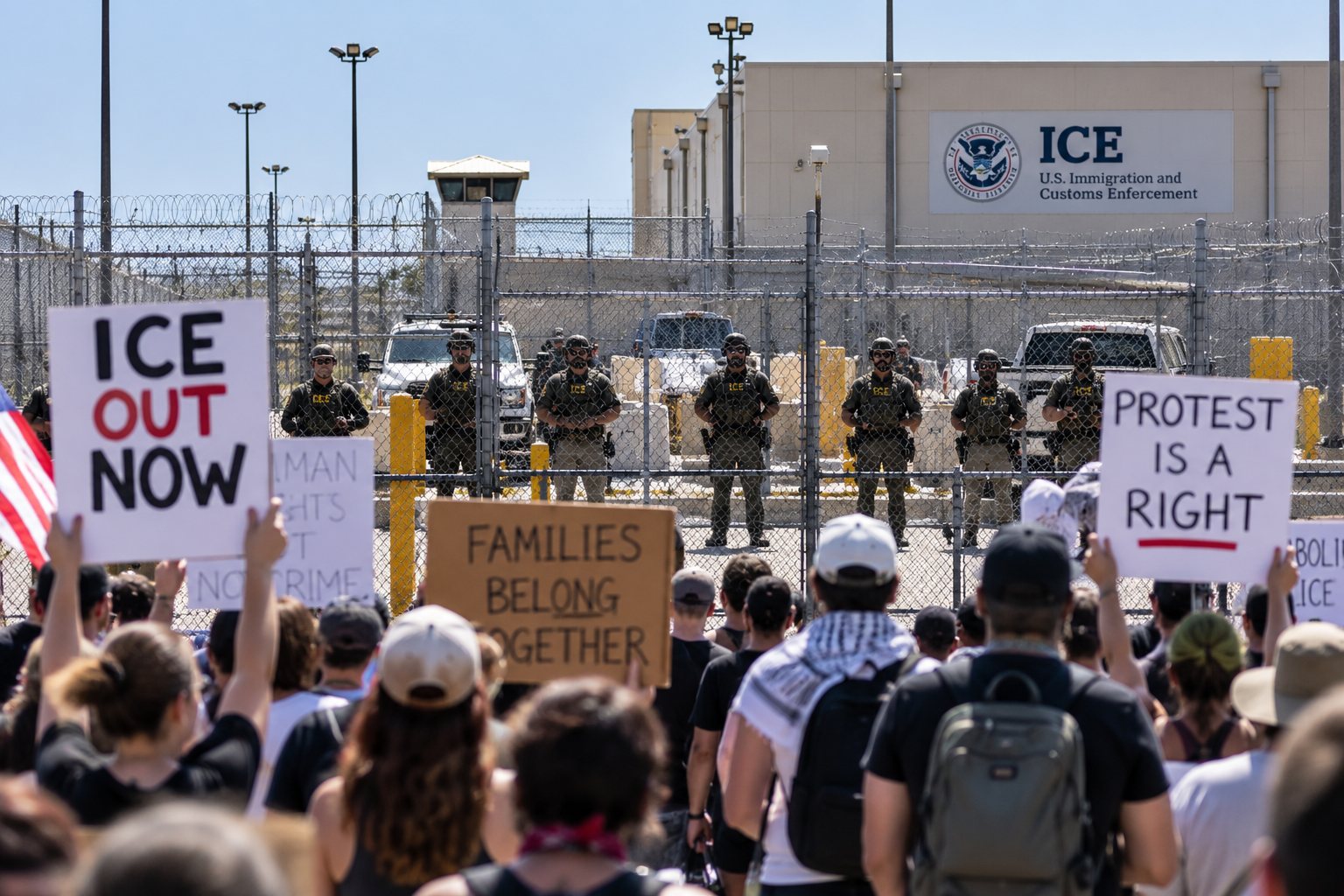
Protesters and activists facing criminal cases under the Trump administration's widening campaign against what it calls “antifa” are beginning to organize together. A new group called the NSPM-7 Defendants Union is bringing together defendants from anti-ICE demonstrations, pro-Palestinian protests and other activist movements, offering legal clinics, media training and coordinated support. Its creation comes amid a much larger question: how broadly can the federal government use terrorism, conspiracy and “antifa” allegations against people involved in political protest?**
Darío Sánchez wasn't at the protest.
He is nevertheless facing criminal charges connected to it.
The 33-year-old Texas middle school teacher has been arrested three times, according to reporting by The Guardian.
His current charges include tampering with physical evidence and hindering the prosecution of terrorism.
The alleged conduct?
Prosecutors say Sánchez removed someone from a Discord group and a Signal chat connected with a July 4, 2025 protest outside an Immigration and Customs Enforcement detention facility in Prairieland, Texas.
Sánchez says his experience demonstrates something much larger.
“I've seen my case as one manifestation of all the different ways the Trump administration is going after people,” he told The Guardian, “regardless of if you've even been to a protest.”
Now Sánchez and other defendants are organizing.
The NSPM-7 Defendants Union
The new organization is called the NSPM-7 Defendants Union.
It launched October 6.
It isn't a labor union in the traditional sense.
There are no dues.
There are no conventional membership rolls.
Instead, the organization intends to connect people facing state and federal prosecutions associated with political demonstrations and activism.
The group plans to provide legal clinics, media training and other assistance while encouraging defendants in separate cases to exchange information and coordinate legal strategies when appropriate.
Its members already include people arrested in connection with anti-ICE protests in Minnesota, New Jersey and Texas, pro-Palestinian demonstrations in Michigan and opposition to Atlanta's controversial police training facility commonly known as “Cop City.”
Organizers also hope to work with activists involved in protests against Elon Musk and Tesla, data-center construction and other causes.
What connects them isn't necessarily ideology or membership in a single organization.
It is prosecution.
Trump's “Antifa” Crackdown
The group's name comes from National Security Presidential Memorandum 7, or NSPM-7.
The Trump administration has used the directive as part of its campaign against what it describes as organized political violence associated with anti-fascist movements.
The memorandum directs federal law-enforcement agencies to investigate what it calls “violent and terroristic activities” associated with anti-fascism and other political violence.
But there is a fundamental complication.
There is no single national organization called Antifa with a president, headquarters, membership list or centralized command structure.
“Antifa” is shorthand for anti-fascist activism encompassing decentralized groups and individuals with widely varying tactics and political beliefs.
That makes the government's use of the label consequential.
If Antifa isn't a conventional organization, exactly who qualifies as an “Antifa operative”?
And what evidence is necessary before the government applies that description to someone?
Teachers. Nurses. Activists. Protesters.
The administration has increasingly used the Antifa label when discussing defendants accused of interfering with federal immigration enforcement.
In Minnesota, nursing assistant Isaac Sant was among 15 people arrested following community protests against an ICE enforcement surge.
Federal prosecutors charged Sant with conspiracy to impede or injure a federal officer.
The White House publicly described the defendants as “antifa operatives.”
Sant has now joined the defendants union.
He argues that the government's surveillance went far beyond the people ultimately arrested.
According to reporting about the investigation, federal surveillance encompassed organizations and locations including unions, churches and libraries.
Sant described it as an attack on Minnesota's civil society.
The administration, meanwhile, maintains that it is targeting unlawful interference with federal officers—not constitutionally protected political disagreement.
That distinction is central to the growing fight.
Protest Is Protected. Violence Isn't.
The First Amendment protects Americans' rights to criticize the government, organize politically and participate in peaceful demonstrations.
It does not provide immunity for assault, destruction of property or physically obstructing federal officers.
And some cases associated with the administration's Antifa crackdown involve allegations far more serious than merely attending a demonstration.
The Prairieland case is an important example.
At the July 2025 protest outside the Texas ICE facility, some demonstrators vandalized vehicles and government property.
One participant fired an AR-15 at a police officer, striking him in the shoulder.
That shooter, Benjamin Song, was later convicted of attempted murder and other offenses and sentenced to 100 years in prison.
Other defendants received extraordinarily long sentences as well.
Those facts cannot simply be dismissed as prosecution of peaceful political dissent.
But the controversy surrounding the government's approach extends beyond the person who fired the weapon.
Other defendants were convicted despite not firing a gun.
Several were acquitted of attempted-murder and firearms charges but convicted of other offenses.
Another man who wasn't at the protest was sentenced to 30 years after prosecutors accused him of concealing records by moving left-wing publications and other materials following his wife's arrest.
Critics argue that prosecutors are using conspiracy and terrorism-related laws to extend criminal liability far beyond the individuals who personally commit violence.
The administration argues that participants in coordinated criminal activity can be legally responsible even when they did not personally carry out every act committed during it.
That dispute is increasingly playing out in federal courts.
And the Cases Keep Appearing
Texas isn't the only battleground.
Protesters in Minnesota have faced conspiracy charges connected with resistance to ICE operations.
Three demonstrators in Spokane, Washington, were convicted after participating in a blockade of an ICE facility.
In Illinois, the government's case against six protesters outside an ICE facility collapsed amid allegations of prosecutorial misconduct.
Pro-Palestinian activists in Michigan have faced federal charges as well.
Different defendants.
Different protests.
Different conduct.
But increasingly, the administration has attempted to place cases involving left-wing protest movements inside a common framework of organized extremism.
The new defendants union is attempting to do exactly the opposite.
Rather than allowing defendants to face those cases individually, organizers want them communicating with one another.
“Antifa Operatives”
The terminology itself matters.
Calling someone an “Antifa operative” implies membership in an organization.
It suggests hierarchy.
Coordination.
Command.
A defined group carrying out a common mission.
Yet anti-fascist activism in the United States has historically been decentralized.
The new union's organizers argue that this ambiguity gives the government enormous freedom to decide who belongs underneath the Antifa label.
One organizer, identified only as Alex for safety reasons, put the argument plainly:
“Antifa's not a real thing.”
What he means is that there is no single organization matching the structure implied by the government's terminology.
The Trump administration sees the issue differently.
It argues that decentralized organization does not prevent ideologically aligned individuals from coordinating criminal activity.
That disagreement is no longer merely rhetorical.
People are going to prison.
Sentences of 30, 50, 70 and 100 Years
The Texas prosecutions demonstrate how high the stakes have become.
Nine activists convicted in the Prairieland case received sentences ranging from decades to a century.
Song, who shot the officer, received 100 years.
Other defendants received 50- and 70-year sentences.
Former federal prosecutor Barbara McQuade told The Guardian that while she would have expected substantial prison sentences, she considered 50-to-100-year terms extraordinarily severe and said she would have expected something closer to 15 to 25 years.
The administration celebrated the sentences.
Acting Attorney General Todd Blanche said they demonstrated that people the administration describes as Antifa terrorists who attack law enforcement and federal facilities would face severe consequences.
The defendants and their supporters see something very different.
They see the government building a legal framework capable of turning protest movements into alleged terrorist networks.
A Union for Criminal Defendants
That's why the new organization is unusual.
Historian Dan Berger told The Guardian that the NSPM-7 Defendants Union may be the first project of its kind in modern American protest history.
There have long been organizations supporting political prisoners and activists facing prosecution.
But this organization is explicitly built around the shared experience of being a defendant.
Its organizers want people facing separate prosecutions to compare what investigators are doing.
Compare legal strategies.
Compare discovery materials.
Compare surveillance techniques.
Compare the language prosecutors use.
And recognize patterns that might be invisible when every defendant is fighting alone.
“When the police or the FBI show up at your door, it feels isolating, like it's happening only to you,” Alex explained.
The union is intended to make sure defendants understand that it may not be happening only to them.
The Larger Question
The Trump administration says it is confronting political violence and protecting federal officers.
Defendants and civil-liberties advocates argue that the government is increasingly using terrorism and conspiracy laws to intimidate political opposition.
Those aren't mutually exclusive questions.
Someone who shoots a police officer can be prosecuted for shooting a police officer.
Someone who destroys government property can be prosecuted for destroying government property.
Someone who conspires to commit violence can be prosecuted for conspiracy.
But Americans also have a constitutional right to protest the government.
They have a right to criticize ICE.
They have a right to oppose Donald Trump.
They have a right to advocate against fascism.
And they have a right to associate with people who share those political beliefs.
The legal battle developing across the country concerns where those constitutional protections end and criminal liability begins—and whether the government is drawing that line based on conduct or political ideology.
Now the Defendants Are Comparing Notes
For the Trump administration, these cases have been pursued in different cities by different prosecutors against different groups of defendants.
For the people being prosecuted, that separation may be ending.
Texas defendants are talking to Minnesota defendants.
Anti-ICE activists are connecting with pro-Palestinian protesters.
People involved with Cop City opposition are sharing experiences with defendants from other movements.
They are comparing surveillance.
Comparing prosecutions.
Comparing evidence.
And comparing the government's repeated use of the same word:
Antifa.
The administration has tried to connect a collection of decentralized protest movements under that label.
Now some of the people facing those prosecutions are building a network of their own.
They call it a union.